Players
Players
The real-life human beings sitting at a computer and accessing a virtual world are its players. Players are distinct from the objects within the virtual world over which they exercise control; these are characters.
The difference between players and characters is absolutely fundamental to virtual worlds. Characters are conduits that enable players to act and interact with the world itself and with other players. Characters exist only within the virtual world; the decision to enter that world and to remain in that world is entirely the preserve of players. The aim of designers is to provide an experience for players, not for characters.
That is the concern of this chapter.
Who Are These People and What Do They Want?
As mentioned in Chapter 1, “Introduction to Virtual Worlds,” the demographics of virtual worlds are important for two reasons:
If you know who likes your virtual world (the actual demographics), you can use this to decide where to look for newbies.
If you know who wants to like your virtual world (the target demographics), you can change the virtual world so as to appeal to those people.
Both of these are essentially marketing issues. In the former, the design group has the upper hand, delivering a product that the marketers have to sell; in the latter, the marketing group has the upper hand, selling a product that the designers have to deliver.
Demographics provide information as to the real-world make-up of your players (or intended players). What you do with that information is another matter, though. If there are relatively few men aged 30–45 in your user base, does that mean you should ignore that demographic (because they don’t want to play) or pander to it (because you want them to play)?
From the designer’s point of view, demographics mean generalizations, generalizations mean stereotypes, and stereotypes mean problems. These problems are four-fold:
Some stereotypes are over-independent. If you design a game for boys aged 12–16, that’s all you’ll get.
Some stereotypes are under-dependent. If you want to attract heterosexual men aged 18–30 to your virtual world then you should try to pack it full of heterosexual women aged 18–30.
Stereotyping is patronizing. There are few slogans more likely to put women off a computer game than, “Designed by women, for women” 1.
Stereotypes force designers to embrace prejudice, whether or not they want to. All these examples, mild though they may seem, are offensive to one or another group of individuals 2.
Demographic information of this nature is not generally helpful to designers of virtual worlds. Designers need to know what players want to do in the virtual world—their playing styles, rather than their socio-economic profiles. Actually, designers need to know a lot of other things about players, too, as we shall see later in this chapter; their playing styles, however, are the most important thing 3, so that’s what we’re looking at first.
Of course, members of a demographic group might share a particular playing style, but this doesn’t help unless you know what that style is; besides, not everyone will conform to the stereotype. If multiple playing styles can co-exist, so can multiple demographics, in which case actual demographics become less of an issue. This means that designers can focus on the practical matter of addressing what players of whatever background like doing, instead of what they believe players of a particular background will probably like doing.
Of course, this is useless unless you have a good categorization of playing styles.
Playing styles are defined by what players do; what players do depends on what they consider to be fun. The former can be divined from a statistical assessment of the demographic information and the latter from a psychological or sociological assessment. Unfortunately, the results of this kind of analysis aren’t always very useful. It’s all well and good knowing that some players are nurturing, helpful people, that others have problems with authority, that some like to collect objects, and so on; these may be valid playing styles, and may even be possible to address in terms of world design (introduce sick animals, quests for loners, coins with dates on them).
What such analyses don’t necessarily say is how one playing style interacts with another. What would be the effect of filling a game with nurturing types? Or loners? Or collectors? Categorizations are also more useful if they’re guaranteed to be complete. Is there an anti-nurturing type? Can an individual be both a loner and a collector? Can different virtual worlds be described in terms of their appeal to the various playing styles that have been categorized?
Players are all different, and they all behave differently. Nevertheless, there will be general playing styles that they adopt, and how these interact will have consequences on the success or otherwise of a virtual world. It would be very useful for designers if they had a demographic-independent theory of playing styles that could be used to predict the long-term future of a virtual world based on a sound categorization strategy. Armed with this, they could ensure that there were activities available for all playing styles (or be prepared to accept the consequences if there weren’t); they could introduce checks and balances to make certain that if one playing style came to dominate, the other styles would be compensated so as to keep a healthy balance; they could alter the form or functionality of the world itself to force it back into equilibrium if circumstances favored or disfavored one style over another; they could implement design protocols to guarantee that new additions to the world are always checked for their overall consequences on different playing styles.
Yes, I wouldn’t be banging on about this if it weren’t the case that there is indeed a proven model for player categorization that has sufficient theoretical underpinnings to allow for a predictive analysis of individual virtual worlds.
Especially if it’s written in pink letters. ↩︎
For those blinded by rage, I’d like to make the obvious point that I did not do this with the intention of offending anyone and do not necessarily hold any of the views implied myself. See how the mere mention of prejudice gets a designer worried? ↩︎
This is only because at the moment it’s the only one with a useful, proven, working theory behind it. ↩︎
Player Types
For almost two decades, virtual worlds had no theories of anything. There were theories of other things that were applied to virtual worlds (as will be discussed in Chapter 6, “It’s Not a Game, It’s a …”), but no theories of virtual worlds themselves. This changed in 1996, with the publication of Hearts, Clubs, Diamonds, Spades: Players Who Suit MUDs 1 in the first issue of the newly founded Journal of MUD Research 2. Its author was Richard Bartle, that’s me 3; if that puts you off, please skip to the next section.
Rather than reproduce the entire paper here in full, I’ll instead focus on its main points. Interested readers who prefer books to web pages are referred to Bridgette Patrovsky and Jessica Mulligan’s Developing Online Games: An Insider’s Guide 4, which includes this paper as an appendix.
http://www.brandeis.edu/pubs/jove. It’s now the Journal of Virtual Environments. ↩︎
This explains why I get to write this book and you don’t. ↩︎
Bridgette Patrovsky and Jessica Mulligan: Developing Online Games: An Insider’s Guide. Indianapolis, New Riders Publishing, 2003. ↩︎
The Nature of “Fun”
Why do people play virtual worlds?
For non-entertainment worlds, the answer may be “because they were told to.” If participation is voluntary, though, the players must expect to get something out of their experience. This may be practical knowledge useful in the real world—playing a MOO to learn to program or to learn a foreign language. For worlds with no pedagogical imperative, though, why do people play?
Isn’t it obvious? To have fun!
At a superficial level, that answer is fine. When you start looking at it in detail, though, it starts to break down. Is having your character killed by a monster fun? Is waiting three hours for a dragon to spawn that may (but probably won’t) be carrying a rare item fun? Is spending 40 minutes tromping across a desert without meeting a single fellow player fun?
Okay, then, perhaps people play because the sum of their experience is fun. When you finally kill the monster, or the dragon carries Rod of Bi’Gloot, or you reach the lost oasis, this balances all the pain you went through to get there. But surely in the end the rewards lose their luster, whereas the drudgery never gets any more interesting?
Well maybe people play because, though it might not be very fun, it’s nevertheless more fun than not playing. People would have to have very sad lives for this to be the case, though, wouldn’t they? Unhappily, it’s entirely possible that they do—not everyone’s real-world existence is an endless whirl of stimulating social engagements in exotic locations.
Whatever it is that causes a player to come back to a virtual world time and time again, there must be things happening that, on the whole, they find enjoyable or personally rewarding. This is what they call fun. There might not be a lot of it, or there may be a good deal of it, but it has to be there. Players enter a virtual world to have fun; other people could have different ideas about whether it’s fun, but to that player it’s fun. It’s relative to individuals.
In a virtual world context, the word “fun” therefore has a slightly more specific meaning than in Standard English. It’s the supreme emotional state that the player expects to experience as a result of playing in that world. It’s a somewhat circular definition: Players play so as to have fun, fun being what it is they aim to feel when playing.
Perhaps by examining what players actually do in a virtual world, the notion of what constitutes “fun” for particular individuals could be broken down more productively?
Player Types
In 1989 and 1990, the senior players of MUD2 got into a debate lasting several months to answer the question, “What do people want out of a MUD?” At its conclusion, I undertook an analysis of their replies, and summarized their ideas of what constituted “fun” for them as falling into one of four categories:
Achievers. These people put the game-like aspect of the virtual world to the fore. They like doing things that achieve defined 1 goals, thereby progressing their character through the world’s built-in ranking system.
Socializers. People for whom the greatest reward is interacting with other people, through the medium of the virtual world. Some do it as themselves; others role-play behind a mask.
Explorers. The ultimate delight for Explorers is increasing their knowledge about the way the virtual world works. Their joy is in discovery. They seek out the new.
Killers. People who want to dominate others. The classic way is through attacking them or otherwise making life difficult for them 2, but it also can manifest in less overt fashion, such as politicking, rumor-mongering, pedanticism, or guilt-trip maternalism (“No, it’s okay, you go and enjoy yourself. I’ll just sit here by myself, waiting for someone to come along, I’ll think of something to do…”) 3.
These categories seemed correct empirically, but I couldn’t be sure that they were exhaustive. Perhaps there was another category that I’d missed? I therefore needed a means of formalizing the player types such that each of them could be shown to be emergent from a more robust framework which was guaranteed to be exhaustive.
I quickly realized that as there were four player types, a two-dimensional graph (with four quadrants) would do the job. However, I needed to find the right axes.
I immediately saw that achievers and explorers were more interested in the game than in the players of the game, whereas socializers and killers were more focused on the players than any game aspects. This distinction provided one axis. What, though, did achievers and either socializers or killers have in common? Could the same partitioning work for explorers and either killers or socializers?
I felt confident that achievers and killers were active, in that they like doing things to other things (the game or its players, respectively). Explorers and socializers were passive, in that they liked things being done to them. I wasn’t very happy with this, however, as it was clear that socializers did like doing things to other people (talking to them) and explorers did like doing things to the game (experimenting).
Over the course of the next few years, I refined my ideas. I relabeled the x-axis players/world instead of players/game, because only achievers regarded the virtual world primarily as a game 4. I still had trouble with the y-axis, though. It wasn’t until I wrote the whole theory as a paper and submitted it for peer review that I got the answer: Alan Schwartz, founding editor of the Journal of MUD Research, suggested that explorers and socializers both valued forms of interaction. This was exactly what I needed to hear, and everything immediately fell into place.
The resulting Player Interest Graph is shown in Figure 3.1.
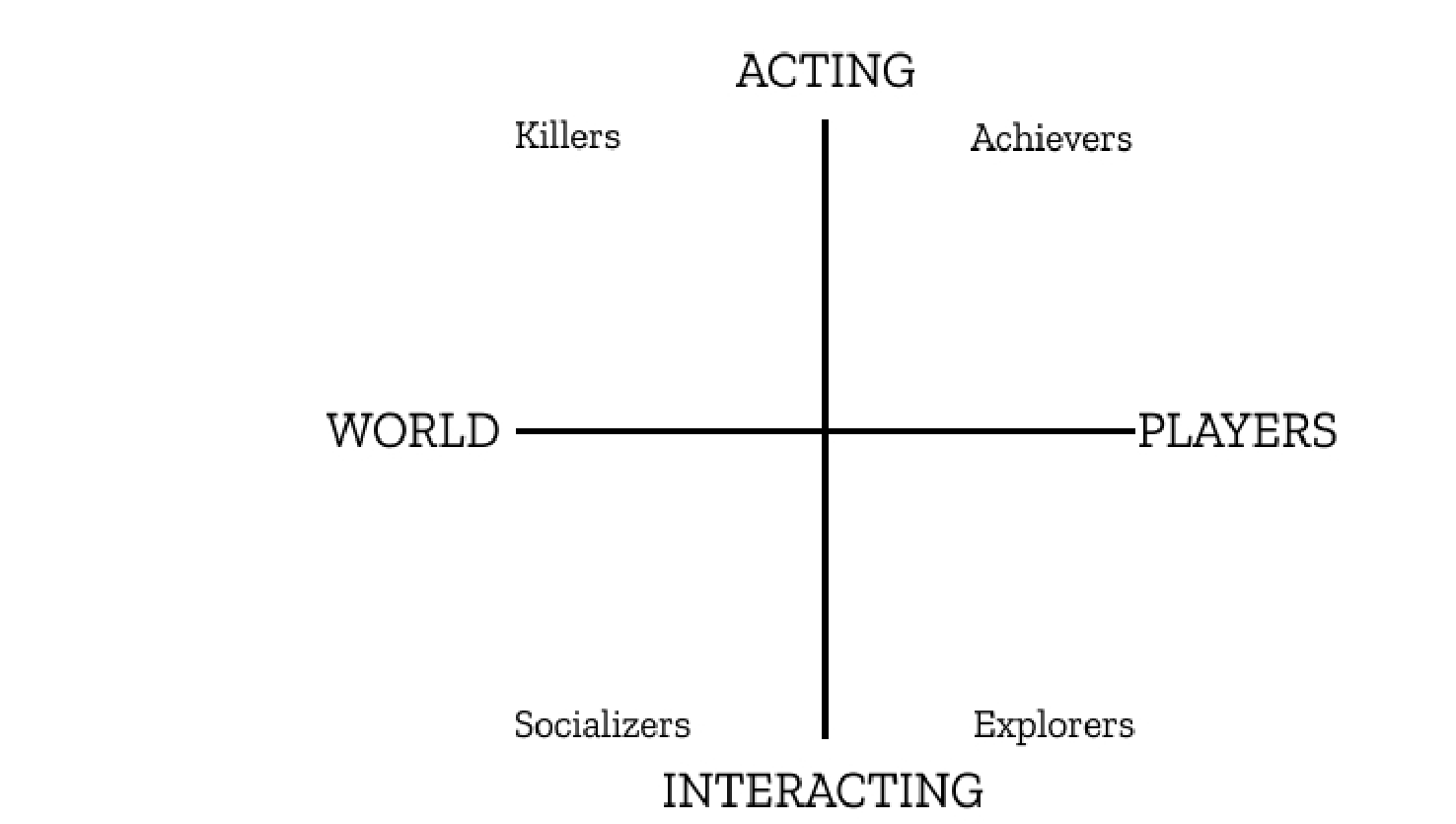
Figure 3.1 Player Interest Graph.
This graph describes players in terms of two (continuous) dimensions: How much they prefer acting on things as opposed to interacting with them; how much they prefer to direct their attentions toward the players or the world in which those players are present (as characters).
Achievers have fun acting on the virtual world.
Explorers have fun interacting with the virtual world.
Socializers have fun interacting with other players.
Killers have fun acting on other players.
Although other categorizations are obviously possible (and may well be superior), the use of opposing criteria for each of the axes in the Player Interest Graph shows that for this particular approach the categorizations are exhaustive.
As it stands, this graph tells designers quite a bit. If you want to increase the attraction of your virtual world to achievers, for example, you should include more content that involves acting upon the world; if you want to have more socializers, you should facilitate the capability to interact with other players, and so on. If you were to constrain the degree to which the world could be changed (for example by making areas out of bounds to certain groups of players), then you’d hit achievers and explorers but not socializers and killers. If you were to increase the capability to interact (for example by allowing players to keep notes on anything in the world they right double-click on), then you’d boost socializers and explorers but not achievers and killers.
It’s possible to do this with other dimensions appropriate either to particular virtual worlds or virtual worlds in general. For example, a MUSH might have axes for story-telling/story-building versus theory/practice. Someone who likes to teach other people how to role-play would be in the theory/story-telling quadrant, whereas someone who likes constructing new content would be in the practice/story-building quadrant. Designers will use whatever categorizations they find most useful.
It’s possible to do more with categorizations than merely state them and demonstrate them to be exhaustive, though. Having divided a set into four (or more) subsets, the question can be asked: What dynamics exist between the sub-sets? Are they independent (an increase in the number of people teaching how to build would have minimal impact on the number of people role-playing) or are there causalities (fewer people teaching how to build eventually leads to fewer builders)?
This is where it gets interesting.
Defined by the virtual world, that is, getting points and rising levels. ↩︎
In this context, they’re generally referred to as griefers. ↩︎
The word “killers” is perhaps unfortunate, given the misunderstandings that arise because of it; “dominators” is a less emotive alternative that some people prefer, although unfortunately it doesn’t imply a desire to dominate people (as with achievers, who want to ‘dominate’ the world). ↩︎
I also considered real/virtual, but didn’t feel it was accessible enough. Players/world deal in the manifestations of these concepts, and it is much easier to get a handle on. ↩︎
Dynamics
In the wild, what effect does increasing the number of wildebeests at a watering hole have on the number of lions in the vicinity? Lions eat wildebeests, so the more wildebeests there are, the greater the number of lions that will turn up looking for a meal. However, wildebeests flee en masse when they so much as sniff a lion. The more lions that show up, the fewer wildebeest will hang around waiting to be eaten. This will lead to a reduction in the number of lions, which will cause an increase in the number of wildebeests, and so on, until equilibrium is reached.
Suppose we were talking about a virtual world rather than a watering hole. Substitute “killers” for “lions,” “socializers” for “wildebeests” and you get a reasonable approximation of the relationship between the two.
This is an example of the dynamics of player types. Increasing or decreasing the number of players practicing one playing style can affect the number practicing another. This in turn can have knock-on effects, and so on, until eventually the system finds some point of balance.
There are two ways that player numbers can change (they can rise or fall) and 10 possible pairings of types (A/A, A/E, A/E, A/K, E/E, E/S, E/K, S/S, S/K, and K/K). Some of these are free of dependencies—increasing or decreasing the number of explorers has no direct result at all on the number of socializers, and vice versa. Others have effects of varying degrees. Based on empirical observations, the dynamics can be summarized as follows:
More achievers leads to:
Slightly fewer socializers
More killers
Fewer achievers leads to:
Slightly fewer socializers
Fewer killers
More explorers leads to:
More explorers
Slightly fewer killers
Fewer explorers leads to:
- Slightly more killers
More socializers leads to:
More socializers
More killers
Fewer socializers leads to:
Fewer socializers
Fewer killers
More killers leads to:
Fewer achievers
Slightly fewer explorers
Far fewer socializers
Fewer killers leads to:
More achievers
Far more socializers
Figure 3.2 shows these relationships.
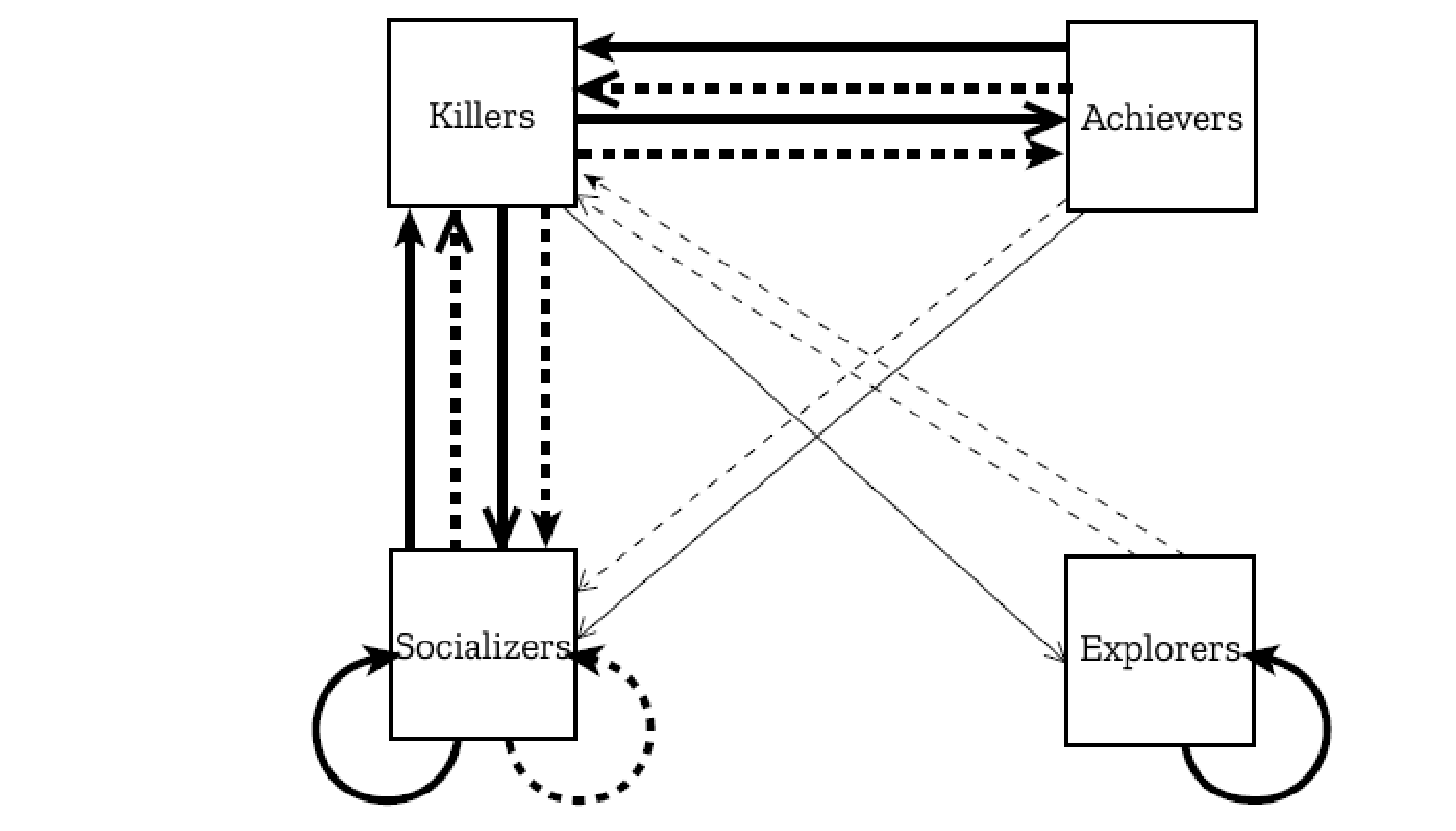
Figure 3.2 Influence graph.
Key: An arrow represents an increase (solid) or decrease (dashed) in the box from which it points. The effect on the box it points at will be either to increase (solid arrowhead) or decrease (open arrowhead) the contents of that box. The effect will be either slight (thin line), medium (medium line), or great (heavy line).
What Figure 3.2 shows is that most of the action concerns killers and socializers, where killer numbers are sensitive to those of socializers and socializer numbers are highly sensitive to those of killers. Explorers keep themselves to themselves, but have a mildly depressing effect on the number of killers; a virtual world can really only ever benefit by attracting explorers. Achievers and killers are in equilibrium, and there’s a negative effect on the number of socializers if the number of achievers changes (up or down).
How can this be used predictively?
As an example, suppose that for whatever reason (advertising, a new patch, the closing of another virtual world) the number of killers increased dramatically. What would happen? Looking at the influence graph, it’s clear that there would be a huge drop immediately in the number of socializers. Socializers are in an amplification loop with themselves—the more/fewer there are, the more/fewer will come/go. Thus, the number of socializers will drop even more until perhaps only a rump remains. Killers also have a lowering effect on the number of achievers. Lowering the number of achievers will reduce the number of killers. Either this will eventually reach some balance, or the numbers of both killers and achievers will drop so far that there are too few left to maintain a critical mass and the game will die.
By repeating this exercise for all player types, stable configurations can be discovered. It turns out there are four:
Type 1. Killers and achievers in equilibrium, with hardly any socializers and explorers.
Type 2. Socializers in dominance, with everyone else having only bit parts.
Type 3. A balance between all four types, with enough explorers to control the killers.
Type 4. An empty virtual world.
Of these, type 3 offers the best prospects for a world’s longevity (types 1 and 2 will tend toward type 4 eventually). However, it is not clear that a large-scale virtual world, with its inherent community fragmentation, could ever attain this state. This explains why most virtual worlds are either social (typified by MUCKs, MUSHes, and MOOs) or adventure (typified by DikuMUDs, LPMUDs, and the big, graphical games). In practice, among the general public there are large numbers of socializers and achievers in comparison to explorers and killers, so it’s just as well that types 1 and 2 are relatively stable.
After the underlying dynamics of a particular virtual world are understood, it’s possible for the live team to influence that world’s condition. If the number of socializers is dropping to the extent that the world is becoming “too” achiever-oriented, a simple solution might be to advertise the virtual world in a manner that would be more likely to attract socializers than achievers. Changes to the virtual world’s design can also help, for example by heavily increasing the challenge to achievers (so as to persuade them to go around in groups, which socializers like) or by adding socializer goodies (such as letting them write their own in-world newspapers). There are plenty of ways to do this 1. Solutions are easy to come by (if not necessarily easy to implement); you have to realize you have a problem first, though.
Incidentally, there is a possibility that a virtual world can fake the presence of a player type without actually having players of that type around. The type most amenable to this is that of killers. Players can tolerate being inconveniently beaten up by mobiles more readily than they can by fellow players, and mobiles have the advantage of being controllable. Surprisingly, there is a lot to be said for this approach; although it doesn’t replicate the effect of having killers exactly, nevertheless it can successfully approximate it to varying degrees. See the discussion on persona death in Chapter 5, “Life in the Virtual World,” for more details.
The original Hearts, Clubs, Diamonds, Spades paper lists over 30 examples. ↩︎
General Observations
I noted in Chapter 1 that many players of virtual worlds don’t consider themselves to be gamers, even if the virtual world is billed as a game. What’s more, they’re correct—they aren’t gamers.
People sign up to large-scale commercial virtual worlds because these are advertised as games, but once there they don’t necessarily want to play them as games; ironically, games have become the new “noble content.” Players have different ways of amusing themselves. Applying the player types categorizations:
Achievers see virtual worlds as games. Their aim is to improve, advance, and ultimately win (for some common, easily stated, world-supported definition of “win”).
Explorers see them more as pastimes, such as reading, gardening, or messing about in the kitchen. Reward comes from discovery and furthering understanding.
Socializers see virtual worlds as entertainment, such as TV, clubs, or concerts. Discussion of the performance and behavior of themselves and others is their main draw.
Killers see virtual worlds as sport. This is of the huntin’, shootin’, and fishin’ kind, rather than the running the 100-meter or the marathon kind 1. If the user base is large enough, some killers may treat virtual worlds as team sports—with themselves as captain or head coach.
It’s interesting to postulate how pitching a virtual world as something other than a game might work. To attract socializers, for example, a world could be portrayed as a sophisticated chat room with built-in toys that players can do things with; in this context, achievement is a mere by-product that arises when people choose to use the toys to play games of their own devising. This approach would apply well to something like The Sims Online.
Of course, by focusing on only one notion of what a particular virtual world “is,” there’s a danger that people will believe it is not for them and will stay away. Would achievers bother with The Sims Online if it didn’t at least nod in the direction of being a game? It’s only because of the growing opinion that computer games don’t have to be games (which was pioneered in part by The Sims itself) that non-gamers have come round to accepting them as noble content. However, if they entered a virtual world and found that it really was all game, they wouldn’t hang around for long. Part of a designer’s work is therefore to ensure that the philosophy governing what their virtual world is “about” is not too exclusive. If the design sends the wrong messages to players, it can alienate them.
On the other hand, there’s a risk of going too far: That by trying to please everybody, a designer can end up pleasing nobody. It can be fine to tailor advertisements to particular audiences: The movie Pearl Harbor 2 was successfully sold as a war story in America and a love story in Japan, for example. However, there can be problems when groups with different expectations meet: Japanese moviegoers would not necessarily have enjoyed Pearl Harbor had they been sharing a theater with Americans cheering the U.S. counter-attack. In describing a virtual world, it’s okay to tell all players the same thing; it’s okay to tell them the same thing in different ways; what isn’t recommended is telling them different things. There’s a distinction between saying “this is a game for everyone” and “this is a game for you.”
What designers tell players shapes the way a virtual world is perceived. “Tell” in this situation means through deeds rather than words: A world may be promoted as a place where basket-weavers are as respected as much as warriors, but when there are 25 different kinds of weapons and two different kinds of baskets, that’s not what it’s saying. This topic of how a design can (for better or worse) send messages to players is discussed in more detail in Chapter 5.
Using Player Types
Why use the player types model for virtual world design?
One purely pragmatic reason is that because it was the first such model, everyone knows about it; it therefore provides common ground for communicating ideas with other designers. This is by no means the only reason, though.
The model’s main strength is its categorization of players into the four particular types: achievers, explorers, socializers, and killers. It has its roots in a consideration of what people find fun in virtual worlds, and is therefore attuned to situations that might impact on this: all big design decisions, in other words. If you’re creating a virtual world and don’t have an actual user base yet, categorizing it along the lines the model advocates will give you some idea of how the players might take to a feature (or not); if you’re running a live game, the model will suggest how proposed changes might be received by existing players.
The dynamics that underlie the categorization are of less practical use to most designers. Occasionally it might be that a major, major alteration is planned, which will throw the balance so out of whack that some compensatory change will be necessary to stop a hemorrhage of players; this is not something that is an issue most of the time, though. When you add new functionality, it’s useful to run through the player types to be sure it doesn’t help or hurt any of them too much; it’s less useful to wonder what the next level of knock-on effects will be. Dynamics are useful for consultants looking at virtual worlds that have either no user base or a very ill one; for day-to-day design, categorization is the handier tool.
You don’t have to use this or any other model, of course. This one happens to have been applied successfully over the years to the players of a wide variety of virtual worlds, but that doesn’t mean another model might not help designers more. The main problem is that there really aren’t any other models to speak of right now; about the only other one in regular use categorizes players on the basis of their experience—“What will newbies make of this?” Perhaps the greatest service the player types model has rendered is to show that theoretical design aids can exist at all; if someone can produce a superior one, so much the better.
The player types model does have its limitations, of course, and designers should be aware of them. The main ones to watch out for are:
It doesn’t address how players change style over time. The classic path is killer to explorer to achiever to socializer, but others are possible.
It doesn’t account for players who appear to play one style while actually playing another. If your achievers regard killing as achievement, it’s bad; if your explorers see it as worthy of exploration, it’s a calamity.
If a virtual world is large enough that it can split into (geographical or social) sub-worlds, the model might apply separately to individual sub-worlds but not to the world as a whole.
It assumes that players are independent. For virtual worlds with large numbers of players, this may not be the case. Killers don’t often get along with each other, so in most worlds they play as lone wolves. However, in a large world where one of them can lead a gang of 50 impressionable achievers, their effect is somewhat magnified.
It assumes that virtual worlds are independent. Players might have cut their teeth in a different virtual world before visiting this one.
It can’t account for poor design. If your world has too few socializers, the model can suggest means by which to increase the numbers, but they may not work. It has no way of knowing you’re running a MUD played using mobile phones and that people just can’t be bothered to thumb in commands.
It is open to misinterpretation. Players aren’t always good judges of their own playing style: Many achievers seem to think they’re killers or explorers; some killers mistakenly label themselves as socializers. Asking self-appointed representatives of one type what they think of a possible major change could lead to a questionable result.
Beyond this, the model may apply but still be of little or no use. Designers of worlds that people play for reasons other than having fun (for example, to learn creative writing) have no real need of it; designers of worlds that people can’t have fun playing (for example, because the worlds are depressing or incomprehensible) have other problems they should solve first.
On the other hand, the model has been successfully applied beyond the confines of virtual worlds into domains such as online community management and tabletop RPGs 1.
Although designers working in areas related to virtual worlds may find the player types model flexible enough to be of use, the further they are away from the subject then the less likely the dynamics are to work. They can use it to inform, but probably not to prescribe.
I should point out that although this research has been used on a number of occasions to “prove” that game-oriented virtual worlds “need” killers, this is not the case. The model is descriptive, not normative: It shows what will happen if the proportions of player types changes, but doesn’t advocate one over another. If you want achievers but don’t want killers, you can have them; you need to be aware that without intervention the achievers won’t stay long, though. Similarly, if you design a game targeted at killers, it will require a major effort to stop the poor ones from quitting in frustration and the better ones quitting when there’s no one left to bully.
It is important to remember that even if the player types dynamics are functioning and changes are being made with an eye to the categorizations, it may all be worth nothing. External influence can easily overwhelm the model. If the virtual world crashes the whole time, or the customer service representatives are unusually surly, or the price triples, then players have some reason other than lack of fun to consider not playing. If that’s the case, designers should concentrate on high-profile changes of whatever nature they feel is appropriate—anything, so long as it will pull in some players after the problems are fixed. It’s no use trying to balance a player base when there are no players to balance; recover the players, then balance it.
Most of these external effects need only be planned for as contingencies, if at all. There is one, however, with which designers do need to be concerned as it is the very life blood of their virtual worlds: the newbie flow.
Footnote addicts who looked at the Knights of the Dinner Table comic book series after I mentioned it in Chapter 1 may be amused to consider the following mapping: Bob/killer, Dave/achiever, Sara/socializer, Brian/explorer. ↩︎
The Newbie Flow
Imagine that your virtual world is a bucket, and players are water. There are holes in the bucket through which the water escapes. If you don’t add water regularly, eventually it will all leak away. There may be a pool at the very bottom that isn’t high enough to reach the lowest hole—that’s you and your die-hard players. Eventually, even this will evaporate away, though.
All virtual worlds need a flow of newbies if they are to survive. It doesn’t matter how wonderful your world is or how dedicated your players are: If you don’t have newbies, you’re in big trouble.
The flow does not have to be constant, just regular. As long as your bucket is big enough to accommodate a sudden wave of newbies should one arrive (for example, because school is out, or because of TV coverage), it’s enough that the average inflow does not fall below the average outflow.
So far, so faucet/drain.
Designers don’t get to control where newbies come from directly, although by designing an appealing virtual world they can do so indirectly (as players tell their real-life friends how great it is 1). Newbies can sometimes show up on their own, having been looking for a virtual world that suits them and deciding to give this one a try. For small-scale virtual worlds, these two sources are often sufficient to keep everything ticking over nicely. Otherwise, if you want newbies, then you have to use marketing to entice them through your door.
Well, that’s not absolutely true: There is another possibility that I alluded to in Chapter 1—the newbie hose 2. This is where someone else has control of a flow of newbies and points it in your direction. The classic example is when a virtual world has links with a large portal that isn’t ashamed of it, as with those on AOL in the mid-1990s. This is not the only way a newbie hose can arise, though. The buzz among the first players of EverQuest was so great that normal word-of-mouth became effectively a newbie hose; Star Wars Galaxies got one by virtue of its license.
The advantage of a newbie hose is that it doesn’t matter how full of holes your bucket is, there’s so much water going into it that it’s always full. Hey, you can even add more buckets if you want. The disadvantage of the newbie hose is that sooner or later it either empties the tank or gets pointed elsewhere. When that happens, someone has to answer the very real question of where the newbies are going to come from instead.
The rate at which people leave a virtual community is called churn. It’s expressed as a percentage of the user base that leaves over a set time period (a month is implied, but other periods are possible). Thus, if you have 100,000 players in your virtual world and every month 5,000 of them fail to renew their subscription, the churn is 5%. This would mean that on average players would last 20 months before quitting. In general, the aim is to keep the churn as low as possible 3.
Companies don’t publish their churn rates, because the figures can affect share prices adversely. AOL, for example, used to run at around 3% churn, but when it was unable to reduce this it stopped releasing the data and emphasized absolute subscriber numbers instead; later, it advocated using the total time that users spent online as a measure of its increasing success 4.
Established virtual worlds have churn rates under 5% 5, which is considered excellent for this kind of product. A newbie hose masks churn, though. If a virtual world is growing by 3,000 players a month, everything looks rosy. However, that’s a net increase. If 3,000 people signed up and none left, it’s good; if 103,000 signed up and 100,000 left, it’s not so good. An August 2002 article 6 quoting SOE stated that EverQuest players stayed with the game for eight months 7. That means an average of one-eighth of EQ players quit every month—around 54,000 of them, in other words. Given that EQ was experiencing a net growth of around 2,300 players a month at the time 8, this suggests that they were signing up 56,300 new subscriptions. Attracting 56,300 new subscribers a month is very impressive; losing 54,000 is also very impressive, but for different reasons. A churn of 12.5% for a user base the size of EverQuest’s makes them very reliant on a newbie hose, which perhaps explains SOE’s decision to expand into the Korean market in 2003.
The importance of the newbie flow is so great that designers should put as little in the way of it as possible. It might be argued that those designers benefiting from the luxury of a newbie hose can concentrate on retention (that is, keeping people who have lasted a few sessions in the virtual world) rather than attraction; for the majority of virtual worlds, though, newbie-friendliness should always come before oldbie-friendliness. Most of the time, the two can exist in harmony anyway, with those problems that do arise only doing so because the designers forget one or the other. Sometimes, though, what interests oldbies can put off newbies entirely. Chapter 5 discusses an important example of this (the trickle-down effect) in more detail.
Player types can help with the newbie flow. They’re no use for absolute newbies, who are often so confused or shy that they simply don’t know what to do (therefore the first concern of designers is to persuade them to do anything at all!). However, once a player has found their feet, player styles apply. Many newbies will first want to ascertain the established norms of behavior (which can involve killer-style behavior), whereupon they will spend a period exploring the virtual world and their abilities within it. Having gained the necessary skills and knowledge, they can start to play “properly” as an achiever. Months later, when they have reached the top, they retire into the life of socializer. This is the killer to explorer to achiever to socializer path I mentioned earlier. Not all players follow this “main sequence,” of course, and not all of them follow it at the same speed. Someone who is at heart a socializer will soon decide that exploring and achieving is not for them, and will reach the final stage early; someone who is basically a gamer will achieve everything they can do, then find there’s little to do but chat or leave (so they’ll leave).
Coming back to newbie streams, then, the things that designers should concentrate most on for inexperienced players are enabling them to find the world’s behavioral boundaries quickly and providing plenty of interesting things to see and do that will help them develop their playing skills 9. Support from customer service greeters can make some of this run more smoothly in practice, but that doesn’t mean designers should shirk their responsibilities.
At this early stage, there’s a possibility that designers can affect the future playing styles of impressionable or open-minded newbies. A player who is an achiever in other virtual worlds may discover the joys of being an explorer in yours, if you let them see what they’re missing. If you want more of one player type than another, then making it appealing to newbies is a way to achieve your goal. This is not to say that players should be given the hard sell: It’s about presenting opportunities, not arm-twisting. EverQuest 2 has a particularly impressive scheme for bedding in newbies (even though what they’re bedded into isn’t a whole lot different from EverQuest 1).
A balance of player types among newbies isn’t important. After they jump off the main sequence and start to play in the style that best suits them, that’s when they join the majority for which standard type dynamics apply. An overall balance among non-newbies is important, because balance leads to retention. Meanwhile, the next batch of newbies is beginning the process, and the wheel turns once more.
We’ll be looking at the concept of “main sequence” in some detail later on in this chapter. It gets a Whole Lot More Complicated.
Hopefully not so great that they have lost all their real-life friends by the time they emerge from it. ↩︎
The term comes from Clement Chambers, whose company On-line ran Federation II in the UK after CompuNet closed down. He also coined the prefix massively multiplayer. ↩︎
For non-commercial virtual worlds, churn is harder to measure because you can never be sure when someone has actually “left.” ↩︎
Actually, 3% churn isn’t bad for an online service. A CompuServe executive once told me its churn ran at 10%, although that may have been part of a sob story to convince me to take a cut in the royalties for British Legends. If it was, it didn’t work. ↩︎
MUD2’s is approximately 4%, for example. ↩︎
Tim Green, Brave New World. London, MCV, Intent Media, August 30 2002. ↩︎
I assume this does not include players who quit in the first, “free” month (for which churn is by far the worst). ↩︎
According to SOE press releases, EverQuest had 400,000 subscribers in late June 2001 and 430,000 in late July 2002, which gives an average net gain of about 2,300 per month for that period. ↩︎
But not so many that the newbie is overwhelmed. With graphical virtual worlds, there is a case for providing special newbie-friendly client skins, so as not to expose newbies to the full majesty of what awaits. Textual worlds do this implicitly by only initially telling newbies about the commands they need to know—the rest can be found deeply nested in help trees or through conversation with more experienced players. ↩︎
The Bartle Test
The final point to mention about player types is the Bartle Test.
I’m often asked about the Bartle Test, on the grounds that because it bears my name I must be responsible for it. Sadly, I’m not. The test is the brainchild of Erwin S. Andreasen and Brandon A. Downey, who wrote it in response to my player types paper so as to test the theory.
The Bartle Test is an online binary-choice questionnaire 1 that players of virtual worlds can take to discover what player type they are. As such, it offers potentially very useful information for designers. Are players mainly achievers and socializers, as empirical observation would suggest? Just how numerous are killers? Are there large numbers of silent explorers out there that no one knows about? How do the different codebases compare? Answers to these questions could provide solid figures that would help designers visualize the make-up of the user base they have or they want.
The result of having taken the Bartle test is a Bartle Quotient, expressed as three letters. For example, ASK 2 means you’re foremost an achiever, then a socializer, and then a killer. The first letter in the result therefore indicates a person’s primary playing style.
Of the 176,000+ people 3 who had taken the test by April 2003, 29% rated as explorers, 25% as socializers, 23% as killers, and 21% as achievers. Of the combinations, SEA was highest at 12%, followed by ESA at 10% and EAS at 8%.
These figures almost certainly do not reflect anything like the actual split among players. Reasons for this include
Participants in the test are self-selecting. Most don’t hear about it until they’ve played a virtual world for a while, therefore they are not representative of the general user population.
It is clear from the nature of many of the questions what is being tested for, which means players can give the answer they believe will lead to a cooler rating (for example, explorer or killer) rather than the truth.
There is no “neither” answer. A socializer being asked to choose between defeating an enemy and exploring an area may as well flip a coin to answer, given that they don’t particularly care for either.
Some answers favor two or more types. Killers and achievers would probably both prefer defeating an enemy to exploring an area, but the questionnaire can’t disambiguate them.
Ties aren’t handled very well. If you choose achiever and socializer answers with equal frequency, you will be recorded as favoring A over S.
Just because the test is flawed, that doesn’t mean it’s useless, however. It helps players, for sure, because it lists the virtual worlds that most closely match each player type combination. So many people have taken the test that it has a large database of scores for individual virtual worlds (over 700 of them); if you end a test with a rating of ASK, you’ll be shown a list of the five virtual worlds that have the most players also rating ASK, and the actual percentages involved. Alternatively, if you’re a killer and want to find a game full of socializers to annoy, you can look at the overall statistics and find that out too. The figures may not be formally accurate, but they’re pretty good in relative terms. If one virtual world scores fewer achievers than another, the chances are it really does have fewer achievers 4.
For designers, the overall average scores aren’t too helpful as they are skewed by the popularity of the virtual worlds from which the figures are derived. The ratings for individual virtual worlds are of more interest (see Table 3.1).
Table 3.1 Bartle Quotients by Virtual Worlds
| Ultima Online | EverQuest | Asheron’s Call | Dark Age of Camelot |
|---|---|---|---|
| SEA 11% | ESA 12% | ESA 12% | SEA 8% |
| ESA 10% | SEA11% | EAS 10% | ESA 8% |
| EAS 8% | EAS 10% | SEA 8% | EAS 7% |
This shows the three top-rated quotients for each of the first four virtual worlds to obtain results from 1,000 respondents. There are obvious similarities: None of these quotients involve killers 5 and none of them place achievers first. The actuality may be different, of course (EQ is achiever heaven, but you wouldn’t know it from this set of data). However, as relative values they allow some conclusions to be drawn:
UO and EQ are fairly similar, although UO allows a little more variety (its ratios are slightly lower).
AC is heavy with explorers—exactly the kind of people who would be expected to like the idea of story arcs.
DAoC accommodates playing styles less rigidly than the others (its ratios are much lower). This is perhaps because many of its players cut their teeth on UO, EQ, or AC but were unsatisfied; DAoC (with its RvR system) could provide a different experience, so they switched.
Bartle Test results don’t allow designers to infer much about an individual virtual world in isolation. However, the relative effects of a major difference between otherwise similar virtual worlds (for example, ones sharing a codebase) can be judged. If a designer is considering such a feature for their own game, some indication of the possible effects on its user base can thus be derived.
For the record, I haven’t taken the Bartle Test. This isn’t because I object to it—I don’t. Rather, it’s because I can no longer play virtual worlds for fun, so I can’t answer fun-related questions. Any responses I did give would depend solely on the player I was role-playing at the time, which would rather miss the test’s point.
ASK is the rating you get if you answer all the questions with the first of the two options presented. ↩︎
Their numbers grow by over a hundred a day. ↩︎
This makes MUD1’s perennial placement in the bottom five for socializers all the more interesting. ↩︎
This may be because killers tend to get banned from these virtual worlds. ↩︎
Other Categorizations
Although my player types categorization is perhaps the best known of those available to designers, it is not the only one. There are many others, of which three are of particular interest. Two of these are based on anecdotal evidence, and one on statistics.
Social Dimensions
One of the earliest systems to use a primarily graphical interface was Habitat, which appeared in the mid-1980s. Although not strictly speaking a virtual world (it was essentially a graphical chat room), it nevertheless did have close similarities and is regarded as an important milestone in the development of graphical virtual worlds.
The system administrator 1 of Habitat between 1986 and 1988 (during what would nowadays be called its beta-test phase) was F. Randall Farmer. In 1992, he wrote a paper describing some of his observations about the social dimensions of online communities 2.
Randy noticed that players behave in one of five different ways:
Passives. People who want to be entertained without effort on their part. Habitat was only one of their online activities. 75% of players by number, but only 20% by connect time.
Actives. Players for whom Habitat was their main online activity. They got involved as soon as they logged in, and used up most of the total connect time.
Motivators. People who make life interesting for the other players by organizing events, setting up institutions, opening debates. A good ratio is one motivator for every 50 passives and actives.
Caretakers. Mature motivators, who may be employees of the developer. They helped newbies, mediated conflicts, noted bugs, and did other things that would today fall into the province of customer service.
Geek Gods 3. The designers and implementers who ensure that the virtual world works, and who make changes when it doesn’t.
The categories here are quite vague, and two of them concern groups of people not normally considered to be proper “players” anyway. However, it’s not so much the categorizations that are important as the fact that Randy noticed there was a pattern involved—what he called the Path of Ascension. Players started off as passives, then became actives, then motivators, then caretakers, then finally geek gods. People should be encouraged to move along the path in order to develop a vibrant, thriving community.
It may seem today that all this is fairly obvious. Of course you should try to get people more involved in the community! Did people really ever think differently?
Yes they did. Back then, players were frequently lumped together as an amorphous mass, especially by the big online services. There was a recognition that there were useful “mother hen” people who would do all your organizing for you happily and without pay, but no one gave any thought to where these individuals might come from—they were just there. Randy pointed out how they got there, and how to get them there.
Unfortunately (for them), this had little influence on the big online services. The way they saw it, there were fewer people at each step of the path, so transition meant a loss of players. If 75% of the players were using 20% of the bandwidth, then any movement would reduce the overall number of players while increasing the bandwidth. Even with players being charged by the hour, this was too big a price to pay, so they kept the status quo. As a result, the community became sterile and unattractive to newbies.
The Path of Ascension concerns the development of players as they grow in maturity. As such, at least in its first three steps it ought to be related to the main sequence of the player types model; we’ll see how, exactly, a little later.
A further refinement to the idea of progression came with the notion of “Circles.”
Circles
Circles is the name given by then Ultima Online player Hedron to his 1998 1 description of how players advance through different states of maturity. Although it is not a particularly well-known approach, I shall describe it here because it makes some very insightful observations 2.
Hedron’s vision is of virtual world players organized as concentric circles. They begin in the outer circles, and advance in their experience and attitudes through the inner circles; the analogy is (ultimately) the mandala of Buddhism, which adherents can use to symbolize conditions of spirituality that they desire to re-create through mental exercises.
From observation, Hedron postulates six circles, representing six increasingly higher states of being for players in virtual worlds:
First Circle—Survival. Players begin as newbies. Their main concerns are acquiring the basic skills, stats, and items they need simply to survive.
Second Circle—Competence. After players have sufficient expertise so that they can make progress, they begin to do so. The virtual world becomes more “fun.”
Third Circle—Excel. Having become “pretty good,” players aim to become “very good.” They seek out the toughest challenge that they can find in order to “beat” it.
Fourth Circle—Prove Mastery. Having acquired technical mastery, players feel the need to demonstrate this to other players. They will typically do this either by helping/mentoring/leading or by attacking them 3.
Fifth Circle—Seek New Challenges. Players feel that they have exhausted everything that the virtual world has programmed in for them to do. The only entertainment left is interaction with other players.
Sixth Circle—Everything Is One. Players recognize all ways that people can play the virtual world, and have a full understanding of the merits of them all. Players accept and appreciate each other, the virtual world, and the way things are.
Hedron’s article goes into some depth about the options available to players at the fifth circle, at least one of which (leaving to play some other virtual world) does not necessarily lead to the sixth circle. There’s no need to discuss that here, however.
All three of the approaches discussed so far rely on the observations of individuals for their substance. There is a more scientific approach available, however: statistics.
Facets
The most extensive study of the player base for any individual virtual world is Nick Yee’s The Norrathian Scrolls 1. This important survey is famed for both its extensiveness and its statistical rigor. It considers the real-world and in-game demographics for EverQuest, and correlates the two. For example, it provided concrete evidence that (on the whole) male players tend more toward achievement than female players and that (on the whole) female players tended more toward socializing. Its scope also considered other issues of use to academic researchers (for example virtual gender-bending).
Although The Norrathian Scrolls found differences among players based on their real-world demographics, they were not strong enough to be of use to designers. Yes, on the whole male players are more driven by achievement than female players, but there are nevertheless plenty of female players who are achievers and plenty of male ones who are socializers. Nick therefore decided to undertake a second survey to look for more fundamental differences—ones that did not make reference to real-world demographics.
In March 2002, he introduced the notion of facets 2.
The point of Nick Yee’s second study was to answer the question, “What do people want out of a game?” 3. The methodology employed was to ask respondents a series of multi-choice questions concerning their motivation for playing in graphical virtual worlds 4, then running a statistical analysis on the results. The multichoice questions themselves were constructed so as to act as indicators for the four player types and a number of other relationships that Nick had noticed in his previous studies. The point of this was to see if the answers that players provided really did cluster toward the player types, or whether there were more “natural” motivational groupings.
A factor analysis of the responses discovered five significant motivations (the facets):
Relationship. The desire to make meaningful relationships with other players in the virtual world.
Immersion. The desire to become immersed in the virtual world.
Grief. The desire to objectify other players for personal gain.
Achievement. The desire to become powerful within the context of the virtual world.
Leadership. The assertiveness and sociability of the player.
Immersion and leadership are qualities not addressed in the player types model. Relationship matches the socializer type well, emphasizing the formation of relationships as a primary motivation. Achievement matches the achiever type well, too, with evidence that the reason players like to achieve is so as to become powerful in the virtual world. Grief corresponds roughly with killers, although not to the extent that it covers the “interfering busybody” variety. Most interestingly, explorers don’t appear to exist as a type at all.
Because of the lack of evidence for explorers, the survey was amended to promote those factors that would indicate their existence 5. Nevertheless, the result did not change. Either: Explorers do not play graphical virtual worlds; explorers do not answer questionnaires; explorers subvert questionnaires; or, explorer is an insignificant type (if it exists at all). This is especially interesting because it seems to contradict the findings of the Bartle Test (which in turn contradicts my own empirical observations).
Of course, the study has its flaws, many of which are discussed in the paper itself. Among the most pertinent are
The motivations suggested by the survey are implicit in the questions.
Brainstorming motivations is as subjective as brainstorming player types.
There is no guarantee that there are only five facets, just that there are at least five facets.
There is no guarantee that the facets are all at the same level of abstraction. They might be like “orange, banana, lemon, lime, fruit.”
The labeling of the facets is not provided by the factor analysis.
Some of the facets overlap, but some don’t. Leadership could be an expression of an achievement, grief, or relationship facet, but not of immersion.
None of these flaws are show-stoppers at this stage of the research. More work needs to be done, of course, particularly in constructing an underlying mechanism to model the motivations, but already there are some interesting results. The non-appearance of explorers is perhaps the most significant of these, but a follow-up study 6 also suggested a number of others. From a designer’s point of view, the big ones are
Highly immersive does not mean highly addictive (and vice versa). Players can feel they are in a world without suffering withdrawal when they are absent from it.
Immersion and addiction both imply retention. Players who experience strong feelings of presence in a virtual world, or who feel anxious when they are not playing, will keep their accounts for longer.
Stickiness is strongest for relationships, then for achievement, then for leadership. If you want people to stay with your virtual world for longer, you should first and foremost try to foster relationships between them. It’s more effective than locking them into an advancement system. It’s more effective than locking them into a team.
These observations alone would make facets worthy of serious consideration by designers, and further research in this area is eagerly awaited. It’s good to know what the correlations are, but it would be better if we knew why they are. If a model could be devised which was able to articulate the causalities that lead to these conclusions, we’d have a theory rather than merely data. Designers could then use it both predictively and quantitatively, backed up by actual numbers.
Facets have the potential to supersede player types as the de facto means by which players are categorized. More research is necessary, but for the moment the results are very promising.
Nick Yee, The Norrathian Scrolls, 2001. http://www.nickyee.com/eqt/report.html. ↩︎
Nick Yee, Facets: 5 Motivational Factors for Why People Play MMORPG’s. 2002. http://www.nickyee.com/facets/home.html. ↩︎
But for using the word “game” rather than “MUD,” this is the same question that my player types paper attempts to answer. ↩︎
Of the 6,700 respondents, the split was: EverQuest 5,486, Dark Age of Camelot 1,044, Asheron’s Call 83, and Anarchy Online 68. ↩︎
This “improved” questionnaire was answered by a further 500 respondents. ↩︎
Nick Yee, Codename Blue: An Ongoing Study of MMORPG Players. 2002. http://www.nickyee.com/codeblue/home.html. ↩︎
Levels of Immersion
One of Nick Yee’s facets is immersion. This is a concept with a long and distinguished history in role-playing contexts 1, and it has been mentioned a number of times already in this book. So what, exactly, is it?
Fundamentally, immersion is the sense that a player has of being in a virtual world. The more immersive a virtual world, the greater its ability to immerse its players. Some virtual worlds (particularly non-game ones) deliberately aim for low immersion, so as not to distract from their purpose; most, however, aim to be as immersive as possible.
Although players can experience many degrees of immersion, there are conceptual or emotional barriers along the way that players must pass if they are to proceed further. Immersion can therefore most usefully be described in terms of a series of levels:
Player
Avatar
Character
Persona
The human being sitting at the computer, interacting with the virtual world, is a player. The player will be controlling an object within the virtual world that is associated with them. The way the player regards that object is a measure of their immersion. If they consider it simply to be a computer construction with which they don’t identify (as they might, say, a document in a word processor), then they are not immersed.
Most players of virtual worlds easily identify with the object they control. At the very least, they regard the object as their representative in the virtual world. For them, the object is their avatar—a puppet that they control and the conduit through which they act. Players will refer to their avatars in the third person, but may flesh them out with a few personality quirks. “Alice has a thing about cats, so she won’t go near them.” On the whole, though, avatars are mere conveniences—ways to effect change in a virtual world.
The next stage is for players to stop thinking of the object they control as their representative, but rather as their representation. The object is a tokenization of the player. This is the character level, at which the majority of players are found. A character is an extension of a player’s self, a whole personality that the player dons when they enter the virtual world. Players may maintain several characters, each a distinct and rounded personality, which the player treats as a friend. Characters are referred to by name; although a player might say, “I lost my sword last night,” what they mean is more like, “Thorina lost her sword when I was playing her last night.”
Avatars are dolls, characters are simulacra, but neither are people. The final level of immersion—the one which makes virtual worlds wholly different to anything else—is that of the persona.
A persona is a player, in a world. That’s in it. Any separate distinction of character is gone—the player is the character. You’re not role-playing a being, you are that being; you’re not assuming an identity, you are that identity; you’re not projecting a self, you are that self. If you’re killed in a fight, you don’t feel that your character has died, you feel that you have died 2. There’s no level of indirection, no filtering, no question: You are there.
This is something that many people examining virtual worlds from the outside fail to understand. Avatars and characters are just steps along the way. Looking at characters to try to develop an understanding of why virtual worlds are so appealing is pointless except in the case of die-hard role-players. Sometimes full immersion is likened to an altered state of consciousness 3; this is much closer to the truth, but still misses the mark (you can daydream while in a virtual world without leaving it).
It’s about identity. When player and character merge to become a persona, that’s immersion; that’s what people get from virtual worlds that they can’t get from anywhere else; that’s when they stop playing the world and start living it.
I should point out that my use of some of the terms here is rather technical. In my explanation of the different levels of immersion, I was at pains to refer to the object that the player is associated with as just that, an “object.” In everyday use, designers will use the terms “players,” “avatars,” and “characters” almost interchangeably. Even at the technical level, there can be differences: Some designers, for example, use “avatar” to refer strictly to what I have called “character,” preferring “puppet” for what I have called “avatar;” others use it to refer to the graphical representation of a character as rendered on a screen (as opposed to the in-world object itself). There’s also a possible additional level between player and avatar, subordinate, whereby the player treats their world object as an independent agent able to obey commands but capable of autonomous action; in practice, though, virtual worlds are set up such that almost every player skips the stage entirely.
Immersion is connected to the computer-mediated communication (CMC) idea of presence—the illusion that a mediated experience is not mediated 4. Presence manifests in several forms, of which two (“presence as immersion” and “presence as transportation”) together correspond well with what virtual world designers mean by “immersion;” others, particularly “presence as realism,” can help effect immersion.
In a CMC context, transportation concerns is the sense a user has that something is elsewhere from where it really is; for virtual worlds, the “something” is the player and the “elsewhere” is the virtual world. The CMC idea of immersion does not rely on transportation, but is otherwise quite similar to what virtual world designers mean by the term. The main difference is one of emphasis: CMC researchers view “perceptual immersion” and “psychological immersion” as equal partners; virtual world designers view psychological immersion as paramount, considering perceptual immersion to be merely one of many possible means to achieve that end.
Immersion is also connected with the psychological concept of flow 5. Indeed, some designers see the two as equivalent. Flow is an exhilarating sense of control and mastery that can arise from pursuing a focused, goal-driven activity; it’s a deep involvement that transcends distractions and sense of time, leading to an ecstatic state of peak productivity. However, although flow regularly occurs in virtual worlds, it’s not the kind of immersion that I’m talking about here. Players can be fully immersed without any sense of ecstasy—indeed, they could be quite miserable. Flow and immersion (as I mean it here) can play off each other, but neither is dependent on the other.
Immersion is an important concept in virtual world design, because it plays so much a part in conveying the entire virtual experience. Without immersion, there is a fence between player and virtual world; with immersion, the barriers are lifted—players can concentrate on doing what they want to do, on being what they want to be.
That said, the role of immersion is often misunderstood. It’s an important facilitator, but that’s all it is: Although players intensely enjoy being immersed, imbuing immersion is not itself the ultimate aim of virtual world design. It does lie on the right path, but a little further back than many designers suppose.
I’m getting increasingly philosophical here, but it’s not immersion itself that is intoxicating; rather, it’s what immersion helps deliver: identity.
The first use of it that I can find with regard to a virtual world is an editor’s introduction to an article I wrote for an early computer magazine: “Richard Bartle immerses himself in MUD.” Richard Bartle, Stuck in the MUD. London, Your Commodore, Argus Press, March 1985. http://www.mud.co.uk/richard/ycmar85.htm. ↩︎
Not that anyone could ever verify that this is what having died actually feels like, of course. ↩︎
Bromberg, Heather. Are MUDs Communities? Identity, Belonging and Consciousness in Virtual Worlds. Rob Shields (editor), Cultures of Internet: Virtual Spaces, Real Histories, Living Bodies. London, Sage, 1996. ↩︎
Matthew Lombard and Theresa Ditton, At the Heart of It All: The Concept of Presence. Los Angeles, Journal of Computer-Mediated Communication, University of Southern California, September 1997. http://www.ascusc.org/jcmc/vol3/issue2/lombard.html. For a description specific to virtual worlds, see John Towell and Elizabeth Towell, Presence in Text-Based Networked Virtual Environments or “MUDs.” Presence: Teleoperators and Virtual Environments Vol. 6 (5). Cambridge MA, MIT Press, October 1997. http://www.fragment.nl/mirror/various/Towell_et_al.1997.Presence_in_MU Ds.htm. ↩︎
Mihaly Csikszentmihalyi, Flow: The Psychology of Optimal Experience. New York, Harper & Row, 1990. For a description specific to virtual worlds, see Katelyn McKenna and Sangchul Lee, A Love Affair with MUDs: Flow and Social Interaction in Multi-User Dungeons. http://www.uni-koeln.de/~am040/ muds/ipages/mud.htm. ↩︎
The Celebration of Identity
I have a story to tell.
Polly’s Tale
So it’s a weekend in 1980. I’m in a computing laboratory with 15 students, all of whom are playing my game, MUD. This being 1980, and this being a computing laboratory, and this being a weekend, everyone here is male. The female computer science undergraduates have better ways to occupy themselves (mainly concerning male noncomputer science undergraduates).
I look around at my friends and realize that chances are not one of us has ever had a girlfriend 1, nor have we any prospect of ever finding one. We regard all the female students on our course as people rather than as girls, and we’d no sooner hit on one of them than we would on each other. We’re desperately short of social skills. The non-computing girls on campus are split between those who shy away in horror and those who laugh in our faces. It’s pointless even trying: We’re inexperienced and out-gunned.
None of us is happy with the situation, but we’re resigned to it. We suffer in silence together. Here we are on a beautiful weekend, sitting around computers writing and playing games.
It’s so sad! I see decent, honest, likeable guys becoming more and more set in their defensive, insular ways. They’re not bad people, but they’re hiding themselves away! They need to grow their personalities, not retreat into them! Yet how can they do so, knowing that every attempt to change will inevitably end in humiliation? There ought to be some means by which they could behave in ways that they wouldn’t ordinarily, yet be safe from the consequences of failure. If they could experiment, could make adjustments, could see themselves succeeding, could discover and emphasize those aspects of themselves they most admired; might this not equip them to behave a similar way in real life?
Then I look at my screen, and a thought occurs to me. (To be continued…)
Or boyfriend. Essex University was politically correct years before the term came into vogue. ↩︎
To Be, or What to Be?
The celebration of identity is the fundamental, critical, absolutely core point of virtual worlds.
Yes, that is quite some assertion.
Except for those worlds that people play for purely practical reasons (such as virtual classrooms), everything that players do ultimately concerns the development of their own identity: who they are. It’s why achievers achieve, explorers explore, socializers socialize, and killers creep up from nowhere and batter you with a stick.
You can’t design for it, because everything affects it; yet for the same reason, you can’t not design for it—it touches everything you do. It’s portable, so it’s beyond a designer’s reach—it can be used across many virtual worlds 1. It’s unquantifiable—you can’t rate for “identity” the actions, objects, structures, or anything else that’s programmed in. You can design for certain expressions of identity, and you can design ways to channel these expressions, but you can’t do so systematically. Identity flowering is an inherent property of virtual worlds; if you control it or repress it or subvert it, the changes you’d have to make to do so would leave you with something that was no longer a virtual world.
Okay, you’ve let me babble on about this for a couple of paragraphs, but enough is enough. Ask a dozen players why they play virtual worlds, and you’d be lucky if even one gave an answer that even hinted at “the celebration of identity.” They usually reply in terms that categorize them as being an achiever, explorer, socializer, or killer (which is how I derived those types in the first place). To convince you that identity really is the fundamental, critical, absolutely core point of virtual worlds, I’m going to have to provide some evidence.
Fair enough. Let’s start with some empirical observations.
Players of virtual worlds often notice that they behave differently in the virtual world than they do in real life. They may be more (or less) assertive, talkative, flirtatious, argumentative, pensive, creative—the list just goes on. For some people, the changes are more dramatic than for others, but most players would concede that they do seem
to have a virtual personality that’s different from their real one. Generally, they like their virtual personality more than their real one, but not always. Reflecting on this difference will cause them to make judgments about themselves, therefore their personality (virtual or real) will either shift 2 or the two will remain in conflict until the issue is resolved.
Most players maintain several characters in a virtual world (if that world allows it). Some may be for specific purposes (for example mules, to do drudge work for the main character) and others may be the result of failed experiments (“Hmm, so elven thieves don’t really work”). There are often two or three, though, that the player uses regularly, depending on their mood. If they’re depressed, they may choose their dark, brooding magic-user; if they’re angry, they may choose their barbarian warrior to let off some steam; if they’re wistful, perhaps their bard would suit best. In these situations, the players are using their various characters in the virtual world to work through their real-life issues. They’ll grow as people because of it.
Suppose you had poor social skills, and found a social environment where this didn’t matter. Merely by interacting in that environment, your skills would improve. In real life, you might be shy and awkward, but if you found a place where wild self-expression was not only permissible, but also positively encouraged, you could suddenly bloom. In becoming accustomed to this virtual personality, you might gain sufficient confidence to be able to maintain it in real life. You wouldn’t necessarily even have to think about it, it could just happen. Wouldn’t that mean you’d developed as a person?
So, after those three cod-psychology examples we can probably agree that it’s possible—common, even—for people to exhibit different behaviors in a virtual world and in reality. This was noticed by academics early in research into virtual worlds. Amy S. Bruckman’s groundbreaking paper on the subject 3 was published back in 1992.
What does this have to do with identity, though?
Well, in the examples I gave there is a separation between the player and the character. This is immersion at the character level. If it stays that way, the player isn’t really going to mature. However, for virtual worlds it’s almost unavoidable that the character and the player will tend toward each other. If you like your virtual self, you’ll take on its characteristics; if you keep mood characters, you’ll gradually stop playing all but one; the social skills you acquire will become skills that you use. Ultimately, you advance to the final level of immersion, where you and your character become one. One individual, one persona: identity.
Okay, so players can create separate selves, and over time unify the best aspects of them into a single identity. That doesn’t mean it’s inevitable, though. This phenomenon of a separate “online self” appears in many other computer-moderated activities, from email to chat rooms to forum postings. Why can’t they raise identity issues if virtual worlds can?
The answer is that they do, but nowhere near as well. Virtual worlds, armed with a potent combination of environment and fellow players that’s unavailable to other online applications, are able to present people with a stream of challenges; an individual’s response to each challenge helps define that individual. The challenges of email, chat rooms and forum postings are much narrower in scope, weaker in intensity and rarer in frequency.
This reaction to challenges is how most identity development occurs. Although mood characters and the like make good, neat, psychology parcels to show to cynics, they’re overt; the main identity action is covert. Things happen, which present challenges; your reaction to these causes you to acquire insights, which in turn lead to minor readjustments in your understanding of yourself (that is, your identity). Examples: Dealing with responsibility, relationships, unfairness, success/failure, betrayal, strangers, and so on.
These aren’t personality change issues. It’s not that you stop being a shy loner and are suddenly compelled to transform into an outgoing extrovert; rather, it’s that you were always an extrovert, you just didn’t realize it. The virtual world lets you try being one, and your opinion of yourself changes as a result of how it works out. If you weren’t an extrovert at heart, then you wouldn’t make the change; the extrovert virtual you would drift toward the introvert real you, rather than the reverse. It can’t make you something you aren’t.
Virtual worlds enable you to find out who you are by letting you be who you want to be.
Not everyone necessarily wants to find out who they are, of course. Others do, but don’t like it when they learn the answer 4. Not everyone wants to change, and not everyone likes challenges. Some people may thus be attracted to virtual worlds by the promise of identity freedom, but become increasingly angry and frustrated—unable to leave, but unwilling to do what is necessary to stay. It’s particularly sad when an individual takes a harsh lesson but doesn’t learn anything—continually acting out rather than working through a difficulty. Fortunately, this doesn’t happen very often, but when it does it can be somewhat disruptive.
Incidentally, if you are at all interested in the psychological and/or psychotherapeutic value of virtual worlds, you should look at Life on the Screen 5, by Sherry Turkle (if you haven’t already). Chapter 7, “Toward a Critical Aesthetic,” in particular is directly relevant to the subject, and includes a number of interesting case studies.
So, to summarize: For the great majority of players, virtual worlds encourage them to present different sides of themselves in a safe environment; challenges arise in the virtual world which enable them to reflect (consciously or otherwise) on their responses to those challenges, which causes them to develop a greater understanding of themselves; over time, this leads to a gradual merging of the virtual side and the real side, as the player becomes increasingly attuned to their persona.
The persona level of immersion isn’t the end of the journey. You’ve reached the top of a hill, but there may be another one that’s higher: There may be a better you. Thus, people will always create new characters and try out new ways of self-expression. Besides, self-affirmation is good, too.
Hey, you’re an Eastern mystic, and you didn’t even know!
And beyond. Many players like to write fiction about their characters, for example. ↩︎
This is called slippage in psychology literature. ↩︎
Amy S. Bruckman, Identity Workshop: Emergent Social and Psychological Phenomena in Text-Based Virtual Reality. MIT Media Laboratory, 1992. ftp.cc.gatech.edu/pub/people/asb/papers/ identity-workshop.rtf. ↩︎
Some people really are total jerks. ↩︎
Sherry Turkle, Life on the Screen. New York, Simon & Schuster, 1995. ↩︎
Identity and Identification
Players play virtual worlds in order to be themselves.
Well, perhaps not quite all of them do, but it’s true of those who play for fun. Even in game worlds, some people will be there for specialist reasons (play-testing, customer service, spying from some competing game); none of these individuals would necessarily have any inclination to become immersed, and those that do would be professional about it. There will also be a few people who are in the process of “getting” what a virtual world is about; these will mainly be insufficiently immersed newbies, but occasionally there are individuals who never “get” what virtual worlds are about but play nevertheless (generally, to the irritation of everyone else). Most of the players will be there because of the freedom to be themselves that the virtual world offers, though.
People who don’t play virtual worlds (but have tried them) find other ways to be themselves. It has been argued that one of the reasons more men play virtual worlds than women could be because in modern society men have less opportunity to experiment with their identities in real life 1. For players, though, virtual worlds afford an unmatched ability simply to be.
Let’s look at this a little more analytically, and see if there’s anything that designers can do to make this salute to identity any easier.
We should begin by noting that identity is not the same as identification, although the two are related. Identification is the modeling of the self on some ideal. For players of virtual worlds who might sense the possibilities of identity exploration without really understanding how to invoke it, the provision of ideals can help. This is why many virtual worlds have a class system.
The idea is that the individual takes on board those aspects that define the ideal, because these are what the individual admires. They provide a target—something to shoot for. If a proposed role model exhibits other features that conflict with an individual’s sense of self, that role model is not suitable as an ideal. It’s therefore easier to identify with an abstraction rather than something concrete, because abstractions present fewer features; you can flesh out what isn’t mentioned without hitting contradictions.
This would imply that the lower an ideal’s detail, the better. Sure enough, many virtual worlds have dozens of classes for players to peruse. The disadvantage of this approach is that the fewer qualities an ideal presents, the less rounded it is, and therefore the flatter it makes those people who aspire to it seem. An ideal with a single outstanding feature leads to players who are defined by that single outstanding feature, that is, who are one-dimensional. One-dimensional characters don’t make for riveting movies, and neither do they make for enthralling virtual worlds. Many virtual worlds with character classes therefore also have character races, to provide another dimension (although there tend to be specific class/race combinations that work better than others, so in practice the choice isn’t quite as wide as it may appear).
Whereas identification is about projecting your self-image onto some ideal, identity is about projecting it onto yourself. The former can help the latter, but has neither its extent nor its fidelity. If it goes too far, it can be counter-productive. Identification is allowing yourself to be defined by an image 2; in excess, it can therefore lead to a conflict between personal identity and that perceived of the ideal. A painting doesn’t change, but an artist must. If a virtual world commits a player to identifying with a fixed set of ideals, there will be problems when those ideals are no longer appropriate.
Identity is a product of thought, manifested by expression (actions, words). It has to be flexible, so it can wander, focus, be reborn. It also has to be true. A false image may be projected for the benefit of other people, as a way to influence them; individuals can’t lie for long to themselves, though—that is, if they can see themselves. In the real world, this can be difficult.
Virtual worlds provide people with a mirror. In a virtual world, you can see yourself. You only see what you show to the mirror, which may not be what everyone else sees, but it’s more than enough. With identity, the question is how much you like your reflection; with identification, it’s how much you believe it.
Virtual world designers have some control over this. They get to provide the ideals; they get to make the mirror. As I said earlier, though, they can’t do this systematically. You can’t draw a graph with an “identity” axis and place players at various places along it. The best you can do is to assess the likely consequences of their progression to greater maturity. To do that, you need to know the course that progression takes.
Progression
I mentioned earlier the main sequence that charts player type drift. This gets its name from the main sequence of star development used in cosmology 1. Players typically start off testing the immediate bounds on their behavior (killer) then begin to acquire knowledge of their environment (explorer); following this, they apply their knowledge (achiever), in the course of which they forge bonds with other players; finally, they retire from this and spend their time chatting with their friends (socializer).
Sometimes, people stay in one area. Long-term killers will often be youngsters who have feelings of inferiority 2 and need constantly to validate their worth to themselves. Long-term explorers know they have the ability to apply their knowledge, and feel no urge to demonstrate the fact to others. That said, a good many people follow the main sequence the whole way.
There’s a flaw in this argument, though. As people grow in virtual worlds, their real selves and their virtual selves gradually become one. Because socializer is the last step on the main sequence, all socializers should be immersed to persona level. They’re not. You can start as a socializer, socializing effectively while being barely immersed to avatar level. Your development is due to social challenges rather than environmental ones. This rather undermines the use of player types in predicting the effects of growing maturity, doesn’t it?
As it stands, yes, it does. There is, however, an interesting solution.
My original work for Hearts, Clubs, Diamonds, Spades: Players Who Suit MUDs evolved from summarizing a discussion among the players of MUD2 that ran from November 1989 to May 1990. The paper as finally presented concerned only the actions and interactions between mortals (that is, normal players); it did not make particular reference to wizzes (that is, players trusted with administration powers—this is MUD2’s elder game). Wizzes 3 had already played the game in its entirety, as that was the qualification to be a wiz; therefore, they were on the whole no longer concerned with the virtual world per se, just in its inhabitants. There were a few explorers who made wiz better to aid their exploring, and a few achievers who regarded building as a competitive act; the majority, though, were either socializers or killers.
In separating wizzes from mortals, I noticed that there were some very distinct behavioral differences between the wizzes themselves. Wizzes were keen to articulate their beliefs about what they and their peers should and should not do to manage the game, as there were particularly strong conflicts between certain groups. Therefore, at the same time I constructed the player interest graph (refer to Figure 3.1) for mortals, I constructed a similar one for wizzes. The players/world axis was not relevant here (because nearly all wizzes were at the players side); in its stead was a different axis that rated the degree to which wizzes did things in an explicit or implicit 4 fashion. Explicit wizzes favored the known over the unknown, realism over idealism, the overt over the covert, expectation over surprise, and order over disorder.
Note that “explicit” here is meant in the general sense of the word: leaving nothing implied. It’s not intended to have any “explicit photographs” style overtones. In computer language semantics, explicit means data, implicit means code; in AI terms, explicit means knowledge, implicit means skills. That’s how I mean it.
There were a number of conflicts suggested by this implicit/explicit analysis, which led to some interesting underlying dynamics (and alarming consequences for inter-wiz balance). However, as the graph was specific to the relatively small set of administrators in a game-oriented virtual world that selected them by unusual means, I felt it would have distracted from the main thrust of my player types model had I presented it in my paper. I therefore left it out.
Perhaps, though, it doesn’t just apply to wizzes?
What would happen were we to incorporate this implicit/explicit dimension 5 into the basic player types model? Specifically, would it help us differentiate between sub-types of the player-oriented styles, killer, and socializer?
Yes, it does 6. We get:
Politicians. Players who act in an open fashion on other players. Whether you view them as inspired, visionary leaders or interfering, self-serving busybodies depends on how gullible or cynical you are.
Networkers. Players who interact openly with other players—even complete strangers—on any and all subjects. Less charitably, gossips.
Friends. Players who interact primarily with people they have known a long time and with whom they have deep bonds (often forged through adversity). They do not feel bound by the conventional rules of interaction, because they understand each other so well.
Griefers. Bullies prepared to use force or other unpleasantness to get their way or be noticed.
Figure 3.3 shows this as a graph.
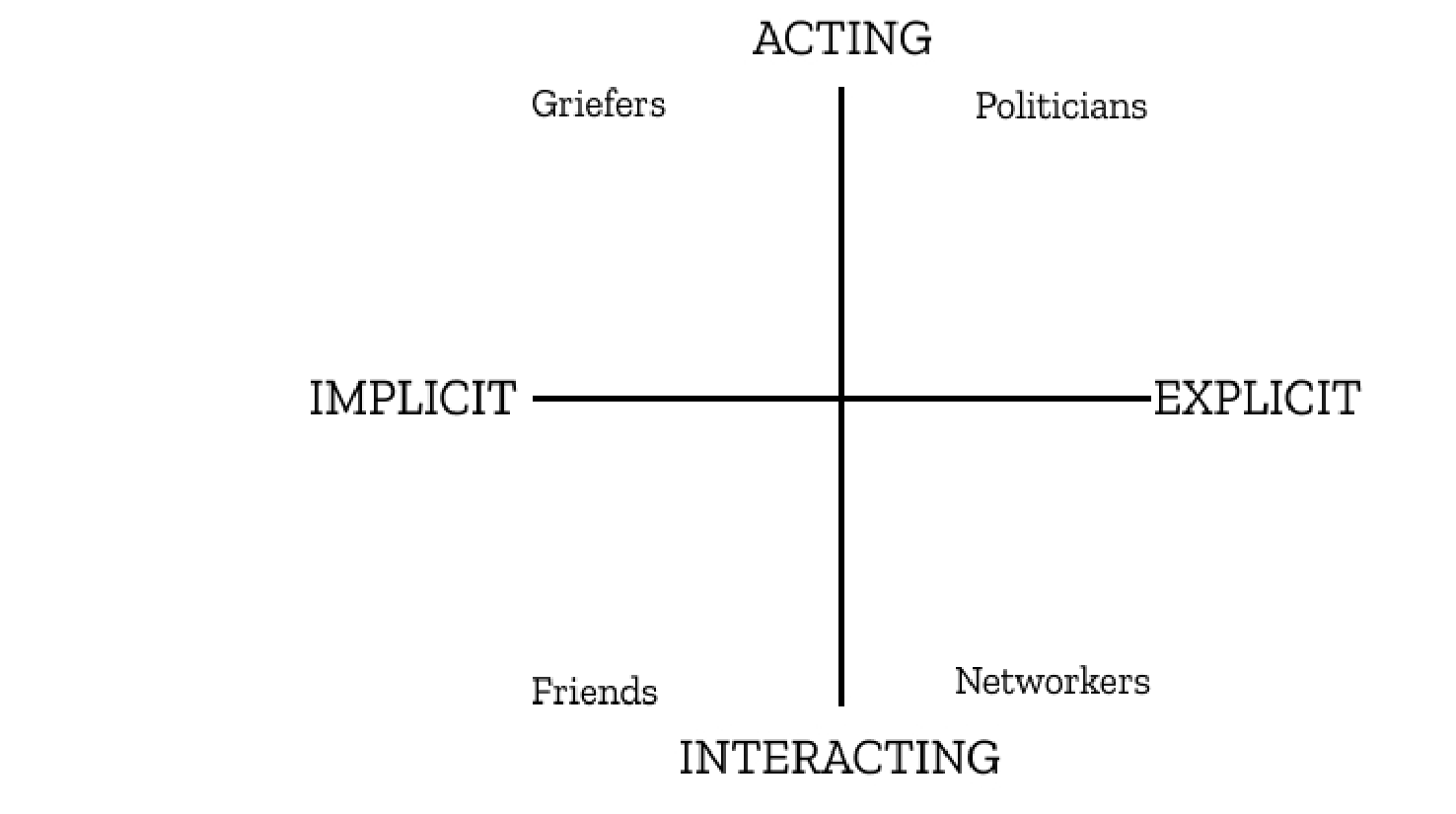
Figure 3.3 Players-oriented Player Interest Graph.
If this served only to clear up some of the confusion about the different varieties of the killer type (griefers and politicians) it would have done its job. However, it’s not quite a one-trick pony.
What happens when a player-oriented newbie enters a virtual world? The first issue many of them face is coming to terms with the fact that they are part of a community. Some will immediately comprehend the situation, but not everyone. Those that don’t will objectify other players, treating them as helpdesks, servants, gophers, and sources of experience points or kit. The reaction of the other players to this approach will cause all but the most mule-headed newbie socializer to understand fairly rapidly the social mechanics of the world. They can then move on to the business of getting to know people. To make friends with someone, you need to meet them, which means you have to network. Some people you won’t like, and some won’t like you, but after a while you’ll find you hang out with the same, relatively small group of people most of the time and be acquainted with many more.
Your group will almost inevitably experience conflicts, both internal and external. Perhaps several people want to be leader, or don’t like where the leader is taking them. The group may grow too large, or too small, or otherwise become dysfunctional. Environmental changes could trigger problems—a change in the way the virtual world works, for example, or a loss of group status. Ultimately, everyone in the group has a view and will at least some of the time want to impose it on the other members—even if it’s only as a form of self-defense. The trials that result put big stresses on relationships, some of which may break down irrevocably. Eventually, though, players will come through with a fuller understanding of themselves and of their friends. Their earlier ties will have been strengthened, and they will at last be able to settle down and appreciate one another.
What we have here is a main sequence for socializers: griefer to networker to politician to friend. Drawn on the graph 7, it’s the same reverse-alpha shape as the standard main sequence, which is nice. Back in two dimensions, it would be killer to socializer to killer to socializer, but it’s less obvious what’s happening when flattened that way.
At this point, we can see where F. Randall Farmer’s Path to Ascension fits in. This is perhaps unsurprising, given that Habitat was a socializer-centric system. Ignoring the “non-player” caretaker and geek god roles: Motivators map onto politicians; actives and passives both map onto networker (actives being more immersed than passives) 8.
So, having added an extra dimension, the obvious question to ask next is: What—if anything—does adding an extra dimension buy us concerning the world-oriented players (achievers and explorers)?
Well, the subdivisions are relatively easy to construct:
Planners. Organized achievers, who decide what they want to do then go off and do it.
Scientists. Explorers who experiment in a thorough, methodical fashion.
Hackers 9. Explorers whose understanding of the virtual world is such that they can proceed purely by intuition.
Opportunists. Achievers who go where their fancy takes them.
Figure 3.4 shows the resulting 3D graph.
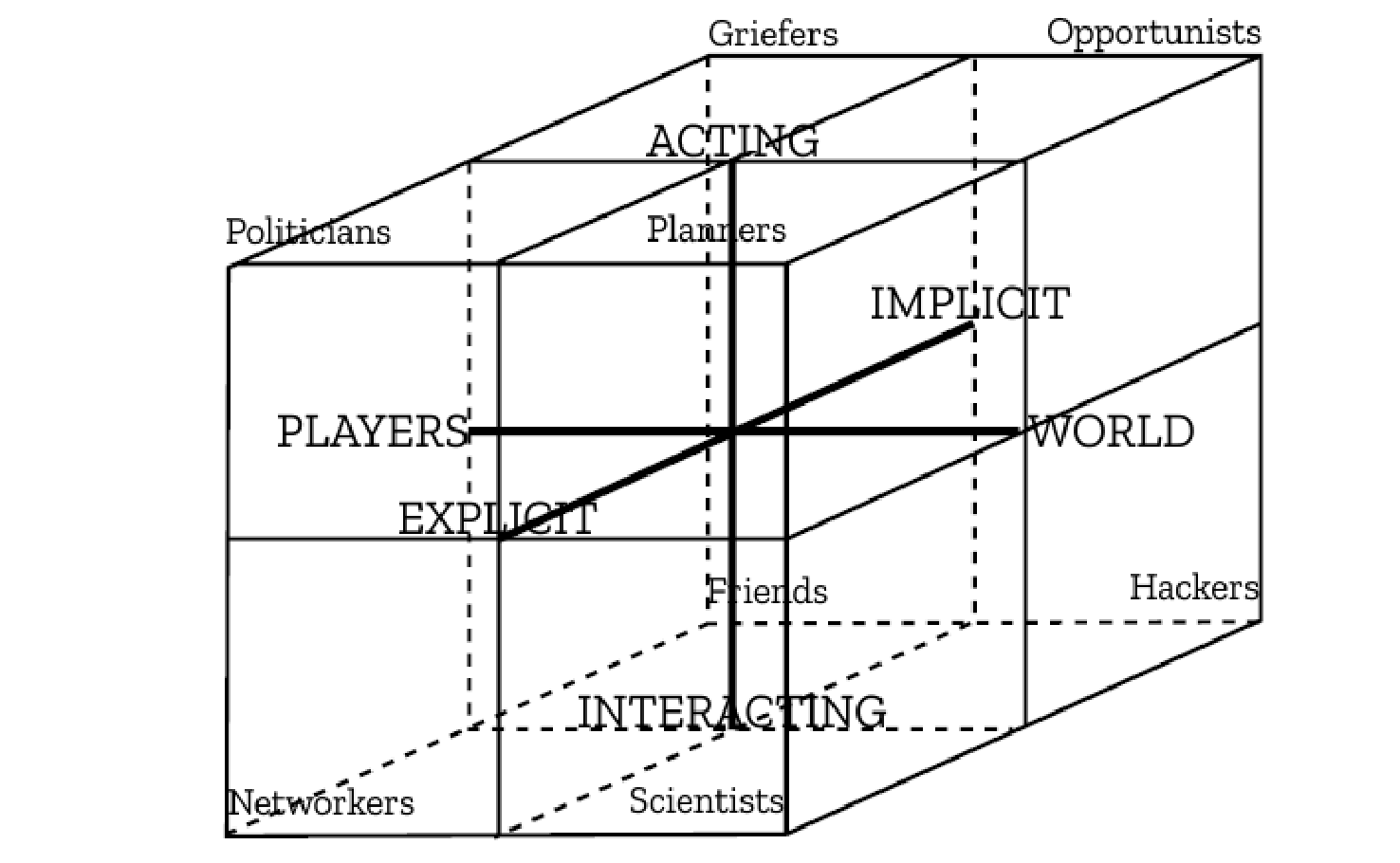
Figure 3.4 3D Player Interest Graph.
Whether this is of tremendous use is another matter, of course 10. Instead of four player types, we now have eight: opportunists, planners, politicians, griefers, hackers, scientists, networkers, and friends. The conflicts between some of the eight are meaningful (for example griefers versus planners), but for others the old types work just as well and are better at encapsulation (for example socializers versus achievers).
If having more categories doesn’t deliver more tools for designers, there’s little point in designers using them. Mere categorization doesn’t itself guarantee utility, even if it can be shown to be inclusive (as this one can) and is easy to validate empirically (as this one is). After all, adding a dimension for the time of the year in which a player was born would be inclusive and verifiable, but designers would find it of very little general efficacy 11.
Concerning our current discussion on player type progression, though, the addition of an extra dimension does have an effect for world-oriented players: It gives another sequence—opportunist to scientist to planner to hacker. We also can “unflatten” the main sequence (killer to explorer to achiever to socializer) from 2D into 3D, giving griefer to scientist to planner to friend. Tempting though it is to look for a sequence matching this of opportunist to networker to politician to hacker, this can’t be validated empirically: People simply don’t follow that career path. However, there is a minor fourth sequence, for opportunist achievers who learn by networking rather than by experimentation. This gives us:
Griefer to scientist to planner to friend (main sequence)
Opportunist to networker to planner to friend (minor sequence)
Griefer to networker to politician to friend (main socializer sequence)
Opportunist to scientist to planner to hacker (main explorer sequence)
At last we’re getting close to a model good enough to use for something. If designers can assess how players are likely to mature, they can account for their progress in their game designs. We’re not quite there yet, though.
The Hertzsprung-Russel diagram: Map absolute visual magnitude against spectral. The main sequence, on which most stable stars lie, runs roughly diagonally from high luminosity/low temperature to low luminosity/high temperature. ↩︎
“Ha! You call that an inferiority complex?!” ↩︎
The term is gender non-specific, meaning “wizards and witches.” ↩︎
For MUD2-specific reasons to do with the nature of the wiz invisibility command, the original axis labeling was open (explicit) and closed (implicit). ↩︎
Readers of Michael Moorcock and players of D&D can use law/chaos if they really must, but it’s not quite a match. ↩︎
Unsurprisingly, as obviously I wouldn’t have mentioned it otherwise. ↩︎
For the record, this also works on the original, wiz-specific graph. ↩︎
This suggests that at least in some cases, refining the model to account for gradations of immersion may be useful. ↩︎
This is in the traditional sense of the word, not the break-into-your- computer-and-erase-your-data one. ↩︎
Tools are only objects if they have no use. What’s more, it’s far better if the tool is designed to fit the problem than if the problem is designed to fit the tool. I don’t want to be a man with a hammer looking for things I can nail. ↩︎
Sorry to break the bad news to any astrologers among you. ↩︎
Development Tracks
The thing is, those sequences overlap. People can switch paths, if they have some moment of epiphany. Someone could go griefer to scientist (main sequence) to planner to hacker (explorer sequence). They could go opportunist to networker (minor sequence) to politician to friend (socializer sequence). They’ll tend to keep to whatever path they began on, but sometimes they decide to go a different way when they meet a fork in the road 1. Writing the sequences out linearly gives Figure 3.5.

Figure 3.5 Player development tracks.
From Figure 3.5, we can make a number of observations. It’s immediately apparent that there’s an oddity with politicians. Although people can become planners by applying knowledge they learned themselves (as scientists) or from others (by networking), for politicians only networking works as a qualification. Similarly, although planners can go on to become friends (forged through adversity) or hackers (understanding the world almost spiritually), politicians only ever go on to become friends. Designers can therefore be fairly confident that their world’s politician-friendly features should not be deeply hard-coded (because no one who experiments with them is going to use them) and that politicians should not be given too much ability to affect the physical structure of the world (because they’re never going to be attuned to it).
Another point that the development tracks show is that the elder game 2 (that is, what they do having played through the virtual world) would work best if it aimed at providing tools for people to tinker with the world or to enjoy one another’s company. Many textual worlds allow players to become builders once they’ve “won”; others provide private gathering places where players can sit and discuss the issues of the day. It’s certainly possible to have an elder game of a different kind, for example, by allowing players to repeat their time as a planner or politician in a different manner, but it’s less satisfactory for individuals that way 3. Only if the elder game is radically different from what went before will players begin development from scratch again.
Designers can take advantage of the fact that immersion is related to how far a player has proceeded in their development. Most networkers will not be deeply immersed, for example, therefore a designer could argue that it’s okay to put in immersion-breaking communication systems that facilitate networking. Most planners are immersed, therefore a designer might decide that statistical information regarding the operation of the virtual world is not available from within it: Players might know from a web site that their sword is a hackmaster +12, but when they bring it up on their inventory the number is represented descriptively or graphically instead.
As a more general comment, Figure 3.5 shows that identity paths progress in the same way; furthermore, this links directly to the 3D player interest graph (refer to Figure 3.4). The original 2D player interest graph (refer to Figure 3.1) is the same as the 3D graph (refer to Figure 3.4) with the implicit/explicit axis removed. If we take out the players/world axis instead, we get Figure 3.6.
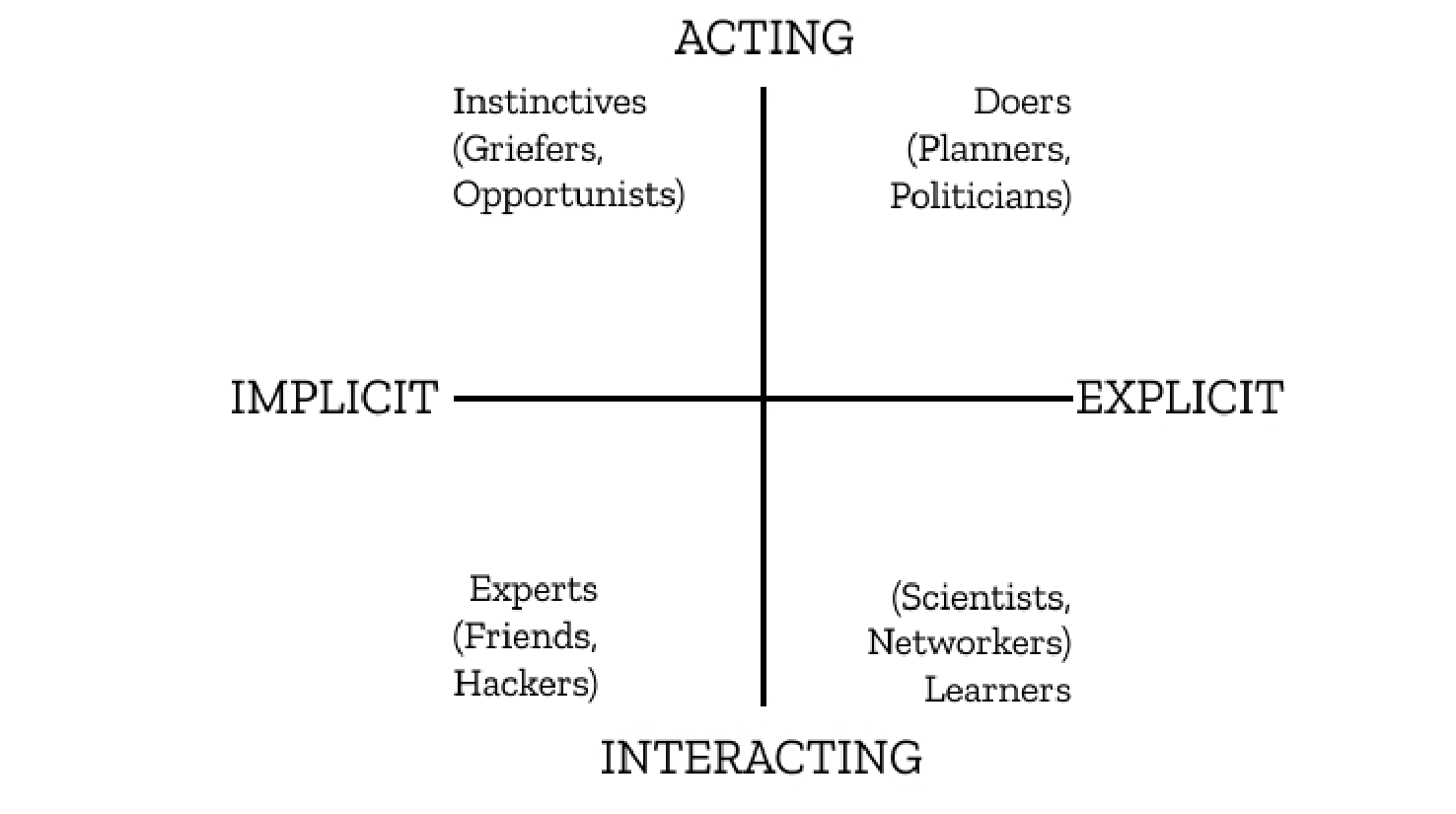
Figure 3.6 Flattened Player Interest Graph.
The player type labels for Figure 3.6 aren’t particularly important; more interesting is how players change from one to the next.
When a player arrives in a completely new situation, they have to act on instinct—there’s little else they can do. A player’s first aim is to determine the parameters that govern what they can do, which means trying everything he can think of to discover what basic actions are available. Having bootstrapped to a level where the player can reliably perform individual “primitive” actions, the next thing to do is to go about discovering sequences and combinations of these actions. The player does this methodically in a data-gathering phase, until he becomes thoroughly acquainted with the options available to them. Following this, the player applies what they have learned intensely, until eventually mastering it and it becomes second nature.
Baby arrives in the world. Baby flails about, until baby realizes how to move its legs, its arms, its feet, and its hands. Baby combines individual movements into sequences, some of which work and some of which don’t. Baby sits up. Baby toddles. Baby toddles more and more, until eventually baby can walk and run. Now, for baby, running is effectively a primitive action.
Locate, discover, apply, internalize. From acting on instinct, acquire knowledge, use that knowledge, and become able to interact on instinct.
I mention this feature of the 3D Player Interest Graph only to show how the player development tracks (refer to Figure 3.5) fit into the overall scheme. In practice, the tracks themselves are of more use to designers than the flattened graph (refer to Figure 3.6), although we’ll see later that there’s an interesting analogy that can be drawn from it.
There remains the question as to whether flattening the graph by removing the acting/interacting axis gives a useful new perspective, but it’s easily answered: No, it doesn’t. This may indicate that there are better choices for axes available which have yet to be discovered.
With that, we reach the end of this discussion of identity. There are some follow-up topics we need to look at, but we’re done with the central issue. The question might now be asked: Was it worth it? Although this analysis has produced some results of tangible use to designers, has it all really been necessary? Isn’t it, beneath the surface, just a lot of pseudo-psychological nonsense? What has it to do with design?
Directly, it contributes only in a few areas. Indirectly, it pervades everything. If you don’t understand the nature of what you’re designing, how can you design it?
People play virtual worlds to celebrate their identity. Designers must understand that. It’s a freedom thing.
Alternatively, they could completely hit a wall and bounce right back to the beginning again. Instead of developing in the face of a crisis, they could, for example, regress to some vengeful griefer state. This is, needless to say, not really what we want to see happening. ↩︎
This is another one of those terms that has come from game-oriented virtual worlds that doesn’t really have a non-game equivalent. ↩︎
This isn’t to say it wouldn’t be better for the health of the virtual world itself, of course. ↩︎
Anonymity
Good simulations allow people to do whatever they want to do; good virtual worlds allow people to be whatever they want to be 1.
Anonymity is itself a neutral concept: You can use it for good or for evil. In practice, someone has to know who you really are, so you can be called to account should you cause pandemonium. In virtual worlds, this will be the administrators; other players don’t get proof of who you are unless (through your behavior) you give it to them.
Reduced consequences for actions makes for the disinhibition that so characterizes virtual worlds. Anonymity is central to this, because only through anonymity do people have the freedom to change. If you make a mistake in the virtual world, you can restart; it’s okay to experiment, to take risks. However, if a real-world friend finds out about some virtual-world mistake, restarting will not erase it. Contact with reality collapses virtual identity like observation does a quantum wave.
Contrast not-so-good virtual worlds, where you can be whatever the designers want you to be. ↩︎
Life with a Backspace
Starting a new character is like backspacing over your identity mistakes and retyping them a different way. It’s only possible in virtual worlds 1.
Anonymity separates the real you from the virtual you. This has three effects:
People in the virtual world won’t prejudge you on superficialities.
Your real-world friends won’t judge you by your virtual-world actions.
Your virtual-world friends won’t judge you by your real-world actions.
Without anonymity, your virtual actions have real-world effects and vice versa. If no one knows you’re the U.S. president, you can be yourself; if they do, you’re back to being the U.S. president.
It doesn’t usually take long for newbies to realize that anonymity means they can restart if they screw up. It’s pretty obvious. However, in practice it’s not actually as important as people often think. The longer you play a character, the more attached to it you become, and the more people come to know that character. You soon reach the stage where you’ve invested so much in that character that if you do screw up you would be very reluctant to throw it all away. Instead, you ride out the storm (and are perhaps a better person because of it).
This can lead to an extra level of anonymity. If you decided to create a second character, you might not want it to be associated with either your real self or your first virtual self. Anonymity lets you branch. Thus, we should think of anonymity 2 as acting as a buffer between all your separate identities, not just the real and the virtual. When you start a new identity, your primary concern is to keep the old identities intact and separate. Therefore, the main advantage of anonymity is not that your new friends won’t find out about your other selves; rather it’s that your other friends won’t find out about your new self. It can be the other way round (for newbies and U.S. presidents), but mostly it isn’t. The virtual girl who doesn’t want her friends to know she’s a real-life guy has less to lose than the real-life guy who doesn’t want his friends to know he’s a virtual girl 3.
It turns out that maintaining separate identities in the same virtual world can be quite difficult. Experienced Wild West telegraph operators were able to tell which of the other operators on their line they were communicating with from nuances in the way they tapped out the Morse code 4; it’s unsurprising, therefore, that players in virtual worlds can often detect other players by subtleties in the way they act and speak. If you always misspell a particular word, for example, people will notice. This means that anonymity across characters can’t always be relied on. There are ways to succeed, which I’ll discuss a little later; on the whole, though, people who feel they need anonymity should switch to either a different virtual world or a different incarnation of the same one.
An interesting side issue here is that although players will often mature quicker if they regularly start up new characters, most of them are reluctant to do so because of the time they have invested in their old ones. They therefore find themselves facing the same challenges as before, responding in the same ways, and generally not getting much out of the experience. Were they occasionally forced to change character (for example, by its erasing following virtual death), would this not perhaps lead to greater enjoyment for them in the long term? Probably, yes; however, if they knew that characters could die dead-dead after months of playing time, players perhaps wouldn’t sign up for a virtual world in the first place. This is the great tragedy of persona death in virtual worlds, which causes more problems than any other for designers. It is discussed in considerable depth later in this book.
Returning to the topic of anonymity, then: What are the implications of all this on virtual world design?
Well firstly, a certain degree of anonymity must be guaranteed. Clearly, the live team needs access to the real-world details associated with a character, but this information should be considered private. If there is any way that a regular player can uniquely identify another regular player without the latter’s permission, it’s not good. You might think that associating email addresses with every character is beneficial for community development, but that’s not how the majority of players will see it.
Secondly, it shouldn’t go too far. People want to have separate identities, not no identity. If every character looked the same, that would lead to anonymity. If you can’t tell people apart, everyone could be anyone. Identities should be constructible to as great (or shallow) a level of detail that a player wants. Anonymity is relative, between characters; it isn’t absolute for individual characters.
Finally, players should be able to start up new characters with relative ease. Players won’t grow if they can’t occasionally experiment, and they’ll eventually lose faith in the virtual world unless they can start afresh occasionally. This does not mean that they should be offered new accounts at a cheaper rate; rather, there should be several slots on their existing account so they can maintain several characters simultaneously (in practice, the absolute minimum is three, but five is normally enough for most people).
Well, that’s the traditional point of view.
There is another argument that says players should only have one account with only one character on it. In game worlds at least, most people use secondary characters either as mules (which screws up game balance) or as griefers (so they can act like jerks without fear of reprisal). In both instances, the virtual world would be better off without them. Furthermore, in a commercial setting you can check names, addresses, credit card numbers, and computer registry settings to ensure that people don’t simply buy a second account to use for their mule or griefer activities 5.
This is the approach adopted by Star Wars Galaxies (although their hands were somewhat tied by the fact that the huge amount of data they store for each character is such that it would exceed their database’s capabilities to allow more than one character per account—well, that’s the official line anyway).
As it happens, none of these are particularly thorny issues for designers (although the number of characters per account may yet become so). The immediate problem with anonymity is practical rather than theoretical: It must be possible for characters to be referenced. This means they need a name. In a virtual world with half a million players, that’s a lot of names.
And witness protection schemes. ↩︎
Because virtual identities are named and can be referenced, the term pseudonymity is preferred by some researchers in this context. ↩︎
As people spend more and more of their time in virtual worlds, this could change. When they spend most of it there (as in True Names, for example), people may want to protect their real-world identities the most. ↩︎
Their styles were known as their “signatures.” ↩︎
CompuServe allowed one character per account on British Legends. Some players therefore accumulated several accounts—a dozen or more in some cases—so they could have multiple characters in the game. Needless to say, these accounts did not come at a cheaper rate, either. ↩︎
The Name Problem
In a virtual world, you are represented by, represent, or are an individual. The world fiction may pretend otherwise, for example, by allowing hive minds (for example, ant nests) or shared-mind couples (for example, Tweedledum and Tweedledee), but these are mere conceits. You are associated with a single, sentient game object: your character 1. So that people can refer to your character in conversation and commands, that character must have a label; in other words, a name.
MUD1 allowed players to have the same names, as long as they weren’t logged on at the same time. This rapidly led to problems of mistaken identity (and, to a lesser extent, impersonation). Permitting only one person with a particular name to be in the virtual world at any one time was no help: Players could find themselves locked out that way. The solution adopted was to allow only one instance of any name in the entire virtual world. There were still occasional problems when a character was killed and someone stole its name before the original player had recovered enough to return, but these were only isolated incidents that could be handled by administrators on a case-by-case basis.
On the whole, this is how virtual worlds are still designed today. There are implementational reasons why two characters 2 with the same name should not be allowed into a virtual world at the same time (it makes parsing and communication so much easier), and disallowing name clashes 3 for offline characters, too, is essentially a customer relations requirement (although there are other benefits to do with helping engender a sense of identity).
Virtual worlds with large numbers of players rapidly run out of decent names. It’s not a problem that dogs only virtual worlds, of course—it’s far worse for URLs, AOL account names, and Hotmail email addresses—but that doesn’t mean it isn’t an issue. The designers of Ultima Online anticipated that names would be in short supply, so they took the decision to allow them to be non-unique. To stop lock-outs, people with the same name could both play at the same time. Impersonation and communication evils ensued. Both were fixable while retaining non-unique names, but only with immersion-breaking solutions. The graphical virtual worlds that immediately followed did not make the same mistake, and used unique names from the beginning.
This still meant that there was a shortage of supply, of course: If you have 400,000 players, they need to have 400,000 names (and more if they have multiple characters). An obvious compromise is to limit uniqueness to server cluster (that is, to an individual incarnation/shard). With 40 servers, players’ imaginations need only stump up 10,000 different names, which is far more tractable. Sure, some other guy might be using your name on a different server, but your friends are all on this one.
How to choose a name? Players identify more with their characters if they get to choose the names themselves; name selection is the first and arguably most important decision concerning their virtual identity that a player can make. Giving them a free hand, though, can be tiresomely fiction-breaking (Robinhood the elf is here). It’s a problem: Randomly select any virtual world with a policy of free naming and the chances are there will be someone called “Gandalf”—irrespective of the genre.
One solution, hinted at previously, is to use a restrictive naming policy. Administrators vet prospective names. This is practical and very effective in virtual worlds with strong role-playing elements, because in explaining why their character has the name it does, a player must necessarily flesh out that character. It’s a barrier to entry, though: If someone tries to play your virtual world and finds there’s a 10-minute delay while you okay the character name, they’ll go somewhere else that doesn’t have a 10-minute delay. It’s also way too expensive to implement for virtual worlds that have thousands of newbies arriving every day.
A way to preserve an element of choice, while limiting the freedom to choose something unfortunate as a name, is to use name lists. The idea is to present players with a list of, say, 10 or 20 available names, and let them pick which one they want. If none of them really suit, another list can perhaps be presented, until all the options are exhausted. Players could still be given the option to enter a freeform name and wait for it to be vetted, but they wouldn’t have to do so.
There are a number of ways that name lists can be generated. The most obvious one is to do it randomly. This has to be good to work: EverQuest tried it, but it wasn’t and it didn’t.
Another way is to use the context of the virtual world to present possibilities. This is used sometimes in pencil-and-paper role-playing games. The idea is that the character’s name is built up from syllables that have a meaning in some ancient language supposedly spoken by the character’s people. A typical arrangement is to have an opening syllable, one or more middle syllables, and a closing syllable. An elf might thus choose “Ard-la-shi-sa” meaning “tree-of-silent-spirit,” whereas a dwarf (using a different set of syllables and ostensible meanings) might pick “Khad-rak-uz” meaning “Stone-strongbeard.” These are fun for designers to design and for players to play with, but you have to be careful—I once managed to get Fu-qu-az-ole out of one of these.
Using such pseudo-cultural definitions for names, it’s possible to re-introduce a modicum of non-unique naming. If players are given a surname based on their character’s race/class/gender/ whatever, then they might be able to choose the same first name as someone else with a different surname. If Urk Wolfhead and Urk Sharpspear play at the same time, either can be referred to as Urk by other members of their tribe or by people in the same general location as they. Only when someone from a different tribe wants to reference one rather than the other does the surname also have to be used (adjectivally). This is a neat solution that allows for some degree of choice while preserving the decorum of the virtual world.
Names are referents, but they are not the only ones. Hey, you know that charismatic, short, French general who conquered half of Europe in the early 1800s? Well yes, of course you do—it was Napoleon Bonaparte. I didn’t have to give you his name before you knew who he was, though, did I 4? There is an argument that virtual worlds should allow this kind of relative description for characters, and that it should be preferred until you’ve actually been introduced to someone (or told who they are by someone who already “knows”). The rationale for this is that in the real world people don’t walk about with their names tattooed to their foreheads, and therefore neither should characters in virtual worlds. The counter argument is that having to refer to someone as “The Tall Stranger” the whole time gets in the way of interactions—even if it eventually encourages people to interact by asking each other their names. As with many real-versus-virtual arguments, both sides have a point, and it’s ultimately up to designers to decide how they want to handle the situation in their own virtual world. Most of them go with the see-the-names approach, because it’s easier on newbies. If people complain, they can always produce some fiction to explain it away (“All player characters are by definition heroic, therefore they’re also famous, therefore everyone knows who everyone else is already”).
Relative names illustrate a point that game designers often forget: Names are owned by an individual, but used by everyone else. If “The Tall Stranger” won’t tell me his name, I may just decide to call him Lanky: I can invent names for other people. In MUD1, killers would give themselves hard-to-type names like Mmnmnnmn so that people would have a hard time casting spells on them, stealing goodies from them, and so on. I got round this by using pronouns, although this was not itself without problems. In particular, you might type something like “sleep him” then just as you were hitting return a friend would appear and change the binding for “him.” MUD2 added the ability to create synonyms for players and objects, so that once you (or anyone else) had typed “syn Mmnmnnmn as “Mm,” you could thereafter refer to Mmnmnnmn as Mm.
Why stop there, though? Why not allow players to annotate one another? Most people see, “Jay says, ‘hello’”; you see, “Jay the boring creep says, ‘hello’.”
This raises the issue of how players annotate themselves.
Or avatar or persona, but these generally lose out to character in discussions for which immersion is not an issue. ↩︎
It’s actually stronger than this: No two objects should have the same name (identifier). ↩︎
Names don’t have to be exact to “clash,” just similar enough that at a glance you could mistake one for another. ↩︎
If I did, you should have paid more attention in history class. ↩︎
Image
Traditionally, virtual worlds make a distinction between stats (short for “statistics”) and knowledge. Stats are what characters have (strength, dexterity, magic points, and so on); knowledge is what players have (how to bring down a dragon, the route to the citadel, that player B is an idiot, and so on). The virtual world knows everything about stats and nothing about knowledge; for this reason, the terms tangibles and intangibles are used when referring to attributes of characters 1 as opposed to attributes of players. A player’s knowledge of tangibles is itself intangible, of course.
Only tangibles are meaningful to the virtual world, but both tangibles and intangibles are meaningful to players. Virtual worlds generally have no way even to know that player A thinks player B is an idiot, let alone to model the fact. Players, however, do like to know this stuff, and are excellent at assimilating it. Many virtual worlds therefore provide what are essentially bookkeeping facilities for players, wound into their own context to maintain a degree of immersion. However, they don’t actually use any of it to introduce goals for the players—they have no access to the content of the information, just to its form. There is therefore no gameplay reason why a player should be able to make a private annotation to another player’s character; it just adds to their enjoyment.
The most important intangible is a character’s name. Unless the name is constructed from components that the virtual world knows about, it has absolutely no handle on what a name might “mean.” Players will hazard a guess that Cupcake and Hardcore might have different personalities, but the virtual world doesn’t know. Names that are names in real-life are especially potent: Anyone picking such a name has some reason for doing so (typically to do with role-playing or real-life self-image). There are plenty of other intangibles, however. It costs a virtual world practically nothing to allow characters to have different color clothes, hair, weapons, and so on, but it allows people to individualize themselves and make personal statements. This is made easier by the fact that these are recognizably intangible: At character-creation time, players aren’t going to worry about the gameplay effect of having blue eyes, whereas they might for having a particular weapon or skill. They can concentrate on their image. Purists often sneer at such distractions from what a virtual world is “about.” Why would anyone in their right mind want to wear a suit of crimson armor if there are cheaper regulation gray ones that offer a better defense? Shouldn’t designers be investing their time in extending gameplay rather than adding yet more eye candy? Some designers do go overboard in this regard, it’s true, but then some non-gameplay features can be absolutely critical. Strictly speaking, for example, communication between players is rarely necessary for gameplay reasons, yet take it away and you don’t have a virtual world.
That said, the purists do have a point in that although there’s no reason why a suit of crimson armor should have any gameplay differences from a regular suit of armor, there’s no reason for it not to, either. If someone has gone to the trouble of collecting all the various crimson parts (breastplate, helmet, gauntlets, epaulettes, grieves, and so on), it doesn’t hurt to make the parts or the suit as a whole give more protection against, say, fire than a standard-issue suit; what’s more, it makes it a little more interesting for achiever types. Even someone who is wearing it only because it makes them look good might feel more satisfied if they can convince themselves there is a “legitimate” gameplay reason for sporting it 2. Note that this does not apply for customizations that players pay for. There is money to be made in selling players one-off character modifications or pieces of customized kit, but only if it doesn’t affect gameplay. It’s okay to replace a shield with a functionally equivalent one that looks different, but it’s not okay to replace it with one that acts different; otherwise, players who can’t afford to pay for such a change will complain bitterly that they are disadvantaged 3. Changes to intangibles are acceptable, but changes to tangibles aren’t.
Tangibles mainly interest achievers. It therefore comes as little surprise to learn that intangibles are particularly important to socializers. Therefore, designers who want to make their virtual worlds attractive to socializers usually incorporate a number of intangible-friendly tools in their worlds. As the celebration of identity lies at the very core of virtual worlds, chief among these will be the means made available to players for determining their appearances in the virtual world.
The mechanisms for creating a basic character differ between textual and graphical worlds, and the various options are discussed fully in Chapter 5, “Life in the Virtual World.” For now, though, we’ll assume that a new character has been created: This new character is the player’s opening statement. Customizations subsequent to it are modifications to that statement and can say important things about the way individuals view themselves. It is therefore in the best interests of designers to make customization easy, so that people can go where they want to go. The simplest method is to allow players to make freeform notes about themselves that other players can read as an adjunct to their name, but this is just one of three general approaches available:
Tangibles real for the virtual world. A character can remove a suit of armor and give it to some other character who will benefit from its protective attributes.
Intangibles real for the virtual world. Your character can dye their hair yellow and their hair will thenceforth be reported as being yellow—even if hair color is transparent to the mechanisms of the virtual world.
Intangibles virtual for the virtual world. You can annotate yourself with a publicly readable note that says dogs adore you, but the virtual world would take no account of it were you to encounter one.
Players can therefore use a combination of methods to make statements about—that is, to express—themselves. They can write their description such that when someone looks at them they’re told they see “a mighty knight;” they can wear some impressive-looking armor that makes them appear like they’re mighty knights; they can wear some top-of-the-range plate mail that makes them be a mighty knight.
Freeform descriptions aren’t as important in graphical worlds as they are in textual ones, because people go by looks in the former and by “look” commands in the latter. Most MUDs have freeform descriptions, and they’re considered the main way (other than by name) to flesh out a character. There are two problems, however, neither of which is immediately apparent.
The first is practical. On the face of it, it might be thought that there could be trouble with hugely unsuitable descriptions 4 if people are allowed to depict their characters however they see fit, but this is only the case for griefers (who are trouble anyway).
Other players may inflate their status, but it’s easy to spot and only makes the perpetrator look foolish (well, not quite “only”—it spoils immersion for others, too). No, the main problem with the content of personal descriptions is that they are often either touchingly illiterate or irredeemably clichéd. There may be a thousand ways to say that a character is tall, dark, and mysterious, but if every male character you meet is basically tall, dark, and mysterious then they all kind of merge into one. They even have eyes that seem to pierce your very soul the same way 5. Female characters are green-eyed, flame-haired, pale-skinned beauties who move with the catlike grace of a dancer while wielding matching swords. Oh, and they have heaving breasts, too. There must be a factory somewhere manufacturing them.
The second problem is less easy to fix by taking someone aside and having a quiet word. The thing is, it’s an act of will to change a description. The player may change, but unless they notice it their character’s description won’t. Even if it does, there are limits; “tall, dark, and mysterious” may mean a player feels out of place and misunderstood yet possessing of hidden depths, but if they later feel at home, at ease, and gregarious, how do they change their description to reflect that? Their character shrank a few inches and went blond overnight? Worse, will they even effect a change if every time they meet someone new they’re treated like they were tall, dark, and mysterious? Freeform descriptions can anchor players too much; in graphical worlds, the same applies to their character’s visual appearance. I didn’t implement character descriptions in MUD1 precisely for this reason: Players can explore their identities more freely if they aren’t tied to some image 6.
There are two basic mechanisms for getting around this.
The first one is to have characters die occasionally, so players have to create new ones. This gives players the opportunity for some redefinition. Persona death has other implications, however, so this is not necessarily an option for most designers.
The other approach is profiling. The idea here is that characters have computer-generated descriptions based on their actions. It’s not as expressive as freeform text you’ve written yourself, but at least it gets updated. Its most basic form is to tag a character’s name by some epithet based on some combination of that character’s level of experience, class, race, and gender: “Felice the heroine” rather than just plain “Felice.” Special titles and epithets, for example “Felice the giant-killing heroine,” can be added for particularly exemplary deeds, either automatically or by admiring administrators.
Longer biographies can be built up separately, for anyone to access if they want to know more about a character’s actual deeds. This allows people to form an opinion about a character, which is particularly useful in virtual worlds where characters never really “die.” The half-life of these descriptions should depend on their importance. “Felice vanquished the maiden and saved the dragon” might be a big deal for a relative newbie, but not worth a mention after a couple of weeks. “Felice beat seven kinds of hell out of Tommy and took his shoes” would probably hang around to stain Felice’s reputation for somewhat longer.
Profiling also can be used as a more general tool to provide information for other parts of the system. For example, if a group of players finally destroy the demon lord after two months of trying, the server could automatically generate a newsflash (for a login message, for a web site, for a mobile phone message, for email) to inform everyone what’s happened. Done right, it may even be possible to create faux articles for the virtual world’s virtual newspapers.
It’s therefore not only individual players who can benefit from a virtual world’s acceptance of intangibles: the whole community can.
These terms extend to the virtual world in general (as described in Chapter 1). ↩︎
The same applies for role-playing props. If there’s a gun on the wall then you ought to be able to fire it, even if laser weapons are better (apologies to Chekhov). ↩︎
There is an argument that this doesn’t apply for virtual worlds (or particular instantiations of them) that are designed to use charging for gameplay-significant objects from the beginning, advertising it as a main feature of their business model. Of course, such worlds might not attract many players, but hopefully they’ll get more money from each one. The main standard-bearer of this approach is Achaea, where player expectation is so geared up for it that they sell over half a million objects with tangible properties a year—a phenomenal figure! ↩︎
If they’re descriptions at all—web site addresses sometimes feature, for example. ↩︎
Which can still happen when they’re asleep, unless the virtual world provides facilities to switch descriptions depending on character states, which most don’t. ↩︎
This is an example of where virtual world designers don’t always understand their virtual world’s design. Why do most textual worlds have free-form descriptions in them nowadays? Well, it’s because someone way back when added the facility to an ancestor world and they’ve simply inherited it. Why was it added in the first place? Was it because the designer who did it knew what they were doing or because they didn’t know what their own “parent” world’s designer was doing? In either case, how can the designers of today’s worlds be sure it’s the right thing for their world? How many of them even consider that the feature might be optional? ↩︎
Role-Playing
I have a story to complete…
(Continued) Polly’s Tale
Why won’t they role-play?
Everyone is in the same real-world room. Everyone can see each other in real life. They’re in MUD, but only shallowly; they’re still connected in Reality. Everything they do in the virtual world is subject to the same peer pressure as in the real one, because they still feel like they’re their real selves. They’re constrained.
Yet I’ve played D&D. I know that people can be connected in the real world and still role-play. MUD offers even more opportunity to experiment with identity—precisely what my friends seek. So, why won’t they step over the line?
They need permission to role-play.
As MUD’s programmer and the group’s overall leader, I’m the obvious choice to give them this permission. Yet how can I do that? And how will they know what to do when I’ve given it anyway? They won’t take direction—I can’t say, “Pretend to be someone a little more tolerant than you are,” and expect them to go with it. The best I can do is to demonstrate role-playing in action.
Yet even then, there’s a strong pull back to reality. I can create a character and pretend it’s a pirate or a monk or an enthusiastically chivalrous knight, but they’ll still identify the character with me. That could be tricky, as there’s no shielding context: Pretending to be an upper-class twit is fine if you’re acting in a play, but bizarre if you do it while playing chess. Somehow, I have to show that MUD is a shielding context.
If I’m going to break the mold, I’m going to have to hit it hard. I formulate a fiendish plan.
I create a character called Polly. Polly is a secondary character I use for testing things in the game. I say that I chose the name because Polly is like a parrot. Everyone knows Polly is my debug character.
When I inherited MUD1 from Roy, it didn’t implement gender. This was entirely due to Roy’s rush to write as much of the program as possible in the short period of time available to him; he felt that gender could easily be added later, whereas things such as communication had priority 1. As far as both Roy and I were concerned, gender was merely a linguistic issue forced on us by the English language; the only changes it meant for the virtual world concerned personal pronouns in event descriptions.
Polly may be the stereotypical name for a parrot, but it’s a female name. This gives me my excuse. I add gender. Players are asked, “By what name shall I call you?” then “What sex do you wish to be?” Naturally, I use Polly to test my new code.
So Polly is no longer a parrot. Polly is a cheerful yet feisty girl who likes helping people but gets cross if they patronize her.
If I’d added gender to MUD and not created Polly, what would have happened? The chances are, people would not have played with switched gender, afraid of the disparaging remarks about their sexuality that doing so would attract.
I run that risk, of course, but I’m confident that I’ve designed Polly well enough that no one is going to see her as a sexual object, just as an ersatz sister. I also have the advantage of not actually caring if people say I’m a transvestite behind my back.
Luckily, Polly works.
People know I’m Polly, but they also know I’m not Polly; I thereby illustrate the massive gulf it’s possible to create between player and character. As MUD’s programmer, my kudos is sufficiently strong enough that I pull it off. People think, “If Richard can have a female persona, maybe I’ll try it myself.”
They do. The gates are open, and new lands await. Players laugh and joke about having female characters, but their other characters also begin to act in smaller, more incrementally different ways. Players have a freedom that they couldn’t have in real life.
I’m ashamed, because I’ve been manipulative, but I believe that overall I did the right thing.
Besides, I’m rather fond of Polly.
This was nothing to do with the fact that we had no female players. Roy was, and is, against blind prejudice of any kind. ↩︎
Postscript
Did any of this help my friends?
To be honest, probably not—it was by then too late for most of them. It did help denerd those that followed, though.
It also set a lasting precedent: Virtual worlds are seen as acceptable shielding contexts. To this day, playing a character in a virtual world with a gender different from your own does not suggest anything about your sexuality—just your readiness to spread your wings and fly.
I’m rather proud of that.
On Being Others
I told Polly’s tale for three reasons:
To illustrate the importance of identity exploration in virtual worlds, and the emptiness of a world without it.
To demonstrate how something that many designers take for granted as part and parcel of virtual worlds has a real-world beginning.
To counter the popular notion among some researchers that MUD1 was written by a couple of one-dimensional hackers whose only aim was to provide a medium for adolescent males to live out fantasies of bloodthirsty violence 1.
Crossing gender with Polly was not done as a means unto itself: I was attempting to show what role-playing enabled, and that it was okay to indulge in; gender was just the mechanism I used to do this. The fact that researchers almost invariably write about crossing gender in virtual worlds as if it were something amazingly special is slightly off the point. It is important, but no more so than any other severe disjunction between player and character. Maintaining the impression that you’re a 90-year-old ninja elf is far more difficult than acting as if you’re the opposite gender 2.
Pretending to be your non-biological sex in a virtual world has a higher profile than other forms of identity dislocation because it’s the only “physical” identity cue that players have to specify in virtual worlds. However, it’s just one of many dimensions. If virtual worlds asked players to specify a real-world race for their characters, whether instead of a fantasy race or in addition to one (a Jewish elf, a Chinese troll), then this would be high-profile too 3. As it is, almost every textual world avoids real-world race; graphical worlds use skin tones and identikit face construction to allow players to present whatever look they want, but it’s never referred to as race or ethnicity. It’s just a look, which is forced on a graphical world in the same way that language forces gender on textual worlds 4.
MUD1 didn’t have race, age, class, weight, or any other physical identity cues except for gender; it wouldn’t have had that either if English was up to the job. Players could have still pretended to be the opposite sex had that been the case, of course, but they wouldn’t have been forced to instantiate to either. Constraints diminish opportunity.
Playing a character of a gender opposite to your own should therefore be regarded as merely one of a number of ways that players can choose to explore their selves; it is discussed in greater detail in Chapter 6, “It’s Not a Game, It’s a ….”
For the moment, however, one of the consequences of this kind of identity experimentation is of more pressing interest.
As a man, there’s nothing incompatible with having a female persona (nor vice versa): Although men can’t be women in real life (without a series of very unnerving operations, anyway), they can be women in virtual worlds. Your persona is you, in the virtual world: You can be female there, whatever your real-life gender.
When you’re starting out, though, you have to play a role. You have to decide how you think a character of the opposite sex would act, and stick with it. Your own identity can adapt toward that of your character’s, but your character’s can’t (at this stage) shift much toward your own. It’s locked in place.
This brings us to consider the nature of role-playing.
Yes, Dale Spender, author of Nattering on the Net: Women, Power, and Cyberspace. Melbourne, Spinifex, 1995. I’m talking to you. ↩︎
Assuming, of course, that you aren’t a 90-year-old ninja elf in real life. ↩︎
For a discussion of race (or lack of it) in virtual worlds, see: Beth E. Kolko, Erasing @race. Beth E. Kolko, Lisa Nakamura and Gilbert B. Rodman (editors), Race in Cyberspace. New York, Routledge, 2000. ↩︎
Most languages, this is. Some languages, for example Chinese written in pin yin, can be gender nonspecific. ↩︎
The Role-Playing Paradox
Experienced players will sometimes speak of “wearing” a character, like they might wear a mask. The freedom of revealing less of their outer selves can lead them to reveal more of their inner selves. They can, therefore, learn more about their inner selves, and change their character so it fits more comfortably. Ultimately, their inner and outer selves line up, and character becomes persona.
This is often described as role-playing. It is not. Role-playing is about assuming a role and maintaining that role. The role doesn’t change; if the character changes, it’s only for reasons that make sense for that character, not for the role-player.
An actor on a stage is playing a part. Actors might put more of themselves into a part as they come to know their character, but they can’t change the part. A theatergoer might notice a distinct difference between performances six months apart in a run, but actors and their characters remain separate. Spending every night playing a poisoner may give an actor insights into the mindset of such a person, but it’s unlikely to turn the actor into a poisoner; crucially, it most definitely won’t turn the poisoner into an actor.
Players can adapt their characters. Role-players determine not to. Role-playing is therefore a sub-class of playing. Both are paths to fulfillment, and both have the same overall goal: Being someone else in order to become a better you. Unfortunately, the term “role-playing” is widely applied to all kinds of playing in virtual worlds—it’s even incorporated into the acronym MMORPG. Properly, though, it should only be used to describe fluid-player-to-set-character play. Much confusion flows from this.
I should point out that putting yourself in someone else’s shoes is a perfectly valid way to learn more about yourself; I’m not about to disparage role-playing here. What I am about to disparage is the misunderstanding of what role-playing is, and the design paradigms this misunderstanding has promoted.
Role-players map themselves onto a character. They don’t map the character onto themselves. In so doing, they can come to an understanding of what makes their character tick, which enables them to reflect on their own attitudes, beliefs, and ways of thinking. The key is that they change, but the character doesn’t. The default for virtual worlds is for both to change. As a role-player, you can only learn about yourself as you approach a character; once you reach the character, you can learn no more from it. You have to take another role if you want to go in a different direction.
This, then, is the role-playing paradox: As a role-player, you try to become your character; however if you succeed then you’re no longer role-playing.
In other words, the journey is the point of the exercise, not what you do when you get there.
So role-playing sets up the necessary conditions for immersion, but the harder you role-play the less immersed you get: Thinking about your character as a separate entity breaks immersion. The more you think about a line to decide whether it’s right for your character, the greater the distance you put between yourself and that character. The conscious post-editing of your character’s words means the subconscious separation of you and your character.
This isn’t how players and designers of virtual worlds usually see it at all.
Soft Role-Playing
Role-playing in virtual worlds is one of those concepts that is inherited from “parent” virtual worlds without a great deal of thought as to its nature. Consequently, over the generations it has become less understood. There are honorable exceptions—particularly among TinyMUSHes—but for the most part virtual worlds have a fairly relaxed idea of what constitutes role-playing.
One of the tenets of role-playing is that role-players must have a role to play. It doesn’t matter per se whether these roles are created by individual players or they’re assigned by some referee. Players usually like to create their own characters, but in practice most settings have constraints on the roles people can play (no cowboys in the court of Louis XIV). A midway position is therefore usually adopted where a number of scenario-specific templates are provided (musicians, advisors, guards, courtiers) and players get to choose which one they want. They can customize their character further if they so wish, so long as they stay within the character’s (and scenario’s) stated parameters. There will be limits on specific roles (only one person gets to be Louis XIV) and balance issues between generic ones (guards are needed—not everyone can be a courtier). These are rarely hard to resolve, though.
Although this template scheme works for role-playing in general (historical reenactments, Murder on the Luxor Express dinner parties, theatrical productions), why does it appear in virtual worlds? In almost every virtual world, one of the major decisions players have to make when they create their characters is what class they have to be. Why is that?
Early MUDs did not have character classes. Some second age virtual words introduced them, but it wasn’t until the third age that they really took off. Character classes 1 were absorbed from AD&D, which ultimately got them from the miniature wargames (that is, wargames using toy soldier “miniatures”) that gave rise to D&D.
In a miniature wargame, units are categorized much as they are in real life: A Napoleon-era general might think in terms of cavalry, infantry, and artillery units, each with its own particular strengths and weaknesses; a player in a miniature wargame will also look on their units this way, with perhaps special miniatures to represent major individuals on the battlefield (for example, Napoleon). If the battle were in a fantasy setting (say, the Battle of the Five Armies from The Hobbit), there might be units representing monsters (wargs, orcs) and specialist troops (elven archers, dwarven axe-wielders), plus a few for individuals (Bilbo, Gandalf, Beorn, Thorin) and wild cards (eagles). A more generic fantasy setting might have units for magic-users, fighters, holy men, and so on, their powers on the battlefield defined in terms of a quick-and-easy level rating.
Taking these characters out of the battlefield and into the dungeon, their classes and levels were already set; their abilities could be defined in terms of those classes and levels. Thus, when role-playing evolved as a concept in gaming, character classes were already there. However, role-playing meant taking on the role of an individual (as opposed to a unit comprising several individuals), not the role defined by a class.
This traces how character classes came to be a part of virtual worlds, but it doesn’t explain why.
Well, there are four reasons:
Expectation. Virtual world designers had played AD&D. AD&D had levels and classes; virtual worlds had only levels, therefore they ought to have classes, too.
Individuality. Players like to feel unique. If a virtual world isn’t richly featured enough for players to differentiate themselves by their deeds, give them one that enforces differentiation.
Balance. If one playing style leads to greater success than others, most people will adopt it. By deliberately partitioning the player base such that there are several styles, each of which is dependent on the others for success, a virtual world is much more interesting. Adventuring groups form social bonds, too.
Direction. Not everyone knows who they want to be. If you stand at a crossroads, can you decide which road to take if there are no signs? Classes provide signs.
Note that none of these have much to do with role-playing. Somewhere, players and designers alike lost sight of what it meant. Instead of class being an aspect of an individual, individuals were aspects of a class. Role-playing meant being a thief or a healer, not being Knuckles or Justina.
Thus, we have two paradigms for role-playing in virtual worlds: classless and classbound 2.
I much prefer classless. Here’s why.
Let’s consider that list of reasons why classes appear in virtual worlds. The first one, expectation, is not really an issue. Nowadays if players see a virtual world with no classes when they were expecting classes, they might want to know why classes are missing—that’s okay, we can tell them. They’re not going to ignore a world through some sense of “incompletion,” though, if indeed they ever were before.
The next reason, individuality, is a consequence of a world’s lack of depth. If your world is so shallow that players can’t do different things unless you give them different tools, you need classes. Today’s virtual worlds should not be this shallow, though. Modern tabletop role-playing games use skills systems rather than classes; this build-from-pieces approach offers far greater variety than the cookie-cutting land of classbound systems.
Balance can be an issue. If there is no explicit fence keeping abilities separate, what is to stop someone from maxing out in fighting skills, magic, and healing, and becoming invincible 3? Won’t everyone end up looking and acting the same? Again, this assumes that your virtual world is so impoverished that it can only offer players one overarching goal (normally “kill things to get stuff so you can kill more things”). However, at a practical level balance is dependent on how advancement works. If it takes you the same time to become a level 20 fighter/magic-user that someone else takes to become a level 40 magic-user, you have the worst deal—they’d probably beat you easily in combat. People can still take different career paths and parties of specialists will still be formed. To stop getting maxed-out killing machines, either introduce permanent death into your virtual world or take off the level caps.
The final reason for having classes is to give players a vision of the future. They choose a destination, board a train, and know where they’re going. The same can be done with character kits, though—skill sets optimized for a particular playing style template. Chapter 5 gives a few other ways to do it. Players seeking direction want to know that fighter and magic-user are careers it’s sensible to pursue; they don’t care whether these are implemented as classes or as kits.
Okay, so a classless “role-playing” system can be tweaked to do what a classbound one can. There are a few other minor reasons for using classes, but solutions to those can be hacked together, too. This doesn’t explain why anyone would want to use a classless system, though. Classes are easy to implement. What does a classless system offer that a classbound system doesn’t?
It offers change.
People play virtual worlds to explore their identities: You pretend to be someone else in order to become a better you.
In classbound role-playing, you begin your journey of self-improvement with a definite goal in mind. If you want to be mysterious, aloof, singular, and powerful, you become a mage; if you want to be quick-witted, spirited, independent yet lovable, you become a rogue; if you want to be strong, noble, valiant, and victorious, you become a fighter. Or you pick one of the many sub-classes that make this virtual world different to the one next door.
It’s aspirational. You decide where you want to go, then you board the train and the virtual world takes you there.
But it’s a train. It runs on rails. You can’t get off. You have to start with another character and board a different train if you want to go somewhere else. There may be a branch line for “fighters who do some healing” or “thieves who thieve for good,” but they’re still lines. Between the lines is a whole continuum of experience that you can’t ever reach. You may get the occasional glimpse through the window, but you can’t ever visit it no matter how much you like the scenery.
In a classless system, you can go where you want. You may start out intending to be a fighter and have your character take a job guarding a merchant caravan. From there, you may try some minor trading yourself so you can improve your weapons and armor, but discover that you prefer the trading to the fighting so you switch to being a merchant full time. Or maybe the bandits who raid the caravan are fighting for freedom from a tyrannical ruler, so you join up with them, rising through the ranks until you find yourself a major revolutionary figure who is given the job of reconstructing the country when peace finally comes. Now if at character-creation time you’d been offered the chance to become a merchant or an aid worker, would you have taken it? No, because you wanted to be a fighter. In a classless system, you can still start off as a fighter; you can still stay a fighter, if that’s where your calling lies. However, you can also veer off and become something else if the muse takes you.
In a classbound system, you can only be what the designers determine you can be. In a classless system, you can be something that the designers haven’t even dreamed of.
It’s possible to tinker with class systems to allow some degree of lateral movement. EverQuest 2 has a funnel-like system, which doesn’t force newbies to make any major decisions as to what class they want to be. As they go up levels, however, they have to specialize more and more, until they become locked in to their chosen career. This is a great way of helping newbies settle in, and by the time they commit themselves to a single class they’re pretty sure it’s the right one. Unfortunately, it’s still only the right one of those available; it’s still only the right choice for now.
The same argument that applies to classes also can be applied to character races. Just as magic-users differ from fighters, so magic-users that are human differ from magic-users that are elves 4. If you take on the role of a blue-skinned, triton-waving, lizardoid fighter then you probably will find things about yourself that you wouldn’t if you didn’t, but it could well be an unsatisfactory experience. It has the same dual player/character drift that you get in classless systems, but the character is constrained; when it reaches the boundaries of what the virtual world allows, the player still wants it to move, but it can’t.
This is soft role-playing: The character can change, but not always by enough to supply the player’s needs. In hard role-playing, the character remains fixed, which sounds like it should be even worse; however, the player changes willfully, and can therefore be more systematic about challenging their attitude and behavior. After the hard role-player has wrung a role dry, they drop it and choose another; soft role-players have no such option, which can make for a frustrating time.
As a virtual world identity-exploration experience, role-playing works. Staying with one role the whole time is inherently limiting, of course, but it can be more intense. Unfortunately, hard role-play immersion is only ever ephemeral. Nevertheless, done right it can be very rewarding for players: MUSHes in particular are often entirely role-play in nature, with no one playing out-of-character (OOC). Role-playing also is
perfectly compatible with virtual worlds in which the majority of players are not role-playing; most of the time, it’s only a problem if people try to use it as a shield (“That wasn’t me who insulted your mother, it was my other character.” Yeah, right.).
That’s most of the time….
Very, very occasionally, over-enthusiastic role-playing can lead to problems—problems that provoke some of the most profound, negative emotions that players in virtual worlds ever have the misfortune to feel.
Traditionally these are all variations on fighter, magic-user, cleric, thief; as these are fantasy-oriented, though, players and designers will sometimes speak of tank, nuker, healer, rogue. ↩︎
Because the early (classless) MUDs were British and the tabletop (classbound) standard came from the U.S., these were originally called the British and American styles of role-playing. I prefer classless/classbound, however, because it’s more accurate and doesn’t carry connotations of nationalistic bias. ↩︎
Such characters used to be called tanks or tank mages, but now the term “tank” is used to apply to any out-in-front fighter character. ↩︎
Gender differences don’t generally apply, though. Hey, virtual worlds are progressive places, they don’t want any sexism. Institutionalizing abstract racism seems to be fine, though. See Chapter 8, “Coda: Ethical Considerations,” for a further discussion of these issues. ↩︎
Masquerading
Role-playing a character is one thing; role-playing a player is something else.
Suppose you’re male in real life, playing a female character. Some other player asks you whether you’re female in real life. You have three options:
Tell the truth. Everyone knows you’re a real-life guy, but who cares? Most people will happily play along with the fiction.
Don’t answer the question. Everyone still knows you’re a real-life guy, but they respect the fact that you’re role-playing and want to keep in character.
Lie. Now you’re not role-playing a character, you’re role-playing a player (an alter ego) who is playing a character.
Why do people lie about player/character mappings?
It may be because they have a real-world reason for it: They are an administrator for the virtual world trying to get a sense of the “the word on the street”; they are famous and want to take a break 1; they are parents checking out that a game is suitable for their children. In this sort of situation, they are said to be playing incognito. Usually, they’ll be happy for the administrators of the virtual world to know the score, just so long as other players don’t find out.
For the majority, though, there usually isn’t any premeditated reason to lie. They do it because they can, or because it gives them a frisson of excitement, or because they like the way people treat them, or simply to see what happens. Almost always, they don’t think it’s all that big a deal to start with; they will nevertheless try to keep their activities a secret from administrators just as much as from other players. Role-playing a person who is playing a character is called masquerading.
The problem with masquerading is that deep relationships are formed between people, not between characters. Characters can have virtual relationships (a player can cause Tommy to act like he loves Tammy), but players have real ones (the player playing Tommy really does love the player playing Tammy). The longer and more convincingly a lie is sustained, the more meaningful the relationships formed become; when the lie is finally exposed, the emotional effect can be absolutely devastating. Finding out that the 20-year-old, wheelchair-bound ex-athlete you’ve been getting to know over the course of two years is actually a 40-year-old company lawyer from Chicago could represent for you a betrayal of trust at a profound level. All that time you were building up an emotional attachment, someone was playing you for a fool. Everything was a lie, from beginning to end.
I’ve seen it happen several times, and it really is very, very upsetting for all concerned. So, how do you spot it?
Most of the time, it’s easy. People will often realize what’s happening in time and stop before things get out of hand. Of those that don’t, many are found out early because of flaws in their role-playing (“How come you type so fast if you have two-inch long fingernails?”). For the remainder, it’s harder. Nevertheless, because most people don’t plan on masquerading (they just fall into it), there are a number of common themes.
Players will:
Claim their alter ego is physically attractive or of high status.
Give their alter ego’s character the same valid real-world name as their alter ego (especially when crossing gender).
Invent some reason why their alter ego can’t go to real-life meets (disability, phobia, lives in Saskatchewan).
Never give out their phone number (or, if they do, will always insist on talking in the virtual world whenever you call).
Avoid players who really are what the player is only pretending to be (men playing women will avoid real women).
Bring in “friends” their alter ego knows “in real life.” These friends never become regular players.
Have their alter ego take on high-profile roles, usually for the good of the community.
Have their alter ego succumb to injuries or ailments that lead to absences or promised absences.
Of these, the saddest sign is perhaps the last one. The player feels guilt over their deceit and has genuine fondness for their virtual world friends. The player knows how distressing it would be were the truth to come out, so they try to provide an exit. They stop playing for no reason, but have to come back because there’s no closure, which means they must explain why they went missing. They set themselves a deadline for when they will quit and invent a fiction for it so everyone knows they’ll be going at that point, but the fiction makes their bonds even stronger and they still can’t leave.
Ultimately 2, something has to give. If a player becomes a persona but that persona can’t become the player, there is a tension that can never be resolved. Either the player feels they have to tell someone, or they make a series of errors so glaring that they are certain to be found out, or they contrive for their alter ego to leave in such a manner that return is impossible.
The single greatest cause of sudden death among beautiful, young, female players is that the guy who was role-playing them wanted an irreversible out.
So could you ever masquerade and get away with it?
Well yes, you could, but you really ought to think about why you’d want to. It’s more appropriate to ask whether you can play incognito and get away with it. The answer here is that it’s relatively easy in the short term if you obey a few simple rules:
Don’t get attached to your alter ego. It isn’t going to last.
Don’t get into relationships with other players beyond politeness.
Keep your head down. High-profile characters attract attention.
Abandon the exercise the moment anyone smells a rat.
When you abort, don’t immediately restart.
For this level of playing incognito, you generally don’t care if you’re caught. This is probably just as well, because if you’re a long-term player of the virtual world, then people will notice your idiosyncrasies sooner or later anyway. After all, if telegraph operators can be identified from tapping out Morse code, what hope do you have?
Well, you can take precautions. You can run a spell-checker over a log of your communications and find out what words you consistently misspell, then resolve not to use them. You can think up a few catchphrases like “I guess” or “you know” that you don’t normally use and sprinkle those into your speech. You can use meticulous capitalization or sloppy abbreviations—anything to disguise your underlying speech patterns. I once played a character incognito whom I decided wouldn’t use nouns that began with vowels; nobody noticed, but it meant I post-edited every line he said and was thus better able to keep in character.
This kind of thing leads to a more serious level of playing incognito. In essence, what you’re doing is designing a player in the same way that a normal player would design a character. You’d give your alter ego a number of superficial differences in playing style to your own, some knowledge (and misconceptions) of the virtual world, enough to throw anyone suspicious off the scent. “That can’t be Mike, he spends all his time killing undead with a sickle;” “Jo never plays this early in the evening;” “It’s spelled LOSE, not LOOSE!”
Using this approach you can play for several weeks or months without detection, although I’d recommend getting an accomplice to help you every once in a while so both your regular characters and your alter ego’s characters can be seen hanging around doing sensible things at the same time.
If you plan on playing incognito in the same virtual world for a year or more, it starts to look less like playing and more like espionage. It’s hard, but not impossible, to escape detection, as long as you’re well prepared in advance and have reasonable acting skills. Here’s what to do:
Be sure you have a very good reason for embarking on this task. “To have fun” is not a very good reason.
Ensure you can spare the time. This will really gobble it up.
Design your alter ego from the ground up. What makes it tick? What are its goals, background, fears? How intelligent, articulate, extrovert is it? Do some personality tests in-character, make sure it’s all consistent.
Give your alter ego a history. What has it done in life? Who are its friends and relatives? Why are they playing this virtual world? Be sure to come up with some reason why no one can phone you (paranoia only works as an excuse for four months or so before it starts getting harder to justify).
Give your alter ego an online history. Six months before you need your alter ego, create a web site. Illustrate it with photos of a friend who is not stunningly good looking. Hand-code the HTML so it looks different from your own web site. Later, create web sites for friends and put links between them. Make some Usenet posts. Tell nobody about these—it’ll look suspicious. Let people find you through search engines.
Don’t give your alter ego skills or knowledge you don’t have. If their favorite music is classical, be ready to answer questions as to whether Mahler’s use of strings is sublime or over the top. If your alter ego speaks German, you’d better speak it too.
Dry-run your alter ego on other virtual worlds and in chat rooms. Make sure it works coherently and you can keep it up.
Either use an accomplice or never go on vacation. Your accomplice plays you when you’re away, not your alter ego.
Use a separate PC for your alter ego. Firewall it. There’s just too much risk of detection from cookies, misdirected emails, and slips in concentration otherwise.
Locate your alter ego somewhere remote, so meeting anyone in real life is impractical. Important: You should have been to this place in real life; keeping a guide book or a web site at hand isn’t enough.
Have an out from the beginning. Absolutely the best is the main reason most people leave—to play some other virtual world instead. However, if you do this, then you may be tempted to return. You might therefore prefer to choose some life-changing event in advance that will enable you to leave your friends behind without causing them any worry—your alter ego is going to college, or is getting married, or is doing voluntary service overseas.
Leave false clues that you are someone else, preferably someone in a position of power in the virtual world. If anyone suspects your alter ego of being someone playing incognito, they won’t think it’s you.
If you plan on doing this several times, build more than one false identity and overlap playing times. If alter ego X is due to leave in a few weeks, introduce alter ego Y now.
Do not form deep relationships. Playing incognito is deceitful, and no matter how good your reasons for doing it, you have no right to trample over people’s emotions. Have a barrier in place from the very beginning—inventing a steady real-world boy/girlfriend is perfectly acceptable.
The instant you are suspected, stop playing. If you don’t, things will only get worse than they are already.
I’ve listed this sneak’s charter for two main reasons.
The first is to continue the discussion on role-playing. If people can go to these lengths and play incognito for two or more years at a time, shouldn’t this have weird side effects on their sense of identity?
It’s quite possible it could have, yes. This really is something nobody should attempt unless they know what they are doing! That said, some people can play this way successfully for long periods—years—without ill effects. This is because it enables the separation of immersion from identity. You don’t feel that you are in the game, you feel that the player you’ve created is. Identity drift can still occur between character and invented player (or even you), but rarely between invented player and you except by explicit reflection. This is because immersion in a real-world invented alter ego is overwhelmingly more difficult than it is in a virtual character, if indeed it makes sense to talk about the concept at all.
The lesson we can learn from this is that although immersion and identity are strongly interdependent, they’re not inseparable. One of my hobbies is taking 3D photographs, which consist of two 2D images taken from slightly different angles, viewed side-by-side. If I cross my eyes, I can make it appear as if there is only one image, but it’s out of focus. I have to bring it into focus while keeping my eyes crossed; this means decoupling the eye’s focusing mechanism from its directional mechanism. After years of experience, I can now do this easily, but it took a while to learn the technique. So it is with immersion and identity: Although normally they work together so closely that it’s as if they’re a single system, actually we can now see they’re not. Immersion may help bring dimension to identity, but it’s only the default way to do it. You can be immersed through the medium of a constructed player without its greatly impinging on your sense of self. From this, we can deduce that it isn’t immersion that drives the celebration of identity, but something else of which immersion is an aspect. We’ll return to this topic later in this chapter.
My second reason for describing how someone might go about dishonestly deceiving players as to their real-world identity in this underhanded fashion is that unfortunately it’s really useful for designers on the live team to be able to do this. Data-mining can only go so far 3. By actually playing a virtual world as a real player from beginning to (nominal) end, designers can get an unparalleled understanding of what it “feels” like. They don’t have to rely on the outpourings of players on rant sites to tell them what’s wrong, they can see it with their own eyes—and they can also see if a problem is nonexistent or is being exaggerated out of all proportion. It really does give them an understanding they simply couldn’t get any other way.
Whether they have any moral defense for these actions is another matter, of course. It’s not unprecedented in the real world: Henry V of England dressed as a common soldier and wandered among his men on the eve of the Battle of Agincourt; the Russian emperor Peter the Great traveled Europe incognito as Sgt. Pyotr Mikhaylov, spending four months as a carpenter in the shipyard of the Dutch East India Company at Saardam before working in the Royal Navy yards at Deptford.
For a game designer, well, it’s up to you. If you don’t like it, don’t do it.
From a purely pragmatic point of view, it would probably be more useful for a large-population virtual world than for a smaller one. I’ve done it several times for both MUD1 and MUD2, and feel that on the whole it’s worthwhile as long as you really are finding it useful. If you’re not, stop. If it becomes an obsession, stop. If your alter ego falls out with your friends, stop. Especially if other people start investing in emotional relationships with you, stop.
Players may take issue with this. The live team stomps on people’s feelings? And because it’s for the long-term “benefit” of the virtual world, that somehow makes it okay? Don’t players have rights?!
That’s actually quite an interesting question.
Even Superman had to be Clark Kent some of the time. ↩︎
Generally, 18–24 months after having started to play. ↩︎
David Kennerly, Better Game Design through Data Mining. San Jose, Proceedings MUD-DEV Conference, 2003. http://userwww.sfsu.edu/~kennerly/game_design/Data_Mining_files/ frame.htm. ↩︎
Player Rights
Players do have rights. Players are real people, real people have rights 1, therefore players have rights.
Characters, on the other hand, have no rights whatsoever.
For example, it makes sense to say that players have a right to exist, but no sense to say that characters share that right. Characters can—and do—get killed regularly in game-style virtual worlds. Characters don’t even have to have a human being controlling them.
When players become so immersed that they merge with their characters, they still have rights. Their characters (personae) now have rights too, but only in the sense that players do. Killing a persona does not kill a player; it might cause a player severe emotional distress, but any system embodying “the right not to be made very upset” would be wholly impractical (“You mean I can’t dump my girlfriend?”). Systematically persecuting a player through the vehicle of their persona, on the other hand, does border on oppression (if not exactly torture). It’s still the player that suffers, though, not the character. Just because someone puts your character on a rack, you can’t claim it’s “just like” you were put on the rack yourself. It isn’t.
There is, however, an often-supposed notion that players nevertheless have rights in a virtual world beyond those granted by the real world. There are two arguments as to why this should be the case.
The first argument is that the players of a virtual world make up a population, and populations determine for themselves what rights they have. Who gave the citizens of the United States their rights? “We, the people.” Unfortunately, for virtual worlds the populace does not have sovereignty. The people who write the code and run the hardware have sovereignty. The counter-argument is that with this power comes responsibility. That’s true, it does, but responsibility doesn’t mean rights.
The second argument is more pragmatic. Rights are granted by those who have power. Administrators have power because they can turn off a virtual world. However, players also have power because they, too, can turn off a virtual world—they can stop playing. By constructing a virtual world and inviting people into it, administrators are conceding that they have a need for players. Players are therefore in a position to insist on guarantees from the administrators, enshrined as a constitution, otherwise they’ll go play elsewhere. Players have rights because in the end it is they who wield the most power, not the administrators.
As a thought experiment, Raph Koster constructed a Declaration of the Rights of Avatars 2, based on the French Declaration of the Rights of Man and of the Citizen and the American Bill of Rights. On the face of it, the result is way too unpalatable for most developers to swallow, however it loses a lot of its bitterness when rewritten in plain English as “advice to virtual world administrators” rather than “rights of avatars.” What it then amounts to can be summed up pretty well as:
Ultimately, someone has their finger on the power button.
What this someone says, goes.
If this someone doesn’t provide a code of conduct for their virtual world, then anyone playing in it deserves all they get.
If this someone wants to change the code of conduct, they should consult their players, but they can ignore whatever they are told.
Codes of conduct should be fair and should be applied fairly.
Codes of conduct are basically sets of laws. Although the Declaration of the Rights of Avatars assumes a U.S. perspective (anything not prohibited by law is permitted), this isn’t to say that alternative forms aren’t valid (in much of continental Europe, what is not permitted by law is prohibited). It’s just one example of what a constitution might look like.
There are two areas of confusion, however: Between players and characters and between real and virtual worlds. The following argument illustrates both.
Let’s accept that people have rights to liberty, property, security, and freedom from oppression. This does not mean that their characters have any such rights. If my character locks your character in a room and steals your stuff, that affronts no inalienable rights. Its rightness or wrongness is determined entirely by the context of the virtual world. Some virtual worlds may be constructed so that this is intrinsic to them. If I were playing in an “escape from Colditz 3” virtual world, I would be disappointed if my character could walk out of the front door simply because some right to virtual liberty was being infringed. I would expect the guards to destroy my character’s digging tools if they found them—it would spoil the game if my character’s property rights made this unconstitutional.
Even if you were to buy a virtual object with real-world money from its real-world owners 4, that still would not mean your character had any “right” to it. My character would not be prevented from stealing it from your character if that’s how the virtual world worked. You’d still real-world own the object, but that would not mean you could demand that it be changed in the virtual world unless you’d also bought some sort of explicit servicing agreement. You could conceivably argue that changes due to bugs in the code be reversed, and you may have a case if your object were destroyed. However, if in the real world you own a piece of a virtual world, you can’t extend this to say your character owns it in the virtual world.
The implementation of the virtual world alone determines the meaning of ownership—and everything else—within that virtual world. If you know this when you buy your virtual object, you can’t complain. It would be like taking a bicycle back to the shop because it didn’t turn to gold when you sat on it. The laws of physics don’t work that way in the real world. In a virtual world, everything tangible is subject to the laws of that virtual world’s physics. That includes concepts that are nonphysical in the real world, such as that of ownership.
Virtual worlds don’t work the same way that the real world works. It is a mistake to assume that they do.
So what can we say about players’ rights?
Players have rights in the real world, of which the virtual world is a part.
When considering rights, virtual worlds should only be thought of in terms of being a part of the real world.
Administrators can take their ball home if they like.
Players don’t have to play ball if they don’t want to.
For designers, the only impact of this is that they should always remember there are real people attached to virtual characters. These people can be affected in the real world by events in the virtual world. If the way these people are affected breaches their rights (or the laws that express these rights), then the designer is errant. Fortunately, the context of the virtual world normally provides enough cover that even when designers do slip up the damage is not normally too great. In the same way that someone who deliberately visits a museum of slavery can’t complain if the accoutrements of enslavement exhibited within give them nightmares, so a player who signs up to an “escape from Colditz” game can’t legitimately complain if there are images of Nazi regalia everywhere. They could, however, complain if their character escaped from Colditz and encountered a starkly realistic depiction of a concentration camp. They didn’t sign up for that, and suddenly the game is not a game any more.
Most problems of this nature will come from misjudgments rather than from deliberate flouting of the law. It’s quite difficult, in fact, to conceive how a designer could contravene a player’s fundamental rights in the real world by means of constructs in the virtual one.
That said, this is not actually hard-and-fast 5. I’m not a lawyer, none of what I have said here has yet been tested in a court of law; it might turn out to be complete hogwash. So young is the debate that its parameters are still being set. The first legal battleground to determine the place of virtual worlds in the real world is likely to be in intellectual property law; whether this will turn out to be robust enough to settle all outstanding issues depends on how the lawyers and judges slug it out, but it seems doubtful. In all probability, it will be some time before a working legal and constitutional understanding of the place of virtual worlds is reached.
It would be easy to conclude this analysis of players’ rights by stating that designers have very little to worry about on the subject, so all is well. It has, however, exposed an issue that really should be of some concern to them. In the concentration camp example mentioned previously, it was clear that occurrences in a virtual world can have such deep real-world implications to a player that it can break that player out from the deepest levels of immersion and make them think, “whoa!” This is something that can’t but concern designers. Unless you’re trying to make some kind of provocative artistic statement 6, it’s not supposed to happen. Players want to be immersed and designers covenant with them to deliver this immersion; if something within the virtual world shakes them out of their immersion, it’s cause for concern.
If a player loses immersion like this, it’s because they have a problem with something in the virtual world. The virtual world falls short of the standards the player expected of it. Those standards could have to do with the world’s physics, appearance, or performance, but in the concentration camp case it’s far worse: It’s an ethical issue. Bugs just show incompetence, and can quickly be fixed; poor ethics show poor principles, and they aren’t so easily forgotten.
Ethics are so important that they get a whole chapter of this book to themselves, Chapter 8, “Coda: Ethical Considerations.” Don’t expect answers—ethical issues are all questions.
I’ll wrap up this discussion about the intrusion of reality into virtual worlds with a celebrated and oft-republished story from LegendMUD.
In theory, if not always in practice. ↩︎
Nazi Germany’s highest security prisoner of war camp, a converted castle. ↩︎
This will originally be the developers, no matter how much players would like to believe otherwise. ↩︎
There are philosophical arguments that suggest avatars (in addition to players) should have rights, although that’s not to say that they must have them or that they should all have the same ones. See Wesley E. Cooper, Wizards, Toads and Ethics: Reflections of a MOO Administrator. CMC Magazine, January 1996. http://www.december.com/cmc/mag/1996/jan/cooper.html. ↩︎
Which for most virtual worlds would run counter to what the player was expecting so much that merely making such a statement would itself be a statement. ↩︎
A Story About a Tree
A Story About a Tree 1 is an eloquent rebuttal by Raph Koster of the suggestion that a virtual world is “just a game.” It concerns a player called Karyn.
In real life, Karyn was from Norway, but she found a virtual home in LegendMUD. She soon made friends, and would sometimes bring friends of her own along (although their English wasn’t always all that good, and she often had to translate). After a while, she set up a web site about LegendMUD, on which she posted a few pictures of herself (she was very photogenic; unsurprisingly, as she was a former Miss Norway).
She became more and more integrated into the virtual community, until eventually she started a guild, “the Norse Traders.” With much effort, she built up this into one of the most popular and well-known guilds in the whole game. The ties between its members were strong, and so were the friendships that developed.
One day, some of her friends realized they hadn’t seen her around for a while. They checked her web site, and found to their dismay a message from her parents. Karyn had died two months earlier in a head-on collision while test-driving a new car. There was a copy on the site of a news item (in Norwegian) describing the accident.
There was an immediate outpouring of grief in LegendMUD. Emails were dispatched, players who hadn’t been around for months logged in to share their sorrow. A memorial service was held, and a garden or remembrance created. In that garden was planted a tree, bearing a plaque: “In memory of Karyn.”
Two things disconcerted the players.
Firstly, how could they feel a genuine sense of loss at the death of someone they had never actually met? Many of them found it hard to articulate their reasons, but eventually it was recognized that Karyn hadn’t been just someone they “gamed with,” she’d been a vibrant part of their community.
Secondly, the grief came at the wrong time. “The Norse Traders” had fallen apart two months earlier, and no one had thought why. It was obvious now, of course—its heart had been torn away. The community had felt Karyn’s loss when she stopped logging in, but only now understood it.
Karyn’s tree stands in LegendMUD to this day. It stands there as a memorial to a much-loved human being, but that it was erected at all is a testament to the realization among the players—as individuals—that they weren’t merely “playing a game.” The grief they felt was real; virtual relationships are real; virtual communities are real.
Virtual worlds are not “just games.”
A Story About a Tree is not unique. In MUD2 there is a Dally Lane, named after the man responsible for bringing it out of academia and into the real world, Simon Dally. Simon was popular not only as an administrator and a player, but also as a human being. When he suffered from a bout of manic depression and committed suicide, the grief felt among the players of both MUD1 and MUD2 was as intense as that for Karyn in LegendMUD.
So why did I present A Story About a Tree here when I could have written A Story About a Road and not have my abridged prose suffer in comparison to Raph’s powerful original?
Let’s look at that opening paragraph again and compare it against the classic indicators for masquerading that I listed earlier:
In real life, Karyn (BONG!) was from Norway (BONG!), but she found a virtual home in LegendMUD. She soon made friends, and would sometimes bring friends of her own along (BONG!) (although their English wasn’t always all that good, and she often had to translate). After a while, she set up a web site (BONG!) about LegendMUD, upon which she posted a few pictures of herself (she was very photogenic; unsurprisingly, as she was a former Miss Norway (BONG!)).
That’s a lot of BONG!s. Add the guild and the violent death, and Karyn starts to look more than a little suspect.
Before any angry players of LegendMUD email me 2 to say that they met Karyn in real life and know for sure she was a real person, I should mention that it’s only the abstract principle I’m concerned with here. The events of A Story About a Tree happened in 1998, so people have had plenty of time to check the facts 3. The point is that even though Karyn almost certainly was whom she said she was, it’s easy to see how, in some other virtual world, someone with her story might not have been real. There could be some unKaryn in some un LegendMUD who was truly a fictional construct.
I wouldn’t doubt that the grief felt by these un LegendMUD players was real. I wouldn’t doubt that many of the people who experienced that grief would be deeply offended by the mere suggestion that unKaryn might have been bogus. It doesn’t undermine the basic point, though.
I’ve seen players fall in love with other players who turned out to be inventions. I’ve seen a player get close to another player who was the creation of two people playing together because they could only afford one account (fortunately they aborted when they realized what was happening). There are complex factors at work here.
A Story About a Tree shows that players can have real relationships with people whom they have never met. The masquerade corollary shows that it’s also possible for players to have real relationships with people who are imaginary.
In virtual worlds 4, people are constructs in the minds of other people; relationships between people exist only in the minds of individuals.
In the end, creating constructs in the minds of players is what a designer’s job is all about.
The original essay is at http://www.legendmud.org/raph/gaming/essay1.html. ↩︎
I ought to mention here that I’m not one of those people. All I know about Karyn is A Story About a Tree. ↩︎
Heavy-duty philosophers and their followers might argue that this applies to the real world, too. ↩︎
Community
So far in this chapter, I’ve been talking about players as individuals, at a “psychological” level. Now it’s time to look at collections of individuals, at a “sociological” level. The object of study increases in size from individual to group to community to society. In virtual worlds, it’s most important to understand individuals and community first; groups have elements of both in them, and society implies large numbers of diverse but interdependent communities that just don’t exist in virtual worlds (yet).
Beginnings
When the Internet hit the headlines in the mid-1990s, there was much talk about how important “community” was. Community meant retention: If you had community, people would keep coming back. I attended numerous conferences where “community” was hailed as if it were an amazing new discovery. Big name executives of games companies’ newly formed online divisions drummed in the idea that community was IMPORTANT. They didn’t know anything else about it, of course, but they knew it was IMPORTANT.
They were right, of course: Community is important. So is money, but my knowing that doesn’t help me get it into my bank account. Identifying a problem doesn’t solve it.
Back then, community was looked on as some kind of commodity. “Why won’t people buy our sheds over the Net? Our web site really needs some community.” Times have changed, of course, and business people now have a better understanding of when community can be used and what it delivers. However, it can still sometimes be seen as a commodity.
Virtual world developers are pretty good in this respect, as it happens, because most of them have played virtual worlds themselves and have first-hand experience of what membership of an “online community” implies. They partition community/ customer and relations/service/management into a separate division and try to staff it with people who know what they’re doing 1.
The big issues concern responsibility: If the community managers want a change made to the way that the virtual world works (perhaps to correct some perceived imbalance by the players) but the designers don’t want to make it (because they feel it undermines the integrity of the virtual world), then who wins? In theory it should be the designers, because they are the only people able to account for the virtual world as a whole; in practice, it’s often the community managers, because they can show company high-ups actual short-term data to support their arguments (designers can only really say long-term “trust us”). Experienced developers have policy documents in place to ensure that a balance between knee-jerk compromise and grandiose vision is achieved.
So, what is community? Interesting though this question is, it doesn’t actually matter to designers—community is what they get, whether or not they like it! The more pressing questions are what kind of community should the virtual world have, and how should designers set about ensuring it has it?
Unfortunately, communities are 20% nature and 80% nurture. Designers set up the nature—the conditions that allow a community to develop along certain lines. The members of the community (influenced to varying degrees by the community management team) perform the nurture—how the community develops. Even identical incarnations of virtual worlds will usually end up having recognizably different communities.
For many small virtual worlds (such as college MUDs), communities are already there at the beginning: A bunch of people from an existing virtual world decide to set up their own, or an enthusiastic individual does so and calls on real-world friends to take a look. The community that develops is sufficiently small so that administrators can directly influence its disposition. For a large-scale virtual world, however, it’s a different story. Complete strangers will be coming together. How will this community develop?
Here’s how it works.
The virtual world reaches a point where it needs to be beta-tested. Invitations to the closed beta are sent out, and a small group of players signs up. The primary aim is for them to test for balance and bugs; the secondary aim is to create a marketing buzz about the virtual world so people will be eager to try it. As time passes, more people are admitted into the program, eager to see the virtual world and put it through its paces. The world goes into open beta, accumulating yet more players; thus, when it finally launches, the developers can be fairly sure that everything will work and that there’ll already be an established player base 2.
So where does the community originate? You can’t simply “create it;” it has to grow from relationships formed between players. Which players? The beta-testers: They are the ones who will establish the social norms, the culture, and the ethos of the virtual world; they seed the community 3. It would make sense, therefore, for a virtual world to pack its beta with responsible individuals who exhibit the kind of mature attitude that will lead to a vibrant and prosperous community. Gung-ho, hard-core, hit-it-till-it-breaks beta-testers are therefore perhaps not the best choice from this perspective.
Here’s how to seed a community badly, which happens to coincide with the industry standard model for graphical virtual game worlds:
Recruit the hard-core players of other games as beta-testers, so you only get the ones with low product loyalty who’ll leave your game the moment a newer one comes along. Go for guild leaders who might bring their whole guild with them.
Enthuse them to create a buzz about your game on super-critical fan sites read mainly by people who need reassurance that the game they play is no worse than any of the others.
Create a web site for your own game that won’t be read by any of the people who’ll eventually play it.
Listen to the beta-testers, so as to make your game exactly like the games they first played against which all others pale in comparison.
Hey presto! You have a virtual world primed with just the kind of players you don’t want!
Designers can’t do a lot about how a community is born, or even how it is fostered, but they control its environment. They can encourage and discourage particularly desirable or undesirable activities, and although their ability to force an issue is limited, nevertheless they do have a considerable part to play.
If they’re to do it right, of course, they need to have a reasonable analytic model of how communities work.
Even at the height of its community management problems, EverQuest’s players had few complaints about individual, street-level representatives. They just hated the guys at the top who made all the bad decisions. Indeed, there’s a growing feeling among community management teams that having a thick-skinned individual to take the flak for screw-ups is a good idea, as it gives players a name at whom to vent their emotions but keeps the relations with the rest of the live team good. ↩︎
Small virtual worlds often have problems attaining a critical mass of players. If a prospective player arrives and finds the world empty, they’ll perhaps potter around for a few minutes but then leave. A second prospective player arriving five minutes later will do the same thing. Critical mass means that there are enough players for prospective players to feel the world is alive. Exact numbers depend on the nature of the virtual world; the longer prospective players can be persuaded to hang around on their own before meeting someone, the smaller the critical mass for that virtual world will be. ↩︎
Seeding is also known as preloading. ↩︎
Levels of Community
Joe Newbie arrives at a virtual world. He’s not there alone—people are busy, they come and go, the whole place looks vibrant. He quickly picks up the basics of the user interface he’s using, and feels a little awkward. He’s new, he doesn’t know the ropes, he doesn’t want to make a fool of himself asking a dumb question. Yet he’s eager to participate, to let people know he’s there. What does he do?
Well, perhaps emboldened by the realization that no one knows who he is, and that character creation wasn’t so painful that he’d hate to do it again, he makes the first move and regales a passer-by. Or perhaps a community representative is on greeter duty and comes over to break the ice. Or perhaps there’s a newbie hose and suddenly standing right next to him is Joanna Newbie, whom he can speak to because she’s in exactly the same situation as he is.
The ability to communicate is the entrance qualification for a community. Everyone who can communicate shares a (very loose) community with everyone with whom they can communicate.
As to what they communicate about, that depends. In the first example here, Joe Newbie just wants to communicate, period. In the second example, he may have some procedural questions he can ask of the community management rep, but it’ll be at the level of polite conversation; to the rep, Joe is just the latest in a long line of newbies, and it’s impossible to form strong ties with all of them. In the third example, though, Joe and Joanna share a context. Both are in an enticing new world that they want to explore but don’t fully understand, while surrounded by people who know a lot more than they do. It’s daunting, but it’ll be easier if they team up. They have a shared interest: Joe can talk to Joanna because they’re both in the same boat.
Greeters have three aims: to reassure newbies; to ensure they understand the basics of how to play; to introduce them to the community. If they can hook them up with another newbie, so much the better. What happens thereafter is up to the players themselves.
A lot of work has been done on the notion of community in the real world. It’s important to architects, anthropologists, aid workers, ad companies (and those are just the A’s). Unlike most of the topics important for virtual worlds, the study of community has a solid body of work behind it. For designers, the problem is therefore the pleasant one of distilling salient points from a wealth of theory.
Here are the basics of community. Communities are groups of people who:
Have the means and opportunity to communicate with one another.
Have some reason for communicating with one another.
Share a cultural context.
Can choose the degree to which they participate in the community.
Can be in other communities at the same time.
Members of communities have to have the ability to communicate (to talk), the chance to communicate (they’re in the same location as someone who can hear), and some grounds to communicate (to find something out) 1. They must share a cultural context, so what they say will be understood (they have to speak the same language). Communities have voluntary participation—you can put as much into them as you want to—and their memberships overlap.
Virtual world designers have understood all this for some time, at least at an intuitive level, and they routinely look for ways to further it in their games. They add new communication commands, new management tools, new ways to enable friends to find each other, and new dimensions along which players can group.
These criteria outline what a community is; all communities must have them to some extent. There are other features that communities often have, but that they don’t necessarily have to have; the more they do have, though, the stronger the community is. From a virtual world perspective, the most important of these characteristics are:
Members have a shared pool of knowledge.
Members adhere to common practices.
The community has a history.
Members share a vision of the community’s future.
Members work together on projects that are for the benefit of the community.
This list is more useful from a designer’s point of view, because it suggests concrete ways to encourage communities to be strong. We’ll look at some of these shortly.
Strong communities are desirable because the stronger the bonds between people, the less likely they are to want to break those bonds (for example, by going off and playing someone else’s virtual world). It may therefore appear that pushing community heavily is an indication that a virtual world doesn’t have enough gameplay to sustain it, however this is not the case: Community is a good thing to have no matter how compelling the content of a virtual world is. That said, when community-friendliness extends to significantly undermining gameplay, that is a warning sign that a virtual world is in trouble.
Community “strength” is described in terms of levels of community. How many levels there are depends on what you want to use them for, and some levels are more important than others for particular applications. For the purposes of virtual worlds, however, there are five levels, the first of which is trivial but I’ll mention it anyway.
In increasing strength:
Communication
Community of interest
Community of practice
Community of commitment
Spiritual community
You get communication by default in virtual worlds; merely by showing up, you’re communicating something. The first “proper” type of community is the community of interest, wherein people with the same individual goals and interests group together as a means of furthering those aims. Mechanisms for pooling and sharing knowledge and information develop, leading to a community of practice. An important emergent property of this is that members start to view the community as offering more than simply a means to an end, but of having intrinsic value itself. Community members then begin to work together on projects that are important to the aims or shared vision of the community, investing significant time and effort for the benefit of the community as a whole: This gives a community of commitment. The final stage, the spiritual community, arises when individual members understand and trust each other so implicitly that they can communicate almost intuitively. At this level, the personal bonds between members are supremely strong. Most communities never reach this level.
For example, suppose after sitting down playing computer games for too long, you decided it was time to get into shape. You go to a gym and sign up. Even if you were there to clean the floors, you’d be able to talk to anyone and they to you, so at the very least you’re in a communication community. The instructors show you and other newcomers the pieces of apparatus available, and you set to work. Everyone else there wants to get fit or keep fit, so they have the same goals as you: You’re in a community of interest. The instructors and some of the longer-term members give you tips on how to tone up your abdomen or whatever, and warnings if you’re doing something wrong. In so doing, you form friendships with some of them. This puts you in a community of practice. One evening, at a dinner party with a few of your friends from the gym, someone mentions that the gym isn’t really used much during the day. Someone else says there must be schools or charities that could make use of the facilities; after all, helping people become fit is always a good thing. Someone on the gym’s management committee suggests a feasibility study. You volunteer to contact the nearby hospital’s physiotherapy unit to see if it would be interested, another friend says they’ll look into any potential problems with insurers, and pretty soon everyone is involved. It’s now a community of commitment. In the months of fighting local bureaucracy that follows, the team suffers several major setbacks; individuals rally to the support of each other, though, which serves to strengthen their relationships further. Eventually, when the first of many batches of underprivileged teenagers arrives for their session, you know exactly how everyone who helped organize it is feeling—it’s as if you shared emotions. You have a spiritual community.
It’s clear from this example that not only can a community be at different levels, but that it can be at different levels at the same time. While long-term members of a community of commitment are out there doing their bit, newbies are arriving who have some definite personal reason for being there that has nothing to do with any grandiose schemes for advancing the community’s aims. To be strictly accurate, of course, the broader community consists of a number of smaller communities that constantly shift, change, and overlap. Whether you treat these sub-communities as distinct from the community as a whole or not is up to you: It makes sense to look at communities both ways, depending on the context.
Looking just at community levels, virtual world designers are presented with a number of opportunities to strengthen the bonds between players. The boundaries between the different levels of community are particularly fruitful.
For example, for people to join a community of interest, they must find other people who share that interest: A matchmaking service to connect players who are looking for a group with groups who are looking for new members is one way of doing this. Allowing groups to own property, keep archives, and institute a formal structure will encourage the development of communities of practice. Communities of commitment will arise if groups are afforded goals that are distinct from the goals of individuals. Spiritual communities will evolve if groups are put under immense emotional pressure.
There are two important points to bear in mind if you want to try this sort of thing.
Firstly, remember that participation in groups is a voluntary thing. If players can’t get anywhere unless they’re in a group, you’re effectively forcing them to join a group. Players should be able to spend time on their own if they feel like it. Explorers may want to discuss what they’ve found out after a hard day’s experimenting, but they probably won’t want to have to hook up with six other people just to do the experimenting.
Secondly, the order is important! Putting a community of interest under severe stress is only going to scatter it most of the time. Use smaller conflicts as filters so that the riskiest situations are only available for those groups mature enough to handle them.
Even in the right order, stress might have unacceptable consequences. A community of commitment is usually strong enough to stay together for the most part when the going gets tough, but there is fallout; it’s in repairing the emotional damage that spiritual communities can arise, but if that means some players fall by the wayside and quit, is it really worthwhile? In the real world, army units often form spiritual communities under fire 2, but no sane army commander is going to bomb their own troops just to build a sense of camaraderie.
Levels of community reflect the relationships between community members. Ultimately, therefore, they depend on the individuals concerned. No matter how much designers or community relations staff might encourage players to form stronger bonds, some people (perhaps most people) are just too independent. Communities of practice are relatively easy to achieve, but as soon as players have to commit to doing something for the community (rather than for themselves), many will balk. Some players relish the opportunity to organize others, but a good many more don’t—and some of these will only reluctantly agree to be organized by anyone at all.
When designers are designing for community, they are really designing for relationships. In Dark Age of Camelot, players who want to join a group can flag themselves as being available. In the real world, people who don’t want to find a partner can flag themselves as being unavailable (by wearing a wedding ring). The defaults are different, but the purpose is the same: to signal availability or otherwise to prospective suitors.
Groups emerge from the interactions of people; communities emerge from the interactions of people in groups; societies emerge from the interactions of people in communities. Interactions are at the heart of all this. Communities are a very useful conceptualization for virtual worlds, just as long as the fact they’re made up of people isn’t forgotten.
It’s a friendship thing.
An Analogy
The reason that virtual world designers find viewing the player base in terms of communities useful is four-fold.
Community ties rank among the most powerful reasons for players to stay with a virtual world. They generate intangible content, but can be aided in tangible ways.
The sheer number of players in some virtual worlds makes it impractical to consider players at a personal level. It’s easier to reach communities than individuals.
Players frequently act in groups. If you look at them as individuals the whole time, you miss what’s going on (“you can’t see the woods for the trees”).
Communities act analogously to players. Many of the things designers know about players can be applied to communities.
We’ve looked briefly at the first of these, and will look at it some more. The second item is purely pragmatic—we have to live with it, but it doesn’t really tell us anything. The third makes a good point; furthermore, because there is an existing body of work on this subject, designers can adapt and apply what has been learned in other fields to virtual worlds. The fourth item, which I’ll address now, is a way that designers can use work in their own field to think about communities.
Put simply, levels of community are analogous to stages of player progression. Look back at Figure 3.6:
Players start as instinctives. They go in all directions at once to find the limits of what they can do. A community of interest behaves the same way, all members pushing their own interests to determine its boundaries.
Next, players become learners. They embark on a process of discovery to find out more about what interests them.
A community of practice is similar, its members pooling what they know to increase the knowledge of the community as a whole.
After this, players become doers. They apply what they have learned to better themselves. This is like a community of commitment, where members work together on projects for the benefit of the community, rather than for the (immediate) benefit of themselves.
Finally, players become experts and communities become spiritual. Both have fully internalized their experiences.
This is only an analogy: Communities resemble players in some respects, but are very different in others. The two aren’t tied together, either—it’s perfectly possible to have scientist-type players in a spiritual community and hacker-type ones in a community of interest, for example. Communities may be defined by their members, but the reverse does not apply.
Knowing this connection between community development and player development, though, it’s possible to look at both with more enlightened eyes. Player development tracks, although they do show how players progress over time, are because of their origins more focused on what players want at each stage (rather than what should be provided for them to advance to the next stage). In contrast, levels of community are mainly to do with development—how to take the next step toward a spiritual community (rather than how to provide for players who are going to remain within a community at the same level for some time). Thus, designers should be aware that they should accommodate the stages and transition between those stages, whether considering community or player progression or both.
There’s one final observation we can make (if not actually use).
Player progression is closely connected with deepening immersion. Progression of communities through increasing levels should therefore, by analogy, be closely connected with immersion of the community (as an entity). How, though, can a virtual community be said to exhibit immersion? In what sense can a spiritual community be more “in” the virtual world than a community of interest? It can’t; but it can be said to be more in the real world than a community of interest, because it forms real bonds between real players.
Immersion puts the real world into the virtual; community puts the virtual world into the real.
That’s enough community theory for the purposes of this book, but there are plenty of places you can look if you want to learn more. For a short introduction to levels of community, read ethnographer Arian Ward’s succinct article, What is a Community? 1. For a longer one, which discusses virtual world communities in terms of community studies in general, Chapter 6 of Lynn Cherny’s Conversation and Community 2 is invaluable. For a psychological perspective of virtual communities (with particular reference to virtual worlds), explore John Suler’s superb ongoing hypertext book, The Psychology of Cyberspace 3. To learn more about managing virtual communities in general, consult Amy Jo Kim’s Community Building on the Web 4 or Jenny Preece’s Online Communities 5, both of which make reference to virtual worlds. If you just want a broad but thought-provoking overview of what virtual communities are, Howard Rheingold’s The Virtual Community 6 is still required reading.
Now let’s see if we can apply some of what we’ve learned here.
For an excellent short introduction (from the point of a work-place ethnographer), see Arian Ward, What is a Community? http://www.workfrontiers.com/what_is_community.htm. ↩︎
Cherny, Lynn, Conversation and Community: Chat in a Virtual World. Stanford, CLSI, 1999. ↩︎
Suler, John, The Psychology of Cyberspace. http://www.rider.edu/users/suler/psycyber/ psycyber.html, 1996 (orig.). ↩︎
Kim, Amy Jo, Community Building on the Web. Berkeley, Peachpit Press, 2000. ↩︎
Preece, Jenny, Online Communities: Designing Usability, Supporting Sociability. New York, Wiley, 2000. ↩︎
Rheingold, Howard, The Virtual Community. London, Secker & Warburg, 1994. ↩︎
Influence Through Design
Virtual world design is about consequences. Every decision that a designer makes will have effects; some effects will be desirable, some will be undesirable, and some will be unforeseen. The direct consequences of a design decision can often be made with a high degree of certainty: If you give players lock-picking skills that go from 0 to 100 and create certain locks that require a skill of 110 to pick, you can be fairly sure that the integrity of those locks will not be compromised unless someone gets hold of the key you’ve given to the boss mobile. The indirect consequences may be trickier to predict: Will thief-class characters ignore lock-picking skills and max out pickpocketing instead so they can steal the keys they need?
Making judgments about the likely reactions of players is difficult, even with behavioral models to help. Designers have total control with regard to the tangible aspects of a virtual world, but with intangibles they can only hope to influence players, not to force them (which is probably just as well). Thus, designers present their most favored options favorably and their most unfavored options unfavorably, but ultimately players decide for themselves what to do.
Immersion and community are the great intangibles. How can designers influence them?
Churn, Sink, and Drift
Churn is the rate at which people leave a virtual community. The greater the level of community, the lower the churn, because the stronger the bonds that hold the community together. Most churn occurs in a newbie’s early days: They play, decide they don’t like the virtual world, and leave. This cause of churn is called sink: Newbies show up, play a little, don’t like it, and sink without trace. They may flit into a few communities, but none of these gain enough of a hold. (Indeed, they may loosen them: The virtual world itself might be compelling but have thoroughly obnoxious players.)
If players take a bite of a virtual world and decide they like the taste, they’ll stay longer. For most commercial virtual worlds, there’s a formal start to this: When their free suck-it-and-see starter period runs out and they have to commit to paying a monthly fee. From this point, they’ll only leave the virtual world if there are real-world reasons (e.g., they get married) or because they lose interest in the virtual world. This cause of churn is called drift.
Contrary to what many players and some community managers believe, most established players do not leave after blazing, public rows. Most of them simply disconnect and drift away. Players who complain the loudest care the most; they’re complaining because they see faults that they perceive as a threat to their world and their community, so of course they’re not going to leave! They may threaten to leave, and may even act on that threat, but in most cases they’re back within two weeks if they do.
No, most players—the “silent majority”—simply drift away without a word. They appear less and less frequently, until eventually they don’t appear at all. For a commercial virtual world, players may have to cancel their subscription explicitly for a break to become formal—a decision they’re often reluctant to make because of the investment they’ve made in their characters (it amounts to killing them). However, eventually the bonds fade so much that even this is not important any more.
Virtual world designers usually want to do as much as they can to minimize both sink and drift. Much sink is often impossible to address, being the result of marketing (direct, indirect, or viral) that draws to the virtual world people who simply aren’t ever going to like it. Beyond that, the more barriers to entry there are, the fewer people will care to surmount them; a virtual world with a beautiful character creation system still needs an “auto” button so that people who just want to play have the opportunity to do so.
Strategies for inveigling players after they’ve made it through the door include giving them a mentor the moment they’ve caught their breath, showing them “wow!” environmental effects within five minutes and rewarding them for absolutely anything they do. Good help facilities, easy early goals, and gentle hand-holding will increase the chance that they’ll make the decision to stay for a while; I’ll mention a few others later in this book.
For most virtual worlds, the newbie experience is not all that great, however. It can be argued that this may be good in the long term, as it means that those players who persevere really do like the world and are therefore worth investing time in; unfortunately, if three times this number of newbies are put off who would have grown to like the world had they spent longer in it, filtering in such a manner isn’t necessarily a wonderful idea.
Sink is about why people want to play virtual worlds; drift is about why they stop wanting to play them.
Immersion and community are the hooks that pull people in and the anchors that keep them there. Both can be used to address sink and drift. Remember, though, that they aren’t themselves the core issues, they’re just expressions of them. Immersion is a freedom thing; community is a friendship thing. Freedom and friendship are what designers should really be concerned with; immersion and community are convenient visualizations that can be used to overlay structure on the two more fundamental concepts.
With that in mind, we can look at specific ways for designers to influence community development and individual immersion.
Influencing Community Development
The first decision that designers must make in looking at their virtual world in terms of community is how large they want their community to be. The rule of thumb here is that beyond 250 members, a community of interest is going to fragment into sub-communities of sub-interests no matter what you do (and most fragment much sooner 1). Most communities will be communities of interest and/or practice, with overlapping subcommunities of commitment. Very few spiritual communities will exist, and when they do they’ll be very small (just a handful of players).
If you’re looking at a large user base, therefore, the question becomes: How large do you want your basic communities of interest and practice to be?
Large communities are:
More robust. In times of stress they can spin off smaller communities instead of shattering.
Easier for newbies to join. They have more people out recruiting.
More accommodating. There’s always “room for one more.”
Fewer in number. You don’t have to provide so many interests about which they can form.
Easier to merchandise to. Sell 50 baseball caps instead of 5.
Easier to link to reality. People visit their web sites and attend their meets.
More powerful. Therefore their actions are more dramatic.
Inclusive. Socializers and achievers prefer them.
Small communities are:
More intense. Someone who is 10% of a community has a bigger say than someone who is 1% of it.
Quicker to develop. Fewer people make for a more streamlined passage through community levels.
Friendlier. Newbies are treated by all members at a personal level.
Less fractious. If a small community erupts into civil war, fewer people are caught in the crossfire.
More diverse. The special interests are more special.
Exclusive. Killers and explorers prefer them.
Of course, you’ll get a range of community sizes whatever you do; your influence comes in pushing the bell curve toward larger or smaller communities.
You can do this in two ways: By providing or failing to provide in-context community management tools for the players (bigger communities need more tools, therefore if you don’t give them these tools it’s harder to keep such communities coherent); by setting the natural lines of partition. In general, failing to provide tools for no reason other than you don’t want players to use them is a bad idea. Partitioning is therefore the favored approach for determining average community size.
Lines of partition vary. The most obvious (because of the way basic communication works in virtual worlds) is to use geographic partitioning. Players who are in the same communication space, with access to the same kind of resources and experiences as other people in that space, will find it easier to form communities with one another than with people in spaces that are remote. Therefore, by providing boundaries to spaces a designer can foment community within the population penned in by the space.
Examples of geographic boundaries (in decreasing strength) are
Physical. Walls, impassable mountains.
Resource-based. Expensive boat rides, hard-to-find single-use keys.
Mental. Tiresome-to-cross forests and deserts.
Relative. Your magical powers diminish as you move further from your mana source.
The most popular 2 way to effect partitions is by functionality. This comes in two flavors: Those who have similar functions (mages all join the mages’ guild) and those who have complementary functions (someone to take damage, someone to cause damage, someone to repair damage). The former tends to lead to large, clearing-house communities of interest that then form sub-communities (while remaining part of the community as a whole); the latter will lead to smaller communities of commitment fairly rapidly.
In theory it’s possible to take any tangible property of a character and use it as a basis for forming a community. It’s conceivable to have communities based on character gender, character race, character strength, color of character’s hair, whether the character’s name begins with J—the list is endless. In practice, though, only character experience happens often enough to be significant: Relative newbies will often join with other relative newbies on the basis that they can’t join up with anyone else. Although mixed-ability groups are possible, providing mixed-ability content for them is awkward, so many designers prefer players to hang out with their peers anyway.
These are communities formed about in-context interests, of course. Many communities form for out-of-context reasons. There may, for example, be communities of real-life friends, of people who speak some foreign language, of fans of some TV series, or of people who share the same real-life gender 3. There is little that designers can do to stop such communities from forming, even though they can spoil immersion for non-members (and for members, too).
Partitions can be formal or informal. Formal partitions are ones that the virtual world provides itself, hardwired in. Most geographic partitioning is formal, although the weaker ones can be informal. Functional partitioning can be both. Typically, a virtual world will come with some prefabricated placeholders for communities that the designer wants or that the fiction demands. For example, all villages may be defined to have a “leader” office, the holder of which is responsible for setting local rates and deciding on what to spend the resulting income. The purpose of this role might be to give politician-type players something to shoot for, but because leaders are elected by other players 4 a “natural” pressure for a geographic community of interests exists. This would be a formal partition. Alternatively, a group of players may get together and become bandits, raiding plump wagon trains. They, too, will choose a leader. This would be an informal partition. The designer may have deliberately created plump wagon trains with the intention of inciting players to become bandits, but unless there’s a tangible, bandit-specific construct involved, the community of bandits is informal.
Communities made up of members with complementary functionality are generally informal, but there is often a “winning formula” that ensures they gravitate toward a common make-up. By careful composition of gameplay elements 5, designers can predefine roles without necessarily hardwiring them. The fighter/magic-user/cleric triple may be classic, but it’s not the only possibility even for combat (the real world’s traditional infantry/cavalry/archer triple is arguably better for gameplay purposes, as it’s more stone/paper/scissors).
The point, though, is that by engineering a need for team play at this level—whatever the roles involved–designers can encourage players to seek out members to complete their team. This means unattached players are actively sought out and brought into communities, rather than left to mope around until someone takes pity on them. Once the team is formed, the barriers go up and its members are relatively insulated from social contact with members of other teams; this usually leads to the speedy formation of a community of commitment. The approach can work spectacularly well (see EverQuest), but suffers in that not everyone wants to play as a team the whole time.
Another decision that designers need to make concerning their groups is how modular or intertwined to make them. If players can be members of more than one community, that gives them multiple possibilities for finding the one that’s right for them. More cynically, it gives them multiple reasons for not leaving. If communities are modular, the argument goes that they provide a hot-house atmosphere, with nowhere for players to go to cool down, therefore disputes come to a head and are resolved rapidly instead of brewing for weeks. Thus, they will grow to a spiritual level that much more quickly. Unfortunately, if a community is modular then it can leave a virtual world as a module if its members so decide, setting itself up in some other virtual world instead.
To entwine communities is fairly easy once you’ve made the decision to do it: You simply provide orthogonal interests that some members of a community might share but that others won’t. A player may bond most tightly to their regular party members, but also have friends in the fighters’ guild, the army, the swordsmith co-operative, the Northlands expatriates club and the glove collectors’ society. If you want to encourage some of them further, build formal hierarchies that have preconfigured cross-links (“Sorry, we only buy old swords from members of the fighters’ guild”).
To modularize communities is easier in one sense, in that it means less design work overall, but it’s quite hard to achieve in practice because of the constraints it imposes on the rest of the design of the virtual world. The DikuMUD paradigm of party roles (as exemplified by EverQuest) is one way, and the fealty hierarchy of Asheron’s Call is another. The key is to stop players from “leaking out” of their tight little groups without stifling them to the extent that they feel they’ve joined some weird mind-control cult. Unfortunately, the more variety a designer provides, the greater the urge players have to pursue disparate interests. EverQuest overcame this by having one overarching interest (kill things to get stuff so you can kill more things). Asheron’s Call attempted it by not providing mechanisms for players to organize outside the central hierarchy, but found to its cost that this caused frustration and resentment. It’s one thing to provide only carrots to eat, quite another to provide a variety of food but only let people eat the carrots.
Big communities will hold together better if they have structure. Structure will also help formal communities come into being, as it gives them a framework to flesh out. On the other hand, structured communities can’t always form in an impromptu fashion and their overt lack of equality is a barrier to achieving spiritual level. Designers realize that structure is important for communities and will often provide a number of methods by which groups can be formed, merged, and unformed, by which positions can be created and players promoted, demoted, or shifted sideward, and by which members can be admitted or expelled. Communication channels, group ownership of property and bank accounts, group-specific iconography—all these can be added to help structure. The only caveat is that it should still be possible for groups not to have structure if they don’t want it. A bunch of mages who meet in a pub and decide on the spur of the moment to go off and try to take down some trolls without a tank, just for the hell of it, don’t want to have to buy a guildhouse in order to get a private communications channel to use.
Chapter 5 discusses different ideas for formal and informal hierarchies and other social arrangements that can be used to help crystallize communities about them. For now, though, we’ll conclude our look at communities by considering ways to promote community in general.
An analysis of community sizes in Reality suggests that 150 is the maximum, but it could be that virtual worlds (in which people aren’t always present) have a wider penumbra. For an in-depth discussion of groups in virtual worlds, see Raph Koster, Small Worlds: Competitive and Co-operative Structures in Online Worlds. San Jose, Proceedings Computer Game Developers’ Conference, 2003. http:// www.legendmud.org/raph/gaming/smallworlds_files/frame.htm. ↩︎
Because it’s a by-product of other design decisions that designers often make. ↩︎
Interestingly, although groups of female-only players aren’t a staggeringly unusual sight, groups that deny entry based on real-life ethnicity are as rare as fish feathers. ↩︎
Non-player characters are usually either disenfranchised or statistical aggregates. ↩︎
Or, more usually, by evolution based on blind chance discoveries. ↩︎
Ways to Promote Community
Having ways to shape communities is all well and good, but you need to have communities in the first place. Communities will form whether or not you want them to, of course, but except in very particular cases (for example, psychological or anthropological studies) you should do everything you can to promote them. Note that’s “promote,” not “force.”
Here are some suggestions.
Communication
The more that people communicate, the more they will develop relationships. The more relationships that develop, the stronger the community becomes. Remember that it’s individual friendships that are important: Community is just an emergent consequence of these friendships.
Provide channels. Let people receive messages by their names, their locations, their character’s properties, the groups they’re members of, by topic—the more the merrier. Let them do it using real-time typing, through message boards, through email—however you can. Let them opt out of channels that don’t interest them so they can focus on the ones that do. If none of this fits with the virtual world fiction, change the fiction. It’s that important.
Supply ways for them to exhibit non-verbal cues. Studies of real life communication always show the importance of body language, facial cues, tone of voice, and so on at conveying meaning. People will use gestures while on the phone, even though the person at the other end can’t see them, because it helps them express their thoughts. You can’t take such things into the virtual world, but you can provide substitutes that allow for players to articulate themselves without using words. Use “smile,” “weep,” and every expression of emotion in between that you can find in your thesaurus. If they need tangible effects to support them, add these. Include modifiers, so you can “annoy Gilead” or “praise Gilead.” Allow adverbs, “say ‘hi there’ sarcastically.” Put in freeform emotes/poses: It doesn’t matter if your graphical world can’t depict “emote bares his fangs in a gesture of territorial defiance,” just let the guy type it. MUD2 has used emoticons,:-), as commands for years. Look at other people’s virtual worlds for ideas.
Filtered Communication
This isn’t as important as communication itself, but by allowing communication itself to be a topic of communication, further communication can be stimulated. Communication filters are fine if they don’t remove too much meaning from the message and don’t become the default. If your virtual world has a “say” command, add “lisp,” “stammer,” “stutter,” and anything else you can think of. If characters drink 10 bottles of ale, replace all occurrences of the letter “s” in their speech with “sh.” It’s only a diversion, but if it prompts only one conversation in 10,000 it’s worth it.
Be very careful about adding barriers to communication. These can be unifying if done carefully, but they also can be counter-productive. Players communicate with one another in (usually) English, but their characters might theoretically be speaking Elvish. Therefore, if another character comes along who doesn’t speak Elvish, they shouldn’t see the English (“Thorina says something in Elvish”). Thus, the players with characters who can speak Elvish can operate as a community closed to those that can’t; it gives them an in-context secrecy filter that works naturally as a community boundary.
Providing a “common tongue” that all players can speak (in addition to one or more other in-context languages) is a way to enable communities to form across these language barriers; allowing characters to learn other languages is another way. If you do decide to use language as a community partition (as Dark Age of Camelot does between its three realms), you have to be confident in advance that you’ll have a player base large enough to withstand such partitioning.
Mutual Dependencies (Characters)
If characters are dependent on other characters to succeed, then players will come to trust those characters who don’t let them down. Bonds will be formed, and (if these are reinforced often enough) communities will arise. All members of an adventuring party should depend on one another to some degree, but there are plenty of other ways to promote mutual dependencies. Simple economic need is a favorite: Miners need blacksmiths to buy their iron, and blacksmiths need miners to provide the raw materials they need. This can be extended in different directions, for example temples may need worshippers to cause deities to give their priests powers, and worshippers may need those priests to cure diseases, purify water, and vaporize undead.
There’s a danger of going too far and forcing players to maintain such a web of contacts that they never get anything done. If you need to source 50 components to make a cart, you’re not going to make any carts.
Remember that the idea is to promote dependencies, not to enforce them. Some people like being independent, and will resent being made to rely on others. If blacksmiths want to dig their own iron ore, it should be possible for them to do so.
The dependencies here are gameplay ones. It’s possible to create social dependencies, but these always seem “forced;” besides, socializers will group together anyway without prompting. The exception is when the dependencies are between community newbies and community oldbies. For example, suppose characters lose status for living in a dirty city, but lose even more status if they sweep the streets clean. Newbies, who have no status, can clean the streets without losing status, for the benefit of the community. It’s therefore in the interests of oldbies to attract newbies to their city, so they don’t lose status. The oldbies depend on the newbies (which is the reverse of the normal state of affairs).
Coupled with the idea of dependencies, find ways to allow players to do each other favors. Player A may not depend on player B to achieve some goal, but player B can make it a lot easier for player A by helping in some trivial way. Acts of kindness are the currency of friendships.
Mutual Dependencies (Communities)
As well as dependencies between individuals, create dependencies between communities. Again, the simplest way to do this is economically: The elves make the bows and arrows that the humans use to hunt boar so they can sell the meat to the elves. It doesn’t have to be this clear cut, though: The sorcerers and the necromancers keep apart so as not to contaminate each other’s magic wells.
Dependencies that are threatened can give cause for conflict. If humans cut down trees to make fires on which to roast their boars, this may impact the elves. If there are so many sorcerers that a single magic well is not enough, they may need to set up a second well nearer the necromancers.
Dependencies are about resources. Although some won’t be physical (“the secret of fire”), most will be. Miners convert land into iron; blacksmiths convert iron into swords; soldiers convert swords into land. Characters can be resources: Priests convert worshippers into powers 1.
Economics and related issues are discussed in Chapter 4, “World Design.”
This brings new meaning to the phrase, “preaching to the converted.” ↩︎
Reconnection
If you miss a session in the virtual world because your cat was ill, the rest of your party may have moved elsewhere. How are you going to find them? Even if you know exactly where they are, it’s not really pleasant to spend half an hour trekking through swampland to hook up with them.
If people are members of a community of interest, they need to be able to communicate with one another; if it’s a community of practice, they need to be able to access one another’s data; if it’s a community of commitment, they need to be able to act in concert with one another; if it’s a spiritual community, they just need each other. The domain in which these proceedings take place is the community space for that community. For mages passing spell sequences between each other telepathically, all action and interactions takes place through the telepathic network, therefore that would be the community space. In most cases, though, the virtual world itself is the community space. In order to participate in a community, members need to be proximate to the rest of the community in its community space; for virtual worlds, therefore, this means that characters must be able to reach the same (virtual) physical location as other members with relative ease. In other words, they have to be able to teleport to them.
There are two main problems with this. First, it’s often fiction-breaking. If it took eight of us five hours to reach the oasis and it took seven of us another five hours to reach the pyramid, how come it takes one of us only five seconds to make the second half of the journey? Magical explanations are always possible, of course, but the players will view them as the cop-out that they are, spoiling immersion. The second problem is that if characters can appear anywhere at a moment’s notice it makes everywhere local to everywhere else; this plays merry hell with economic systems.
Fortunately, there are ways to promote connection without screwing either the fiction or the economics too badly. These are discussed in Chapter 5 in some detail, but they essentially involve finessing everything through the medium of offline action. When you’re not playing, your character is still active. When you restart, you decide where your character traveled during your offline period and appear there.
Jargon
Jargon consists of new (or specialized meanings for old) words, terms, and phrases; it comes with communities of practice. Although often seen as a barrier (if you don’t speak the language, you’re not ready to join), jargon can be a very effective way of making players feel they really are part of something. It serves to draw in people: You hear someone say “rotate aggro” and you want to know what it means 1. Acquiring the vocabulary gives you a badge that says, “Hey, I’m one of you.”
Don’t consciously create your own jargon—let it evolve. That way, you’ll get terms that fill a genuine need. The important thing is to record anything that sticks, and make the record available to players. Journalists called the jargon used by MUD1 players MUDspeke, so for MUD2 I compiled the MUDspeke Dictionary, accessible from within the virtual world itself as an out-of-context command 2. People look up what words mean, and can use them themselves. It helps them become accepted; it makes them part of the club.
Don’t dismiss jargon as unimportant. Try speaking to a fellow designer without knowing what PvP, PvE, RvR, PD, and PK mean, and see how far you get….
It’s EverQuestish for “take it in turns to become the subject of the attacking creature’s aggression.” ↩︎
It’s also available at http://www.mud.co.uk/muse/speke.htm. ↩︎
Communal Activities
Sadly, players can’t gather round a camp fire and have a good sing-song; lag, if nothing else, prevents players from acting in concert to this degree. Nevertheless, there are things that players can do together as (virtual) leisure activities, and designers should support them.
For example, players like to tell stories. This doesn’t mean that there should be a bard class and everyone should be obliged to listen politely to their excruciating poetry. It does mean that there should be venues and situations conducive to storytelling and suggestions as to how to go about it. A somewhat overt approach would be to have a Storyteller’s Hall, for example, containing a variety of atmospheric rooms, each with a Storyteller Stone that bears the legend “tell your part of the story, then pass me on.” It’s crude, but it works.
Another example: Provide players with musical instruments. When someone plays the instrument, generate music. It doesn’t have to be complicated (although you can allow some MIDI-style composition if you wish). Playing an instrument is tangible: If someone else in the vicinity plays another instrument, you can lock it in to the same time and rhythm as the other player, lag or no lag. It’s possible to build up bands and orchestras this way. Other players can dance to the music. They’re communal activities that serve no gameplay purpose (although one could be devised). They’re popular because they bring people together. Asheron’s Call 2 features the playing of musical instruments precisely for this reason.
When people have done something exhausting, they want to relax. In the real world, that can mean going to the virtual world for some fun. Sometimes, though, the nature of this fun can itself be exhausting, and players need a way to relax within the virtual world. Give them ways to do it, or they’ll log off and find a real-world alternative.
Stake-Holding
Members of communities act and interact in community space. If they own some of that community space, it can help them feel like they’re a permanent part of that community. For virtual worlds, that generally means they should own some virtual place of residence. It shows they care for the community space, and therefore (by extension) for the community.
Textual worlds introduced the idea of owning property; indeed, building their own house was a major preoccupation of players of TinyMUDs from the very beginning. Many MUDs using codebases that didn’t let players access content-generation tools also allowed characters to own houses, although the practice was not widespread. Its importance was only really highlighted by its inclusion in Ultima Online, where it proved a galloping success 1.
Stake-holding is good for other reasons, too. Like any property, players see housing as an investment. If they spent weeks collecting the necessary resources, found the perfect plot and designed exactly how they wanted their building to look, they will be loath to quit and leave it to decay.
From the live team’s point of view, property can be a useful indicator of a community’s well-being. If the area where all the bards congregate is run-down, with few people on the streets, something is wrong in bardland and it merits investigation.
I’m talking about stake-holding in terms of housing here, but it doesn’t have to be just that. Players who create in-world works of art, or who have acquired some (other) unique piece of content, will often feel that they have more of a stake in the virtual world than those who don’t.
There are no major reasons not to have housing (or some equivalent) but plenty of major reasons to have it. Unless you have a compact or highly content-driven virtual world, put it in.
Interestingly, it almost didn’t happen. The development team worked all weekend to implement it, having got word that Origin’s upper management planned to include it in a deadline-beating feature—cut the following Monday. ↩︎
Things to Demote
Some things are generally good for communities, and some things are generally bad. There are any number of real-world reasons you wouldn’t want these anyway, but players being players they’ll sometimes occur. Designers should make every effort to prevent this from happening unless explicitly trying to make some kind of point or working with precisely controlled gameplay mechanics.
The main ones to watch out for are:
Xenophobia
Prejudice
Oppression
Xenophobia can cause an individual community to become stronger within itself, but it will be isolated from the rest of the virtual world in a way that other communities aren’t. In some virtual worlds, modular communities often have no motive to interact with other communities, but that’s quite different from having a motive not to interact with them. A party of EverQuest adventurers might keep itself to itself, but if some other party asked to team up for a while to tackle a particularly tough monster, they’d generally give the suggestion a fair hearing. A system that made it easy for the second party to slaughter members of the first party once they’d gained their trust would cause these communities to become more tightly woven (which sounds good) while treating every other community as a threat (which may also sound good, but is most certainly not). People don’t like having to be on their guard the whole time. Under this kind of pressure, modular communities will emigrate to some other virtual world where they’re not going to have to watch their back.
Prejudice is another problem, and one that is harder to deal with as it relies on real-world points of view. An adventurer might consider all socializers to be lazy cowards and a socializer might consider all adventurers to be one-dimensional primitives. Making socializers and adventurers have some mutual dependency would help if done well, but done badly it could cause resentment and make matters even worse. You have to be very careful, but it’s tractable.
When prejudice is based on the real-life attributes of players (“She’s a real girl, they’re unreliable”) there’s very little that can be done; when it’s perceived as a response to prejudice (“We don’t want your male prejudices in our group”) there’s even less. The only strategy available is to make the virtual world sufficiently engrossing and immersive that people leave their real-world prejudices behind; if they form new ones in the virtual world, well, at least your community-promoting strategies are there to address it.
Prejudice is bad because it uses the community-promoting tools to undermine community. What causes bonds can be used to break them. Communication is good, but not when what is being communicated is an ill-judged message not to communicate with someone else. Some people really are detestable, of course, and deserve their fate; prejudice metes out the same fate on those who don’t deserve it. Again, this could strengthen a community under attack, but it can provoke xenophobia while doing so and drive the community out.
Finally, oppression is not to be encouraged. Again, some idealistic designers might see it as the ideal way to fuel community. Under the heel of the despot, the players form tight, close-knit groups as they plot the revolution. Then, suddenly, they rise up as one, depose the tyrant and form a spiritual community that lasts in perpetuity.
Unfortunately, players intensely dislike being given orders by other players or having to hand over their property. The only reason they’ll put up with it for extended periods is if they figure that at some point they’ll get to have a slice of the oppressor’s power themselves. In the real world, oppressed peoples have no escape except revolution or liberation; in virtual worlds, they just go somewhere more conducive to having fun. Thus, designers should strike out anything in the virtual world that allows any player unfettered access to mechanisms by which they can make the lives of other players a misery. Always have checks and balances.
Influencing Immersion
People want to be immersed. Designers want them to be immersed. Therefore, designers and players can collude to make immersion happen. In this sense, immersion is easier to design for than community, because it mainly involves telling players what they want to hear. You don’t have to worry about how much immersion you want, or how quickly to deliver it—just give them as much as you can as quickly as you can, and they’ll do the rest.
The key to immersion is persuasion. The more persuasive an environment is, the easier it is to become immersed in it. The biggest weapon in the designer’s armory of persuasion is familiarity. You might at an intellectual level know you’re in a virtual world, but if everything acts just like it would in the real world then you gradually find yourself treating the world as if it were real while knowing it isn’t. Because you do know it isn’t real, you can still behave as an individual in ways that you wouldn’t if it were the real world, yet because it feels real you can nevertheless believe you’re in it. When knowledge and belief coincide, that’s immersion 1.
Although similarity to reality is a good way to influence immersion, it suffers from the fact that at first glance players don’t want reality; if they did, they could have it by default for free—they wouldn’t be in the virtual world. Historical, magical, and futuristic virtual worlds by necessity must differ from reality; however, that doesn’t mean they don’t intersect with reality. Players can still be given a strong sense of familiarity, which will smooth their path to immersion just as much as it would in a present-day setting.
This “similarity to reality” approach to inducing immersion seems to suggest that graphical virtual worlds have the edge on textual ones, because they have pictures (like reality) whereas textual worlds don’t. Although in the short term they are indeed patently more like reality, in the long term the situation is not so clear cut. The constructs that designers are creating exist only in the minds of players: Graphics put it there through the senses; text puts it there through the imagination. Text can convey nuances that graphics can’t; indeed, it can convey nuances that reality can’t except through language. Text is also harder to deny. It is not, however, anywhere near as immediate as graphics. On the whole, therefore, text gives the more immersive experience, but it starts too slowly for many people. With graphics, you can still reach immersion, and you start off halfway there already.
The more that players don’t have to think about interacting with their environment, the less they will think about it, and therefore the more immersive their time in the world will be. As an example, consider gravity. There’s no inherent reason why a virtual world should have gravity pulling people down—it could just as easily pull them clockwise around the planet. If it pulls them down, though, players take it for granted. They know what will happen when they drop something. They know what will happen when they jump off the ledge. They don’t even have to think about it, as it matches their model of real-world physics. It enhances immersion.
If they know it, they don’t have to learn it; if it works like reality, it seems more real; if functionality is transparent, it won’t be seen. When players say that a virtual world is unrealistic, they’re complaining that it is breaking their immersion 2. Magic doesn’t happen in real life, but in a Fantasy virtual world it’s not unrealistic; if it appeared in a Cyberpunk setting, that would indeed make it unrealistic.
Let players use their intellect to operate within the context of the virtual world; don’t force them to use it to maintain the illusion of reality for themselves.
In viewing the presence of individuals in virtual worlds as participatory theater, that is, as hard role-playing, the concept of immersion stops short of this. There’s a discussion of this kind of immersion with respect to text- based virtual worlds in Chapter 4 of Janet H. Murray, Hamlet on the Holodeck: The Future of Narrative in Cyberspace. New York, Free Press, 1997. ↩︎
Ironically, many breaks in realism occur for playability reasons. This is a trade-off common to all games that have some form of reality simulation in them. For a clear and relatively concise assessment of the issues, see Steve Jackson, Realism versus Playability in Simulation Game Design. Proceedings Joks i Tecnojocs conference, Barcelona, 1991. ↩︎
Ways to Promote Immersion
Immersion will happen almost by default in a virtual world eventually. Nevertheless, designers shouldn’t take this for granted. Here are some ways by which to promote immersion. Again, note that’s “promote,” not “force.”
Control
The more immersed a player is, the less the virtual world can dictate to them. In particular, it can’t treat their characters as if they weren’t people.
If my character waves and the feedback is, “You wave enthusiastically,” that takes control away from me. I didn’t “wave enthusiastically;” what I did was “wave.” Virtual worlds should not presume to control my character for me.
The only exception is if I give my consent. If my character consumes alcohol, I’m explicitly relinquishing some degree of control. Loss of control is a well-understood property of alcohol. Therefore, if my character suddenly staggers off involuntarily in some direction after consuming a bottle of port, I’ve consented.
There is an implied consent to submit to environmental effects, but only in moderation. Your character may sneeze from dust, laugh when tickled, catch a bad cough—all these are acceptable if done infrequently, and help sustain the impression that the virtual world works like the real one. It’s just about okay to let characters faint if they spend too long near a powerful heat source. It’s not okay to have a mind-control spell go off that makes them attack their friends.
There’s a gray area covering the situation where players try to do something really stupid. If a newbie runs up to a cliff edge and doesn’t stop, what should the virtual world do? Let them continue running and fall to their doom? Or put some self-awareness into their character and have them pull up? If a newbie wants to attack a dragon alone, should the virtual world let them or should it point out they stand only a one in 20 billion chance of winning?
The best (albeit still not ideal) solution is to allow players to set a safety switch. If they decide at character-creation time to be prudent, then an attempt to jump off a cliff would be blocked (“You don’t think this would be prudent”). A reckless character would make the jump; a paranoid character wouldn’t drink an unlabeled potion. Later, the player could change their safety setting if it started getting in the way of play.
Another example of taking control from players is giving them goals they don’t have. This most often happens in training programs for newbies, where designers are trying to teach new players the ropes. New characters aren’t necessarily new players, so there should always be a way to decline a quest. “The first thing you need is a weapon. There is a shop….” No, the first thing I need is a teleport ring from a guy who owes me one, so I can meet my buddies up on the mountain where we’re tracking werebears.
Detail
More detail makes for more persuasiveness. There are two caveats: Detail should be non-contradictory, and it should be at a consistent level. Contradictions usually only arise when two different designers working on disjoint parts of the virtual world independently specify content that clashes; this problem is almost always easy to fix. Inconsistent levels of detail are another matter, though. They arise because designers focus on one feature without following through the implications. For example, it may be possible to fell a tree to expose a hollow core that you can climb down through, but not be possible to fell any other trees, even saplings. Players would accept the same level of depth throughout (that is, no fellable trees) but if one tree can be chopped down and others can’t, they’re reminded that they’re in a virtual world. Furthermore, it’s an incomplete one (from their point of view) because felling trees isn’t fully implemented. Better you can fell no trees than just one.
Detail in the virtual world is in terms of both depth and breadth. This means lots of things working in lots of ways, arranged together in an integrated fashion. Initially, everything in the virtual world should make sense. Alchemists making fire bombs wouldn’t live in crowded areas, loggers would have their depot next to a river, forest creatures wouldn’t all be carnivores. If players come across something out of place, it’s either out of place for a reason (“This tower is miles from civilization, how did they build it? Unless…”) or it’s because some player did it.
Critical to this is the sense that the virtual world has a past—that it was fully functioning before players came along. Most virtual worlds have a backstory to explain how and why things came to be the way they are. This serves two purposes: to introduce gameplay concepts that wouldn’t make sense otherwise; to set the context so that newbies know in advance what kind of world they’re entering (it may even attract some of them, especially if it’s a big license).
Backstory isn’t history, though. You may assert that in the time before the coming of the humans, elves, and dwarfs roamed the lands, but that doesn’t tell you which parts of the land they stalk now, and why that makes sense. A handy tip is to run a board game simulation 1 of the virtual world’s history that can provide the necessary explanations. Use what the simulation implies in the virtual world: Why this area has a sizeable minority population of dwarfs; why that area has ancient reptilian monuments; why in those areas the humans speak Elvish. It all adds to the veracity of the detail that will enable players to buy into the world.
Detail is important. Having greater detail is one reason that textual virtual worlds can be more immersive than graphical ones.
Just choose some existing board game that you think will work and use your own map. Half a day playing Diplomacy is fine if it gives you concrete reasons for why the elves ended up scattered to the four winds and the dwarfs remained stuck in their mountain redoubt. ↩︎
Freedom of Choice
Designers decide what options to provide to players and the manner in which to provide them. This is how design influences players.
For promoting immersion, it’s slightly different. The whole point of identity play is that you’re free to make choices. Designers may suggest directions that you hadn’t considered, but they have to stop short of actually recommending any of them. It’s for you to make up your own mind.
Virtual worlds should be as open-ended as possible. Players should be able to try anything. They don’t have to succeed (there are too many killer-type players for that), but they do have to know they could have tried. The decision not to do something can be as life-changing as the decision to do it. Let players take their own path.
This particular way to promote immersion is one with which many designers feel uncomfortable. They don’t like giving players the freedom to make major decisions because, all too often, they make the wrong one. They then refuse to accept it’s their fault, sulk, and quit. The counter-argument is that these are the players who were going to quit after a short while anyway, so why pander to them? From this point of view, the question boils down to: Do you want their business for a couple of months or don’t you?
It’s actually a broader issue than that, though, involving concerns such as narrative, content, and (of course) community. Choice of action has implications beyond immersion that must be considered.
Choice promotes immersion. It’s up to individual designers to decide whether to act on the fact, though.
Self-Expression
Self-expression is another way to promote immersion. By giving players freeform ways to communicate themselves, designers can draw them more deeply into the world—they feel more of a part of it. Communication and stake-holding help players to exhibit self-expression in addition to being ways to promote community; the decision to have them therefore looks trivially easy.
Self-expression allows players to discover more about themselves, which is almost a definition of the goal of immersion. It also, to a lesser extent, lets them find out more about the virtual world; this, too promotes immersion.
The only real reason to curtail self-expression is the impact that it can have on other players. However, that is a very powerful reason. One person’s self-expression can be someone else’s “limbo dancing wasn’t a feature of life in ancient Rome.” The appearance in a recreation of Victorian London of a character called Ladyboy is going to unimmerse even those players who smile when they see the incongruity of it. It can undo hours of work: A designer may have agonized over the exact positioning of a field to create just the right sense of rural idyll from a neighboring hillock, but if someone has planted potatoes in it in the shape of a smiley face then it’s all to waste.
Self-expression will find a way, but promoting it will increase its prevalence. It helps immersion for individuals, although it can reduce immersion for other players. Whether this becomes a problem depends on the maturity of the player base and the vigilance of the community management representatives.
Things to Demote
The twin enemies of immersion are Reality and sterility.
If players are continually reminded that they’re in Reality, it will disrupt their sense of immersion. You can’t stop someone’s significant other from bringing them a mug of coffee, but you can stop your virtual world’s interface from being intrusive and you can prevent references to Reality from sneaking in. Keeping Reality out is why commercials are unacceptable in virtual worlds, but product placement is comparatively okay.
Demoting Reality can be tricky because designers often want to provide mechanisms to support other features (particularly community) that involve reference to it. Immersion usually loses out in these conflicts, because returning to it is relatively quick. When it does become necessary, designers must first consider whether they can hide it within the virtual world’s fiction. If they can, that’s fine; if they can’t, they should formally take it out of the virtual world in some way—a separate window, a different color of font—so that players perceive it as being distinct from where they were. When the screen returns to normal, they can then (hopefully) dive right back in where they left off.
Sterility is counter-immersive because it induces ennui. While they’re having fun, players are working toward immersion; when they become bored, the direction changes and they work away from it. Note that this does not happen in the face of unpleasantness, unless the unpleasantness is relentless; players accept change while immersed, but not fossilization. It’s as if you’re watching a movie and suddenly the projector locks in freeze-frame: You may not have been enjoying the movie, but at least you were absorbed by it; now, you’re out of it.
Of all the ways to kill a virtual world through bad design, boring the players is the one most guaranteed to succeed.