Player Types
Player Types
For almost two decades, virtual worlds had no theories of anything. There were theories of other things that were applied to virtual worlds (as will be discussed in Chapter 6, “It’s Not a Game, It’s a …”), but no theories of virtual worlds themselves. This changed in 1996, with the publication of Hearts, Clubs, Diamonds, Spades: Players Who Suit MUDs 1 in the first issue of the newly founded Journal of MUD Research 2. Its author was Richard Bartle, that’s me 3; if that puts you off, please skip to the next section.
Rather than reproduce the entire paper here in full, I’ll instead focus on its main points. Interested readers who prefer books to web pages are referred to Bridgette Patrovsky and Jessica Mulligan’s Developing Online Games: An Insider’s Guide 4, which includes this paper as an appendix.
http://www.brandeis.edu/pubs/jove. It’s now the Journal of Virtual Environments. ↩︎
This explains why I get to write this book and you don’t. ↩︎
Bridgette Patrovsky and Jessica Mulligan: Developing Online Games: An Insider’s Guide. Indianapolis, New Riders Publishing, 2003. ↩︎
The Nature of “Fun”
Why do people play virtual worlds?
For non-entertainment worlds, the answer may be “because they were told to.” If participation is voluntary, though, the players must expect to get something out of their experience. This may be practical knowledge useful in the real world—playing a MOO to learn to program or to learn a foreign language. For worlds with no pedagogical imperative, though, why do people play?
Isn’t it obvious? To have fun!
At a superficial level, that answer is fine. When you start looking at it in detail, though, it starts to break down. Is having your character killed by a monster fun? Is waiting three hours for a dragon to spawn that may (but probably won’t) be carrying a rare item fun? Is spending 40 minutes tromping across a desert without meeting a single fellow player fun?
Okay, then, perhaps people play because the sum of their experience is fun. When you finally kill the monster, or the dragon carries Rod of Bi’Gloot, or you reach the lost oasis, this balances all the pain you went through to get there. But surely in the end the rewards lose their luster, whereas the drudgery never gets any more interesting?
Well maybe people play because, though it might not be very fun, it’s nevertheless more fun than not playing. People would have to have very sad lives for this to be the case, though, wouldn’t they? Unhappily, it’s entirely possible that they do—not everyone’s real-world existence is an endless whirl of stimulating social engagements in exotic locations.
Whatever it is that causes a player to come back to a virtual world time and time again, there must be things happening that, on the whole, they find enjoyable or personally rewarding. This is what they call fun. There might not be a lot of it, or there may be a good deal of it, but it has to be there. Players enter a virtual world to have fun; other people could have different ideas about whether it’s fun, but to that player it’s fun. It’s relative to individuals.
In a virtual world context, the word “fun” therefore has a slightly more specific meaning than in Standard English. It’s the supreme emotional state that the player expects to experience as a result of playing in that world. It’s a somewhat circular definition: Players play so as to have fun, fun being what it is they aim to feel when playing.
Perhaps by examining what players actually do in a virtual world, the notion of what constitutes “fun” for particular individuals could be broken down more productively?
Player Types
In 1989 and 1990, the senior players of MUD2 got into a debate lasting several months to answer the question, “What do people want out of a MUD?” At its conclusion, I undertook an analysis of their replies, and summarized their ideas of what constituted “fun” for them as falling into one of four categories:
Achievers. These people put the game-like aspect of the virtual world to the fore. They like doing things that achieve defined 1 goals, thereby progressing their character through the world’s built-in ranking system.
Socializers. People for whom the greatest reward is interacting with other people, through the medium of the virtual world. Some do it as themselves; others role-play behind a mask.
Explorers. The ultimate delight for Explorers is increasing their knowledge about the way the virtual world works. Their joy is in discovery. They seek out the new.
Killers. People who want to dominate others. The classic way is through attacking them or otherwise making life difficult for them 2, but it also can manifest in less overt fashion, such as politicking, rumor-mongering, pedanticism, or guilt-trip maternalism (“No, it’s okay, you go and enjoy yourself. I’ll just sit here by myself, waiting for someone to come along, I’ll think of something to do…”) 3.
These categories seemed correct empirically, but I couldn’t be sure that they were exhaustive. Perhaps there was another category that I’d missed? I therefore needed a means of formalizing the player types such that each of them could be shown to be emergent from a more robust framework which was guaranteed to be exhaustive.
I quickly realized that as there were four player types, a two-dimensional graph (with four quadrants) would do the job. However, I needed to find the right axes.
I immediately saw that achievers and explorers were more interested in the game than in the players of the game, whereas socializers and killers were more focused on the players than any game aspects. This distinction provided one axis. What, though, did achievers and either socializers or killers have in common? Could the same partitioning work for explorers and either killers or socializers?
I felt confident that achievers and killers were active, in that they like doing things to other things (the game or its players, respectively). Explorers and socializers were passive, in that they liked things being done to them. I wasn’t very happy with this, however, as it was clear that socializers did like doing things to other people (talking to them) and explorers did like doing things to the game (experimenting).
Over the course of the next few years, I refined my ideas. I relabeled the x-axis players/world instead of players/game, because only achievers regarded the virtual world primarily as a game 4. I still had trouble with the y-axis, though. It wasn’t until I wrote the whole theory as a paper and submitted it for peer review that I got the answer: Alan Schwartz, founding editor of the Journal of MUD Research, suggested that explorers and socializers both valued forms of interaction. This was exactly what I needed to hear, and everything immediately fell into place.
The resulting Player Interest Graph is shown in Figure 3.1.
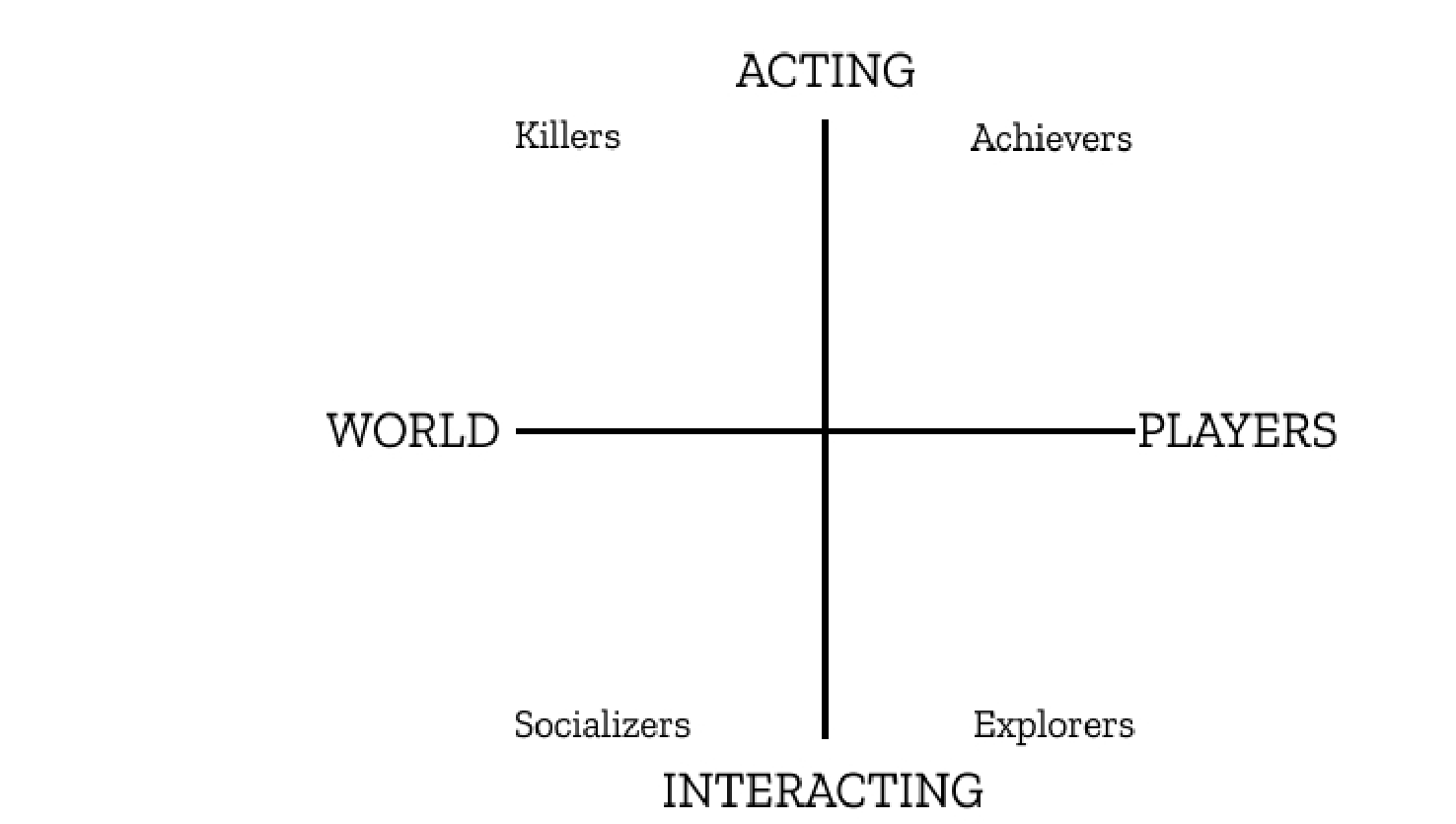
Figure 3.1 Player Interest Graph.
This graph describes players in terms of two (continuous) dimensions: How much they prefer acting on things as opposed to interacting with them; how much they prefer to direct their attentions toward the players or the world in which those players are present (as characters).
Achievers have fun acting on the virtual world.
Explorers have fun interacting with the virtual world.
Socializers have fun interacting with other players.
Killers have fun acting on other players.
Although other categorizations are obviously possible (and may well be superior), the use of opposing criteria for each of the axes in the Player Interest Graph shows that for this particular approach the categorizations are exhaustive.
As it stands, this graph tells designers quite a bit. If you want to increase the attraction of your virtual world to achievers, for example, you should include more content that involves acting upon the world; if you want to have more socializers, you should facilitate the capability to interact with other players, and so on. If you were to constrain the degree to which the world could be changed (for example by making areas out of bounds to certain groups of players), then you’d hit achievers and explorers but not socializers and killers. If you were to increase the capability to interact (for example by allowing players to keep notes on anything in the world they right double-click on), then you’d boost socializers and explorers but not achievers and killers.
It’s possible to do this with other dimensions appropriate either to particular virtual worlds or virtual worlds in general. For example, a MUSH might have axes for story-telling/story-building versus theory/practice. Someone who likes to teach other people how to role-play would be in the theory/story-telling quadrant, whereas someone who likes constructing new content would be in the practice/story-building quadrant. Designers will use whatever categorizations they find most useful.
It’s possible to do more with categorizations than merely state them and demonstrate them to be exhaustive, though. Having divided a set into four (or more) subsets, the question can be asked: What dynamics exist between the sub-sets? Are they independent (an increase in the number of people teaching how to build would have minimal impact on the number of people role-playing) or are there causalities (fewer people teaching how to build eventually leads to fewer builders)?
This is where it gets interesting.
Defined by the virtual world, that is, getting points and rising levels. ↩︎
In this context, they’re generally referred to as griefers. ↩︎
The word “killers” is perhaps unfortunate, given the misunderstandings that arise because of it; “dominators” is a less emotive alternative that some people prefer, although unfortunately it doesn’t imply a desire to dominate people (as with achievers, who want to ‘dominate’ the world). ↩︎
I also considered real/virtual, but didn’t feel it was accessible enough. Players/world deal in the manifestations of these concepts, and it is much easier to get a handle on. ↩︎
Dynamics
In the wild, what effect does increasing the number of wildebeests at a watering hole have on the number of lions in the vicinity? Lions eat wildebeests, so the more wildebeests there are, the greater the number of lions that will turn up looking for a meal. However, wildebeests flee en masse when they so much as sniff a lion. The more lions that show up, the fewer wildebeest will hang around waiting to be eaten. This will lead to a reduction in the number of lions, which will cause an increase in the number of wildebeests, and so on, until equilibrium is reached.
Suppose we were talking about a virtual world rather than a watering hole. Substitute “killers” for “lions,” “socializers” for “wildebeests” and you get a reasonable approximation of the relationship between the two.
This is an example of the dynamics of player types. Increasing or decreasing the number of players practicing one playing style can affect the number practicing another. This in turn can have knock-on effects, and so on, until eventually the system finds some point of balance.
There are two ways that player numbers can change (they can rise or fall) and 10 possible pairings of types (A/A, A/E, A/E, A/K, E/E, E/S, E/K, S/S, S/K, and K/K). Some of these are free of dependencies—increasing or decreasing the number of explorers has no direct result at all on the number of socializers, and vice versa. Others have effects of varying degrees. Based on empirical observations, the dynamics can be summarized as follows:
More achievers leads to:
Slightly fewer socializers
More killers
Fewer achievers leads to:
Slightly fewer socializers
Fewer killers
More explorers leads to:
More explorers
Slightly fewer killers
Fewer explorers leads to:
- Slightly more killers
More socializers leads to:
More socializers
More killers
Fewer socializers leads to:
Fewer socializers
Fewer killers
More killers leads to:
Fewer achievers
Slightly fewer explorers
Far fewer socializers
Fewer killers leads to:
More achievers
Far more socializers
Figure 3.2 shows these relationships.
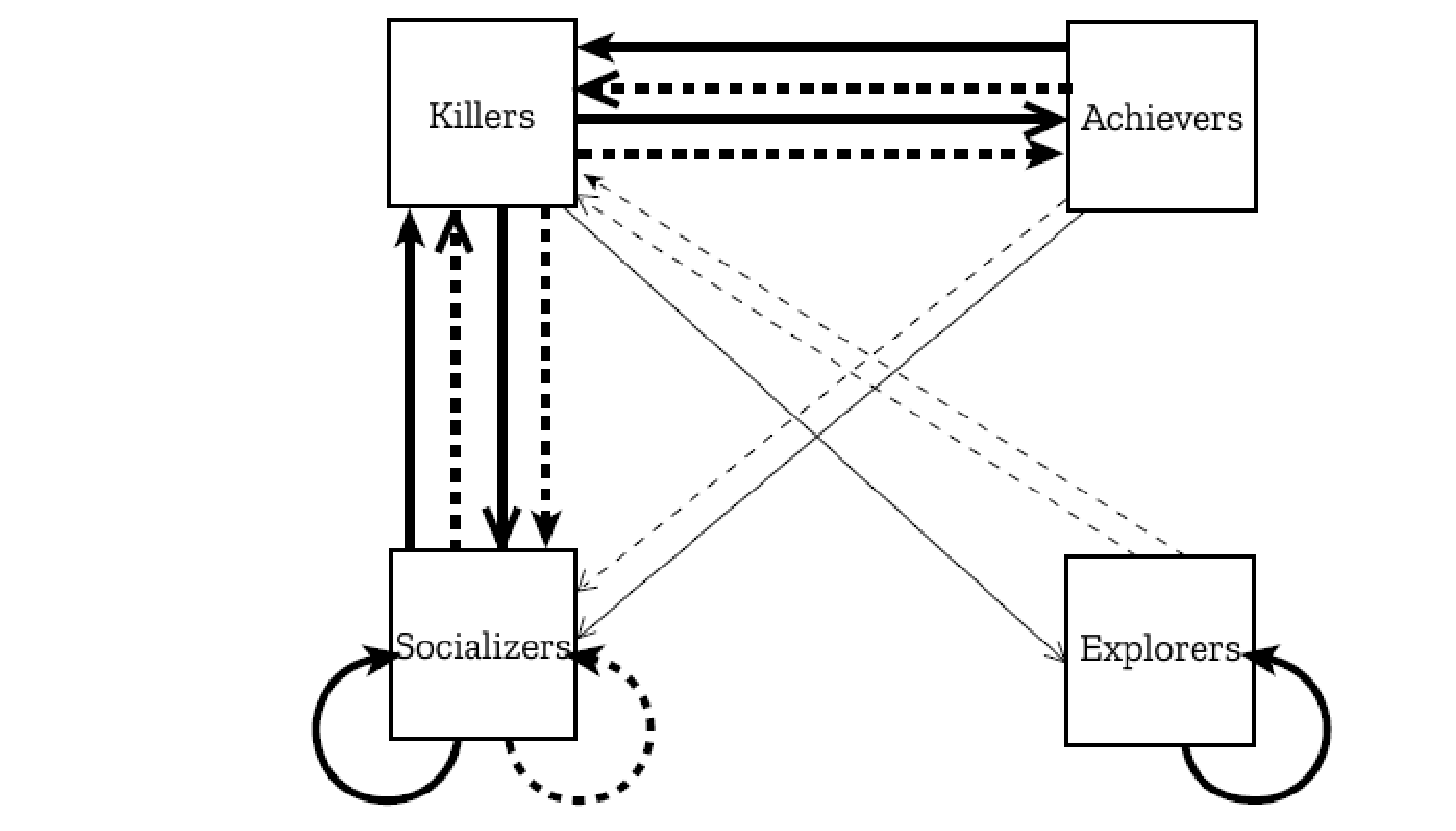
Figure 3.2 Influence graph.
Key: An arrow represents an increase (solid) or decrease (dashed) in the box from which it points. The effect on the box it points at will be either to increase (solid arrowhead) or decrease (open arrowhead) the contents of that box. The effect will be either slight (thin line), medium (medium line), or great (heavy line).
What Figure 3.2 shows is that most of the action concerns killers and socializers, where killer numbers are sensitive to those of socializers and socializer numbers are highly sensitive to those of killers. Explorers keep themselves to themselves, but have a mildly depressing effect on the number of killers; a virtual world can really only ever benefit by attracting explorers. Achievers and killers are in equilibrium, and there’s a negative effect on the number of socializers if the number of achievers changes (up or down).
How can this be used predictively?
As an example, suppose that for whatever reason (advertising, a new patch, the closing of another virtual world) the number of killers increased dramatically. What would happen? Looking at the influence graph, it’s clear that there would be a huge drop immediately in the number of socializers. Socializers are in an amplification loop with themselves—the more/fewer there are, the more/fewer will come/go. Thus, the number of socializers will drop even more until perhaps only a rump remains. Killers also have a lowering effect on the number of achievers. Lowering the number of achievers will reduce the number of killers. Either this will eventually reach some balance, or the numbers of both killers and achievers will drop so far that there are too few left to maintain a critical mass and the game will die.
By repeating this exercise for all player types, stable configurations can be discovered. It turns out there are four:
Type 1. Killers and achievers in equilibrium, with hardly any socializers and explorers.
Type 2. Socializers in dominance, with everyone else having only bit parts.
Type 3. A balance between all four types, with enough explorers to control the killers.
Type 4. An empty virtual world.
Of these, type 3 offers the best prospects for a world’s longevity (types 1 and 2 will tend toward type 4 eventually). However, it is not clear that a large-scale virtual world, with its inherent community fragmentation, could ever attain this state. This explains why most virtual worlds are either social (typified by MUCKs, MUSHes, and MOOs) or adventure (typified by DikuMUDs, LPMUDs, and the big, graphical games). In practice, among the general public there are large numbers of socializers and achievers in comparison to explorers and killers, so it’s just as well that types 1 and 2 are relatively stable.
After the underlying dynamics of a particular virtual world are understood, it’s possible for the live team to influence that world’s condition. If the number of socializers is dropping to the extent that the world is becoming “too” achiever-oriented, a simple solution might be to advertise the virtual world in a manner that would be more likely to attract socializers than achievers. Changes to the virtual world’s design can also help, for example by heavily increasing the challenge to achievers (so as to persuade them to go around in groups, which socializers like) or by adding socializer goodies (such as letting them write their own in-world newspapers). There are plenty of ways to do this 1. Solutions are easy to come by (if not necessarily easy to implement); you have to realize you have a problem first, though.
Incidentally, there is a possibility that a virtual world can fake the presence of a player type without actually having players of that type around. The type most amenable to this is that of killers. Players can tolerate being inconveniently beaten up by mobiles more readily than they can by fellow players, and mobiles have the advantage of being controllable. Surprisingly, there is a lot to be said for this approach; although it doesn’t replicate the effect of having killers exactly, nevertheless it can successfully approximate it to varying degrees. See the discussion on persona death in Chapter 5, “Life in the Virtual World,” for more details.
The original Hearts, Clubs, Diamonds, Spades paper lists over 30 examples. ↩︎
General Observations
I noted in Chapter 1 that many players of virtual worlds don’t consider themselves to be gamers, even if the virtual world is billed as a game. What’s more, they’re correct—they aren’t gamers.
People sign up to large-scale commercial virtual worlds because these are advertised as games, but once there they don’t necessarily want to play them as games; ironically, games have become the new “noble content.” Players have different ways of amusing themselves. Applying the player types categorizations:
Achievers see virtual worlds as games. Their aim is to improve, advance, and ultimately win (for some common, easily stated, world-supported definition of “win”).
Explorers see them more as pastimes, such as reading, gardening, or messing about in the kitchen. Reward comes from discovery and furthering understanding.
Socializers see virtual worlds as entertainment, such as TV, clubs, or concerts. Discussion of the performance and behavior of themselves and others is their main draw.
Killers see virtual worlds as sport. This is of the huntin’, shootin’, and fishin’ kind, rather than the running the 100-meter or the marathon kind 1. If the user base is large enough, some killers may treat virtual worlds as team sports—with themselves as captain or head coach.
It’s interesting to postulate how pitching a virtual world as something other than a game might work. To attract socializers, for example, a world could be portrayed as a sophisticated chat room with built-in toys that players can do things with; in this context, achievement is a mere by-product that arises when people choose to use the toys to play games of their own devising. This approach would apply well to something like The Sims Online.
Of course, by focusing on only one notion of what a particular virtual world “is,” there’s a danger that people will believe it is not for them and will stay away. Would achievers bother with The Sims Online if it didn’t at least nod in the direction of being a game? It’s only because of the growing opinion that computer games don’t have to be games (which was pioneered in part by The Sims itself) that non-gamers have come round to accepting them as noble content. However, if they entered a virtual world and found that it really was all game, they wouldn’t hang around for long. Part of a designer’s work is therefore to ensure that the philosophy governing what their virtual world is “about” is not too exclusive. If the design sends the wrong messages to players, it can alienate them.
On the other hand, there’s a risk of going too far: That by trying to please everybody, a designer can end up pleasing nobody. It can be fine to tailor advertisements to particular audiences: The movie Pearl Harbor 2 was successfully sold as a war story in America and a love story in Japan, for example. However, there can be problems when groups with different expectations meet: Japanese moviegoers would not necessarily have enjoyed Pearl Harbor had they been sharing a theater with Americans cheering the U.S. counter-attack. In describing a virtual world, it’s okay to tell all players the same thing; it’s okay to tell them the same thing in different ways; what isn’t recommended is telling them different things. There’s a distinction between saying “this is a game for everyone” and “this is a game for you.”
What designers tell players shapes the way a virtual world is perceived. “Tell” in this situation means through deeds rather than words: A world may be promoted as a place where basket-weavers are as respected as much as warriors, but when there are 25 different kinds of weapons and two different kinds of baskets, that’s not what it’s saying. This topic of how a design can (for better or worse) send messages to players is discussed in more detail in Chapter 5.
Using Player Types
Why use the player types model for virtual world design?
One purely pragmatic reason is that because it was the first such model, everyone knows about it; it therefore provides common ground for communicating ideas with other designers. This is by no means the only reason, though.
The model’s main strength is its categorization of players into the four particular types: achievers, explorers, socializers, and killers. It has its roots in a consideration of what people find fun in virtual worlds, and is therefore attuned to situations that might impact on this: all big design decisions, in other words. If you’re creating a virtual world and don’t have an actual user base yet, categorizing it along the lines the model advocates will give you some idea of how the players might take to a feature (or not); if you’re running a live game, the model will suggest how proposed changes might be received by existing players.
The dynamics that underlie the categorization are of less practical use to most designers. Occasionally it might be that a major, major alteration is planned, which will throw the balance so out of whack that some compensatory change will be necessary to stop a hemorrhage of players; this is not something that is an issue most of the time, though. When you add new functionality, it’s useful to run through the player types to be sure it doesn’t help or hurt any of them too much; it’s less useful to wonder what the next level of knock-on effects will be. Dynamics are useful for consultants looking at virtual worlds that have either no user base or a very ill one; for day-to-day design, categorization is the handier tool.
You don’t have to use this or any other model, of course. This one happens to have been applied successfully over the years to the players of a wide variety of virtual worlds, but that doesn’t mean another model might not help designers more. The main problem is that there really aren’t any other models to speak of right now; about the only other one in regular use categorizes players on the basis of their experience—“What will newbies make of this?” Perhaps the greatest service the player types model has rendered is to show that theoretical design aids can exist at all; if someone can produce a superior one, so much the better.
The player types model does have its limitations, of course, and designers should be aware of them. The main ones to watch out for are:
It doesn’t address how players change style over time. The classic path is killer to explorer to achiever to socializer, but others are possible.
It doesn’t account for players who appear to play one style while actually playing another. If your achievers regard killing as achievement, it’s bad; if your explorers see it as worthy of exploration, it’s a calamity.
If a virtual world is large enough that it can split into (geographical or social) sub-worlds, the model might apply separately to individual sub-worlds but not to the world as a whole.
It assumes that players are independent. For virtual worlds with large numbers of players, this may not be the case. Killers don’t often get along with each other, so in most worlds they play as lone wolves. However, in a large world where one of them can lead a gang of 50 impressionable achievers, their effect is somewhat magnified.
It assumes that virtual worlds are independent. Players might have cut their teeth in a different virtual world before visiting this one.
It can’t account for poor design. If your world has too few socializers, the model can suggest means by which to increase the numbers, but they may not work. It has no way of knowing you’re running a MUD played using mobile phones and that people just can’t be bothered to thumb in commands.
It is open to misinterpretation. Players aren’t always good judges of their own playing style: Many achievers seem to think they’re killers or explorers; some killers mistakenly label themselves as socializers. Asking self-appointed representatives of one type what they think of a possible major change could lead to a questionable result.
Beyond this, the model may apply but still be of little or no use. Designers of worlds that people play for reasons other than having fun (for example, to learn creative writing) have no real need of it; designers of worlds that people can’t have fun playing (for example, because the worlds are depressing or incomprehensible) have other problems they should solve first.
On the other hand, the model has been successfully applied beyond the confines of virtual worlds into domains such as online community management and tabletop RPGs 1.
Although designers working in areas related to virtual worlds may find the player types model flexible enough to be of use, the further they are away from the subject then the less likely the dynamics are to work. They can use it to inform, but probably not to prescribe.
I should point out that although this research has been used on a number of occasions to “prove” that game-oriented virtual worlds “need” killers, this is not the case. The model is descriptive, not normative: It shows what will happen if the proportions of player types changes, but doesn’t advocate one over another. If you want achievers but don’t want killers, you can have them; you need to be aware that without intervention the achievers won’t stay long, though. Similarly, if you design a game targeted at killers, it will require a major effort to stop the poor ones from quitting in frustration and the better ones quitting when there’s no one left to bully.
It is important to remember that even if the player types dynamics are functioning and changes are being made with an eye to the categorizations, it may all be worth nothing. External influence can easily overwhelm the model. If the virtual world crashes the whole time, or the customer service representatives are unusually surly, or the price triples, then players have some reason other than lack of fun to consider not playing. If that’s the case, designers should concentrate on high-profile changes of whatever nature they feel is appropriate—anything, so long as it will pull in some players after the problems are fixed. It’s no use trying to balance a player base when there are no players to balance; recover the players, then balance it.
Most of these external effects need only be planned for as contingencies, if at all. There is one, however, with which designers do need to be concerned as it is the very life blood of their virtual worlds: the newbie flow.
Footnote addicts who looked at the Knights of the Dinner Table comic book series after I mentioned it in Chapter 1 may be amused to consider the following mapping: Bob/killer, Dave/achiever, Sara/socializer, Brian/explorer. ↩︎
The Newbie Flow
Imagine that your virtual world is a bucket, and players are water. There are holes in the bucket through which the water escapes. If you don’t add water regularly, eventually it will all leak away. There may be a pool at the very bottom that isn’t high enough to reach the lowest hole—that’s you and your die-hard players. Eventually, even this will evaporate away, though.
All virtual worlds need a flow of newbies if they are to survive. It doesn’t matter how wonderful your world is or how dedicated your players are: If you don’t have newbies, you’re in big trouble.
The flow does not have to be constant, just regular. As long as your bucket is big enough to accommodate a sudden wave of newbies should one arrive (for example, because school is out, or because of TV coverage), it’s enough that the average inflow does not fall below the average outflow.
So far, so faucet/drain.
Designers don’t get to control where newbies come from directly, although by designing an appealing virtual world they can do so indirectly (as players tell their real-life friends how great it is 1). Newbies can sometimes show up on their own, having been looking for a virtual world that suits them and deciding to give this one a try. For small-scale virtual worlds, these two sources are often sufficient to keep everything ticking over nicely. Otherwise, if you want newbies, then you have to use marketing to entice them through your door.
Well, that’s not absolutely true: There is another possibility that I alluded to in Chapter 1—the newbie hose 2. This is where someone else has control of a flow of newbies and points it in your direction. The classic example is when a virtual world has links with a large portal that isn’t ashamed of it, as with those on AOL in the mid-1990s. This is not the only way a newbie hose can arise, though. The buzz among the first players of EverQuest was so great that normal word-of-mouth became effectively a newbie hose; Star Wars Galaxies got one by virtue of its license.
The advantage of a newbie hose is that it doesn’t matter how full of holes your bucket is, there’s so much water going into it that it’s always full. Hey, you can even add more buckets if you want. The disadvantage of the newbie hose is that sooner or later it either empties the tank or gets pointed elsewhere. When that happens, someone has to answer the very real question of where the newbies are going to come from instead.
The rate at which people leave a virtual community is called churn. It’s expressed as a percentage of the user base that leaves over a set time period (a month is implied, but other periods are possible). Thus, if you have 100,000 players in your virtual world and every month 5,000 of them fail to renew their subscription, the churn is 5%. This would mean that on average players would last 20 months before quitting. In general, the aim is to keep the churn as low as possible 3.
Companies don’t publish their churn rates, because the figures can affect share prices adversely. AOL, for example, used to run at around 3% churn, but when it was unable to reduce this it stopped releasing the data and emphasized absolute subscriber numbers instead; later, it advocated using the total time that users spent online as a measure of its increasing success 4.
Established virtual worlds have churn rates under 5% 5, which is considered excellent for this kind of product. A newbie hose masks churn, though. If a virtual world is growing by 3,000 players a month, everything looks rosy. However, that’s a net increase. If 3,000 people signed up and none left, it’s good; if 103,000 signed up and 100,000 left, it’s not so good. An August 2002 article 6 quoting SOE stated that EverQuest players stayed with the game for eight months 7. That means an average of one-eighth of EQ players quit every month—around 54,000 of them, in other words. Given that EQ was experiencing a net growth of around 2,300 players a month at the time 8, this suggests that they were signing up 56,300 new subscriptions. Attracting 56,300 new subscribers a month is very impressive; losing 54,000 is also very impressive, but for different reasons. A churn of 12.5% for a user base the size of EverQuest’s makes them very reliant on a newbie hose, which perhaps explains SOE’s decision to expand into the Korean market in 2003.
The importance of the newbie flow is so great that designers should put as little in the way of it as possible. It might be argued that those designers benefiting from the luxury of a newbie hose can concentrate on retention (that is, keeping people who have lasted a few sessions in the virtual world) rather than attraction; for the majority of virtual worlds, though, newbie-friendliness should always come before oldbie-friendliness. Most of the time, the two can exist in harmony anyway, with those problems that do arise only doing so because the designers forget one or the other. Sometimes, though, what interests oldbies can put off newbies entirely. Chapter 5 discusses an important example of this (the trickle-down effect) in more detail.
Player types can help with the newbie flow. They’re no use for absolute newbies, who are often so confused or shy that they simply don’t know what to do (therefore the first concern of designers is to persuade them to do anything at all!). However, once a player has found their feet, player styles apply. Many newbies will first want to ascertain the established norms of behavior (which can involve killer-style behavior), whereupon they will spend a period exploring the virtual world and their abilities within it. Having gained the necessary skills and knowledge, they can start to play “properly” as an achiever. Months later, when they have reached the top, they retire into the life of socializer. This is the killer to explorer to achiever to socializer path I mentioned earlier. Not all players follow this “main sequence,” of course, and not all of them follow it at the same speed. Someone who is at heart a socializer will soon decide that exploring and achieving is not for them, and will reach the final stage early; someone who is basically a gamer will achieve everything they can do, then find there’s little to do but chat or leave (so they’ll leave).
Coming back to newbie streams, then, the things that designers should concentrate most on for inexperienced players are enabling them to find the world’s behavioral boundaries quickly and providing plenty of interesting things to see and do that will help them develop their playing skills 9. Support from customer service greeters can make some of this run more smoothly in practice, but that doesn’t mean designers should shirk their responsibilities.
At this early stage, there’s a possibility that designers can affect the future playing styles of impressionable or open-minded newbies. A player who is an achiever in other virtual worlds may discover the joys of being an explorer in yours, if you let them see what they’re missing. If you want more of one player type than another, then making it appealing to newbies is a way to achieve your goal. This is not to say that players should be given the hard sell: It’s about presenting opportunities, not arm-twisting. EverQuest 2 has a particularly impressive scheme for bedding in newbies (even though what they’re bedded into isn’t a whole lot different from EverQuest 1).
A balance of player types among newbies isn’t important. After they jump off the main sequence and start to play in the style that best suits them, that’s when they join the majority for which standard type dynamics apply. An overall balance among non-newbies is important, because balance leads to retention. Meanwhile, the next batch of newbies is beginning the process, and the wheel turns once more.
We’ll be looking at the concept of “main sequence” in some detail later on in this chapter. It gets a Whole Lot More Complicated.
Hopefully not so great that they have lost all their real-life friends by the time they emerge from it. ↩︎
The term comes from Clement Chambers, whose company On-line ran Federation II in the UK after CompuNet closed down. He also coined the prefix massively multiplayer. ↩︎
For non-commercial virtual worlds, churn is harder to measure because you can never be sure when someone has actually “left.” ↩︎
Actually, 3% churn isn’t bad for an online service. A CompuServe executive once told me its churn ran at 10%, although that may have been part of a sob story to convince me to take a cut in the royalties for British Legends. If it was, it didn’t work. ↩︎
MUD2’s is approximately 4%, for example. ↩︎
Tim Green, Brave New World. London, MCV, Intent Media, August 30 2002. ↩︎
I assume this does not include players who quit in the first, “free” month (for which churn is by far the worst). ↩︎
According to SOE press releases, EverQuest had 400,000 subscribers in late June 2001 and 430,000 in late July 2002, which gives an average net gain of about 2,300 per month for that period. ↩︎
But not so many that the newbie is overwhelmed. With graphical virtual worlds, there is a case for providing special newbie-friendly client skins, so as not to expose newbies to the full majesty of what awaits. Textual worlds do this implicitly by only initially telling newbies about the commands they need to know—the rest can be found deeply nested in help trees or through conversation with more experienced players. ↩︎
The Bartle Test
The final point to mention about player types is the Bartle Test.
I’m often asked about the Bartle Test, on the grounds that because it bears my name I must be responsible for it. Sadly, I’m not. The test is the brainchild of Erwin S. Andreasen and Brandon A. Downey, who wrote it in response to my player types paper so as to test the theory.
The Bartle Test is an online binary-choice questionnaire 1 that players of virtual worlds can take to discover what player type they are. As such, it offers potentially very useful information for designers. Are players mainly achievers and socializers, as empirical observation would suggest? Just how numerous are killers? Are there large numbers of silent explorers out there that no one knows about? How do the different codebases compare? Answers to these questions could provide solid figures that would help designers visualize the make-up of the user base they have or they want.
The result of having taken the Bartle test is a Bartle Quotient, expressed as three letters. For example, ASK 2 means you’re foremost an achiever, then a socializer, and then a killer. The first letter in the result therefore indicates a person’s primary playing style.
Of the 176,000+ people 3 who had taken the test by April 2003, 29% rated as explorers, 25% as socializers, 23% as killers, and 21% as achievers. Of the combinations, SEA was highest at 12%, followed by ESA at 10% and EAS at 8%.
These figures almost certainly do not reflect anything like the actual split among players. Reasons for this include
Participants in the test are self-selecting. Most don’t hear about it until they’ve played a virtual world for a while, therefore they are not representative of the general user population.
It is clear from the nature of many of the questions what is being tested for, which means players can give the answer they believe will lead to a cooler rating (for example, explorer or killer) rather than the truth.
There is no “neither” answer. A socializer being asked to choose between defeating an enemy and exploring an area may as well flip a coin to answer, given that they don’t particularly care for either.
Some answers favor two or more types. Killers and achievers would probably both prefer defeating an enemy to exploring an area, but the questionnaire can’t disambiguate them.
Ties aren’t handled very well. If you choose achiever and socializer answers with equal frequency, you will be recorded as favoring A over S.
Just because the test is flawed, that doesn’t mean it’s useless, however. It helps players, for sure, because it lists the virtual worlds that most closely match each player type combination. So many people have taken the test that it has a large database of scores for individual virtual worlds (over 700 of them); if you end a test with a rating of ASK, you’ll be shown a list of the five virtual worlds that have the most players also rating ASK, and the actual percentages involved. Alternatively, if you’re a killer and want to find a game full of socializers to annoy, you can look at the overall statistics and find that out too. The figures may not be formally accurate, but they’re pretty good in relative terms. If one virtual world scores fewer achievers than another, the chances are it really does have fewer achievers 4.
For designers, the overall average scores aren’t too helpful as they are skewed by the popularity of the virtual worlds from which the figures are derived. The ratings for individual virtual worlds are of more interest (see Table 3.1).
Table 3.1 Bartle Quotients by Virtual Worlds
| Ultima Online | EverQuest | Asheron’s Call | Dark Age of Camelot |
|---|---|---|---|
| SEA 11% | ESA 12% | ESA 12% | SEA 8% |
| ESA 10% | SEA11% | EAS 10% | ESA 8% |
| EAS 8% | EAS 10% | SEA 8% | EAS 7% |
This shows the three top-rated quotients for each of the first four virtual worlds to obtain results from 1,000 respondents. There are obvious similarities: None of these quotients involve killers 5 and none of them place achievers first. The actuality may be different, of course (EQ is achiever heaven, but you wouldn’t know it from this set of data). However, as relative values they allow some conclusions to be drawn:
UO and EQ are fairly similar, although UO allows a little more variety (its ratios are slightly lower).
AC is heavy with explorers—exactly the kind of people who would be expected to like the idea of story arcs.
DAoC accommodates playing styles less rigidly than the others (its ratios are much lower). This is perhaps because many of its players cut their teeth on UO, EQ, or AC but were unsatisfied; DAoC (with its RvR system) could provide a different experience, so they switched.
Bartle Test results don’t allow designers to infer much about an individual virtual world in isolation. However, the relative effects of a major difference between otherwise similar virtual worlds (for example, ones sharing a codebase) can be judged. If a designer is considering such a feature for their own game, some indication of the possible effects on its user base can thus be derived.
For the record, I haven’t taken the Bartle Test. This isn’t because I object to it—I don’t. Rather, it’s because I can no longer play virtual worlds for fun, so I can’t answer fun-related questions. Any responses I did give would depend solely on the player I was role-playing at the time, which would rather miss the test’s point.
ASK is the rating you get if you answer all the questions with the first of the two options presented. ↩︎
Their numbers grow by over a hundred a day. ↩︎
This makes MUD1’s perennial placement in the bottom five for socializers all the more interesting. ↩︎
This may be because killers tend to get banned from these virtual worlds. ↩︎