The Celebration of Identity
The Celebration of Identity
I have a story to tell.
Polly’s Tale
So it’s a weekend in 1980. I’m in a computing laboratory with 15 students, all of whom are playing my game, MUD. This being 1980, and this being a computing laboratory, and this being a weekend, everyone here is male. The female computer science undergraduates have better ways to occupy themselves (mainly concerning male noncomputer science undergraduates).
I look around at my friends and realize that chances are not one of us has ever had a girlfriend 1, nor have we any prospect of ever finding one. We regard all the female students on our course as people rather than as girls, and we’d no sooner hit on one of them than we would on each other. We’re desperately short of social skills. The non-computing girls on campus are split between those who shy away in horror and those who laugh in our faces. It’s pointless even trying: We’re inexperienced and out-gunned.
None of us is happy with the situation, but we’re resigned to it. We suffer in silence together. Here we are on a beautiful weekend, sitting around computers writing and playing games.
It’s so sad! I see decent, honest, likeable guys becoming more and more set in their defensive, insular ways. They’re not bad people, but they’re hiding themselves away! They need to grow their personalities, not retreat into them! Yet how can they do so, knowing that every attempt to change will inevitably end in humiliation? There ought to be some means by which they could behave in ways that they wouldn’t ordinarily, yet be safe from the consequences of failure. If they could experiment, could make adjustments, could see themselves succeeding, could discover and emphasize those aspects of themselves they most admired; might this not equip them to behave a similar way in real life?
Then I look at my screen, and a thought occurs to me. (To be continued…)
Or boyfriend. Essex University was politically correct years before the term came into vogue. ↩︎
To Be, or What to Be?
The celebration of identity is the fundamental, critical, absolutely core point of virtual worlds.
Yes, that is quite some assertion.
Except for those worlds that people play for purely practical reasons (such as virtual classrooms), everything that players do ultimately concerns the development of their own identity: who they are. It’s why achievers achieve, explorers explore, socializers socialize, and killers creep up from nowhere and batter you with a stick.
You can’t design for it, because everything affects it; yet for the same reason, you can’t not design for it—it touches everything you do. It’s portable, so it’s beyond a designer’s reach—it can be used across many virtual worlds 1. It’s unquantifiable—you can’t rate for “identity” the actions, objects, structures, or anything else that’s programmed in. You can design for certain expressions of identity, and you can design ways to channel these expressions, but you can’t do so systematically. Identity flowering is an inherent property of virtual worlds; if you control it or repress it or subvert it, the changes you’d have to make to do so would leave you with something that was no longer a virtual world.
Okay, you’ve let me babble on about this for a couple of paragraphs, but enough is enough. Ask a dozen players why they play virtual worlds, and you’d be lucky if even one gave an answer that even hinted at “the celebration of identity.” They usually reply in terms that categorize them as being an achiever, explorer, socializer, or killer (which is how I derived those types in the first place). To convince you that identity really is the fundamental, critical, absolutely core point of virtual worlds, I’m going to have to provide some evidence.
Fair enough. Let’s start with some empirical observations.
Players of virtual worlds often notice that they behave differently in the virtual world than they do in real life. They may be more (or less) assertive, talkative, flirtatious, argumentative, pensive, creative—the list just goes on. For some people, the changes are more dramatic than for others, but most players would concede that they do seem
to have a virtual personality that’s different from their real one. Generally, they like their virtual personality more than their real one, but not always. Reflecting on this difference will cause them to make judgments about themselves, therefore their personality (virtual or real) will either shift 2 or the two will remain in conflict until the issue is resolved.
Most players maintain several characters in a virtual world (if that world allows it). Some may be for specific purposes (for example mules, to do drudge work for the main character) and others may be the result of failed experiments (“Hmm, so elven thieves don’t really work”). There are often two or three, though, that the player uses regularly, depending on their mood. If they’re depressed, they may choose their dark, brooding magic-user; if they’re angry, they may choose their barbarian warrior to let off some steam; if they’re wistful, perhaps their bard would suit best. In these situations, the players are using their various characters in the virtual world to work through their real-life issues. They’ll grow as people because of it.
Suppose you had poor social skills, and found a social environment where this didn’t matter. Merely by interacting in that environment, your skills would improve. In real life, you might be shy and awkward, but if you found a place where wild self-expression was not only permissible, but also positively encouraged, you could suddenly bloom. In becoming accustomed to this virtual personality, you might gain sufficient confidence to be able to maintain it in real life. You wouldn’t necessarily even have to think about it, it could just happen. Wouldn’t that mean you’d developed as a person?
So, after those three cod-psychology examples we can probably agree that it’s possible—common, even—for people to exhibit different behaviors in a virtual world and in reality. This was noticed by academics early in research into virtual worlds. Amy S. Bruckman’s groundbreaking paper on the subject 3 was published back in 1992.
What does this have to do with identity, though?
Well, in the examples I gave there is a separation between the player and the character. This is immersion at the character level. If it stays that way, the player isn’t really going to mature. However, for virtual worlds it’s almost unavoidable that the character and the player will tend toward each other. If you like your virtual self, you’ll take on its characteristics; if you keep mood characters, you’ll gradually stop playing all but one; the social skills you acquire will become skills that you use. Ultimately, you advance to the final level of immersion, where you and your character become one. One individual, one persona: identity.
Okay, so players can create separate selves, and over time unify the best aspects of them into a single identity. That doesn’t mean it’s inevitable, though. This phenomenon of a separate “online self” appears in many other computer-moderated activities, from email to chat rooms to forum postings. Why can’t they raise identity issues if virtual worlds can?
The answer is that they do, but nowhere near as well. Virtual worlds, armed with a potent combination of environment and fellow players that’s unavailable to other online applications, are able to present people with a stream of challenges; an individual’s response to each challenge helps define that individual. The challenges of email, chat rooms and forum postings are much narrower in scope, weaker in intensity and rarer in frequency.
This reaction to challenges is how most identity development occurs. Although mood characters and the like make good, neat, psychology parcels to show to cynics, they’re overt; the main identity action is covert. Things happen, which present challenges; your reaction to these causes you to acquire insights, which in turn lead to minor readjustments in your understanding of yourself (that is, your identity). Examples: Dealing with responsibility, relationships, unfairness, success/failure, betrayal, strangers, and so on.
These aren’t personality change issues. It’s not that you stop being a shy loner and are suddenly compelled to transform into an outgoing extrovert; rather, it’s that you were always an extrovert, you just didn’t realize it. The virtual world lets you try being one, and your opinion of yourself changes as a result of how it works out. If you weren’t an extrovert at heart, then you wouldn’t make the change; the extrovert virtual you would drift toward the introvert real you, rather than the reverse. It can’t make you something you aren’t.
Virtual worlds enable you to find out who you are by letting you be who you want to be.
Not everyone necessarily wants to find out who they are, of course. Others do, but don’t like it when they learn the answer 4. Not everyone wants to change, and not everyone likes challenges. Some people may thus be attracted to virtual worlds by the promise of identity freedom, but become increasingly angry and frustrated—unable to leave, but unwilling to do what is necessary to stay. It’s particularly sad when an individual takes a harsh lesson but doesn’t learn anything—continually acting out rather than working through a difficulty. Fortunately, this doesn’t happen very often, but when it does it can be somewhat disruptive.
Incidentally, if you are at all interested in the psychological and/or psychotherapeutic value of virtual worlds, you should look at Life on the Screen 5, by Sherry Turkle (if you haven’t already). Chapter 7, “Toward a Critical Aesthetic,” in particular is directly relevant to the subject, and includes a number of interesting case studies.
So, to summarize: For the great majority of players, virtual worlds encourage them to present different sides of themselves in a safe environment; challenges arise in the virtual world which enable them to reflect (consciously or otherwise) on their responses to those challenges, which causes them to develop a greater understanding of themselves; over time, this leads to a gradual merging of the virtual side and the real side, as the player becomes increasingly attuned to their persona.
The persona level of immersion isn’t the end of the journey. You’ve reached the top of a hill, but there may be another one that’s higher: There may be a better you. Thus, people will always create new characters and try out new ways of self-expression. Besides, self-affirmation is good, too.
Hey, you’re an Eastern mystic, and you didn’t even know!
And beyond. Many players like to write fiction about their characters, for example. ↩︎
This is called slippage in psychology literature. ↩︎
Amy S. Bruckman, Identity Workshop: Emergent Social and Psychological Phenomena in Text-Based Virtual Reality. MIT Media Laboratory, 1992. ftp.cc.gatech.edu/pub/people/asb/papers/ identity-workshop.rtf. ↩︎
Some people really are total jerks. ↩︎
Sherry Turkle, Life on the Screen. New York, Simon & Schuster, 1995. ↩︎
Identity and Identification
Players play virtual worlds in order to be themselves.
Well, perhaps not quite all of them do, but it’s true of those who play for fun. Even in game worlds, some people will be there for specialist reasons (play-testing, customer service, spying from some competing game); none of these individuals would necessarily have any inclination to become immersed, and those that do would be professional about it. There will also be a few people who are in the process of “getting” what a virtual world is about; these will mainly be insufficiently immersed newbies, but occasionally there are individuals who never “get” what virtual worlds are about but play nevertheless (generally, to the irritation of everyone else). Most of the players will be there because of the freedom to be themselves that the virtual world offers, though.
People who don’t play virtual worlds (but have tried them) find other ways to be themselves. It has been argued that one of the reasons more men play virtual worlds than women could be because in modern society men have less opportunity to experiment with their identities in real life 1. For players, though, virtual worlds afford an unmatched ability simply to be.
Let’s look at this a little more analytically, and see if there’s anything that designers can do to make this salute to identity any easier.
We should begin by noting that identity is not the same as identification, although the two are related. Identification is the modeling of the self on some ideal. For players of virtual worlds who might sense the possibilities of identity exploration without really understanding how to invoke it, the provision of ideals can help. This is why many virtual worlds have a class system.
The idea is that the individual takes on board those aspects that define the ideal, because these are what the individual admires. They provide a target—something to shoot for. If a proposed role model exhibits other features that conflict with an individual’s sense of self, that role model is not suitable as an ideal. It’s therefore easier to identify with an abstraction rather than something concrete, because abstractions present fewer features; you can flesh out what isn’t mentioned without hitting contradictions.
This would imply that the lower an ideal’s detail, the better. Sure enough, many virtual worlds have dozens of classes for players to peruse. The disadvantage of this approach is that the fewer qualities an ideal presents, the less rounded it is, and therefore the flatter it makes those people who aspire to it seem. An ideal with a single outstanding feature leads to players who are defined by that single outstanding feature, that is, who are one-dimensional. One-dimensional characters don’t make for riveting movies, and neither do they make for enthralling virtual worlds. Many virtual worlds with character classes therefore also have character races, to provide another dimension (although there tend to be specific class/race combinations that work better than others, so in practice the choice isn’t quite as wide as it may appear).
Whereas identification is about projecting your self-image onto some ideal, identity is about projecting it onto yourself. The former can help the latter, but has neither its extent nor its fidelity. If it goes too far, it can be counter-productive. Identification is allowing yourself to be defined by an image 2; in excess, it can therefore lead to a conflict between personal identity and that perceived of the ideal. A painting doesn’t change, but an artist must. If a virtual world commits a player to identifying with a fixed set of ideals, there will be problems when those ideals are no longer appropriate.
Identity is a product of thought, manifested by expression (actions, words). It has to be flexible, so it can wander, focus, be reborn. It also has to be true. A false image may be projected for the benefit of other people, as a way to influence them; individuals can’t lie for long to themselves, though—that is, if they can see themselves. In the real world, this can be difficult.
Virtual worlds provide people with a mirror. In a virtual world, you can see yourself. You only see what you show to the mirror, which may not be what everyone else sees, but it’s more than enough. With identity, the question is how much you like your reflection; with identification, it’s how much you believe it.
Virtual world designers have some control over this. They get to provide the ideals; they get to make the mirror. As I said earlier, though, they can’t do this systematically. You can’t draw a graph with an “identity” axis and place players at various places along it. The best you can do is to assess the likely consequences of their progression to greater maturity. To do that, you need to know the course that progression takes.
Progression
I mentioned earlier the main sequence that charts player type drift. This gets its name from the main sequence of star development used in cosmology 1. Players typically start off testing the immediate bounds on their behavior (killer) then begin to acquire knowledge of their environment (explorer); following this, they apply their knowledge (achiever), in the course of which they forge bonds with other players; finally, they retire from this and spend their time chatting with their friends (socializer).
Sometimes, people stay in one area. Long-term killers will often be youngsters who have feelings of inferiority 2 and need constantly to validate their worth to themselves. Long-term explorers know they have the ability to apply their knowledge, and feel no urge to demonstrate the fact to others. That said, a good many people follow the main sequence the whole way.
There’s a flaw in this argument, though. As people grow in virtual worlds, their real selves and their virtual selves gradually become one. Because socializer is the last step on the main sequence, all socializers should be immersed to persona level. They’re not. You can start as a socializer, socializing effectively while being barely immersed to avatar level. Your development is due to social challenges rather than environmental ones. This rather undermines the use of player types in predicting the effects of growing maturity, doesn’t it?
As it stands, yes, it does. There is, however, an interesting solution.
My original work for Hearts, Clubs, Diamonds, Spades: Players Who Suit MUDs evolved from summarizing a discussion among the players of MUD2 that ran from November 1989 to May 1990. The paper as finally presented concerned only the actions and interactions between mortals (that is, normal players); it did not make particular reference to wizzes (that is, players trusted with administration powers—this is MUD2’s elder game). Wizzes 3 had already played the game in its entirety, as that was the qualification to be a wiz; therefore, they were on the whole no longer concerned with the virtual world per se, just in its inhabitants. There were a few explorers who made wiz better to aid their exploring, and a few achievers who regarded building as a competitive act; the majority, though, were either socializers or killers.
In separating wizzes from mortals, I noticed that there were some very distinct behavioral differences between the wizzes themselves. Wizzes were keen to articulate their beliefs about what they and their peers should and should not do to manage the game, as there were particularly strong conflicts between certain groups. Therefore, at the same time I constructed the player interest graph (refer to Figure 3.1) for mortals, I constructed a similar one for wizzes. The players/world axis was not relevant here (because nearly all wizzes were at the players side); in its stead was a different axis that rated the degree to which wizzes did things in an explicit or implicit 4 fashion. Explicit wizzes favored the known over the unknown, realism over idealism, the overt over the covert, expectation over surprise, and order over disorder.
Note that “explicit” here is meant in the general sense of the word: leaving nothing implied. It’s not intended to have any “explicit photographs” style overtones. In computer language semantics, explicit means data, implicit means code; in AI terms, explicit means knowledge, implicit means skills. That’s how I mean it.
There were a number of conflicts suggested by this implicit/explicit analysis, which led to some interesting underlying dynamics (and alarming consequences for inter-wiz balance). However, as the graph was specific to the relatively small set of administrators in a game-oriented virtual world that selected them by unusual means, I felt it would have distracted from the main thrust of my player types model had I presented it in my paper. I therefore left it out.
Perhaps, though, it doesn’t just apply to wizzes?
What would happen were we to incorporate this implicit/explicit dimension 5 into the basic player types model? Specifically, would it help us differentiate between sub-types of the player-oriented styles, killer, and socializer?
Yes, it does 6. We get:
Politicians. Players who act in an open fashion on other players. Whether you view them as inspired, visionary leaders or interfering, self-serving busybodies depends on how gullible or cynical you are.
Networkers. Players who interact openly with other players—even complete strangers—on any and all subjects. Less charitably, gossips.
Friends. Players who interact primarily with people they have known a long time and with whom they have deep bonds (often forged through adversity). They do not feel bound by the conventional rules of interaction, because they understand each other so well.
Griefers. Bullies prepared to use force or other unpleasantness to get their way or be noticed.
Figure 3.3 shows this as a graph.
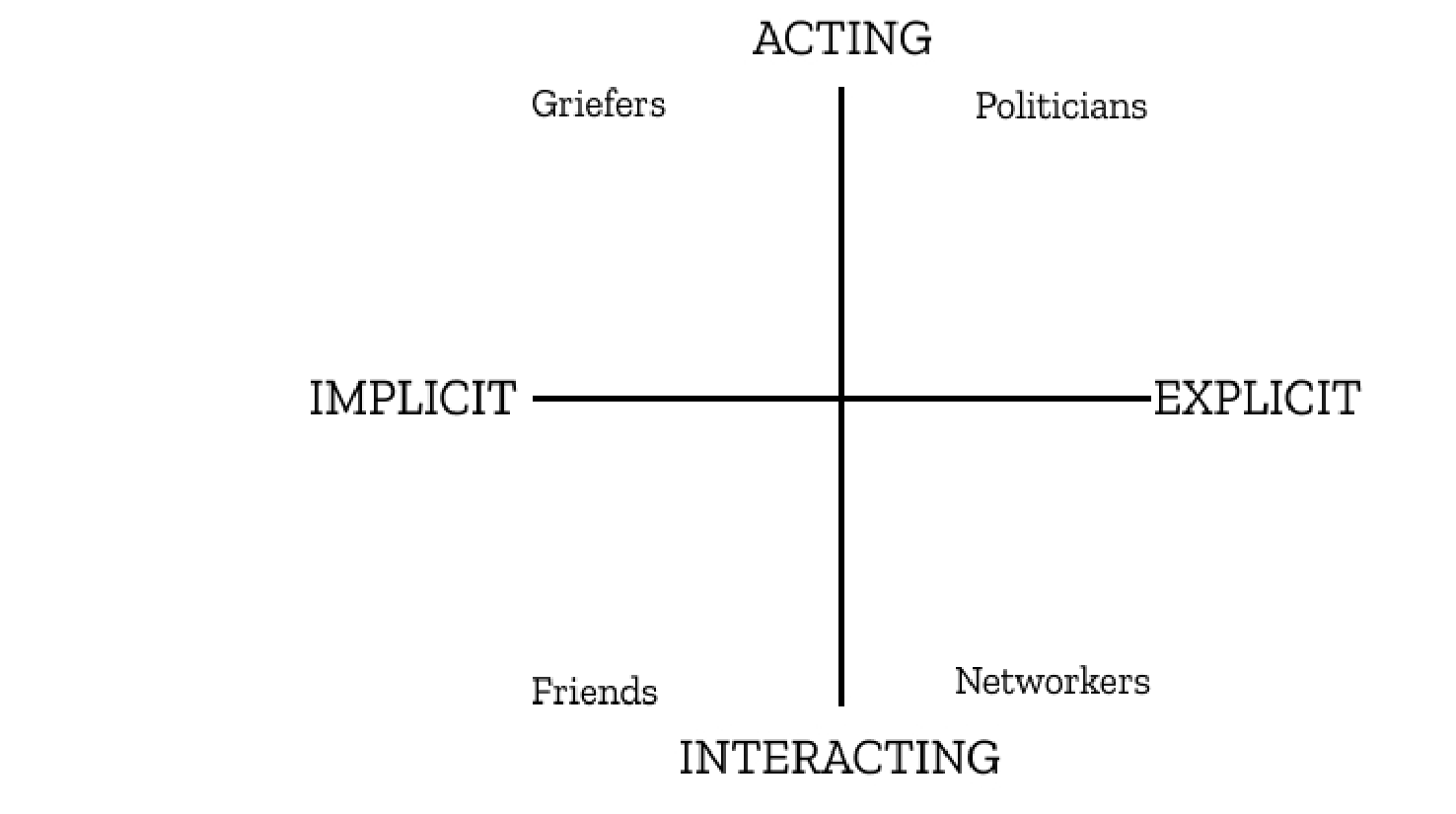
Figure 3.3 Players-oriented Player Interest Graph.
If this served only to clear up some of the confusion about the different varieties of the killer type (griefers and politicians) it would have done its job. However, it’s not quite a one-trick pony.
What happens when a player-oriented newbie enters a virtual world? The first issue many of them face is coming to terms with the fact that they are part of a community. Some will immediately comprehend the situation, but not everyone. Those that don’t will objectify other players, treating them as helpdesks, servants, gophers, and sources of experience points or kit. The reaction of the other players to this approach will cause all but the most mule-headed newbie socializer to understand fairly rapidly the social mechanics of the world. They can then move on to the business of getting to know people. To make friends with someone, you need to meet them, which means you have to network. Some people you won’t like, and some won’t like you, but after a while you’ll find you hang out with the same, relatively small group of people most of the time and be acquainted with many more.
Your group will almost inevitably experience conflicts, both internal and external. Perhaps several people want to be leader, or don’t like where the leader is taking them. The group may grow too large, or too small, or otherwise become dysfunctional. Environmental changes could trigger problems—a change in the way the virtual world works, for example, or a loss of group status. Ultimately, everyone in the group has a view and will at least some of the time want to impose it on the other members—even if it’s only as a form of self-defense. The trials that result put big stresses on relationships, some of which may break down irrevocably. Eventually, though, players will come through with a fuller understanding of themselves and of their friends. Their earlier ties will have been strengthened, and they will at last be able to settle down and appreciate one another.
What we have here is a main sequence for socializers: griefer to networker to politician to friend. Drawn on the graph 7, it’s the same reverse-alpha shape as the standard main sequence, which is nice. Back in two dimensions, it would be killer to socializer to killer to socializer, but it’s less obvious what’s happening when flattened that way.
At this point, we can see where F. Randall Farmer’s Path to Ascension fits in. This is perhaps unsurprising, given that Habitat was a socializer-centric system. Ignoring the “non-player” caretaker and geek god roles: Motivators map onto politicians; actives and passives both map onto networker (actives being more immersed than passives) 8.
So, having added an extra dimension, the obvious question to ask next is: What—if anything—does adding an extra dimension buy us concerning the world-oriented players (achievers and explorers)?
Well, the subdivisions are relatively easy to construct:
Planners. Organized achievers, who decide what they want to do then go off and do it.
Scientists. Explorers who experiment in a thorough, methodical fashion.
Hackers 9. Explorers whose understanding of the virtual world is such that they can proceed purely by intuition.
Opportunists. Achievers who go where their fancy takes them.
Figure 3.4 shows the resulting 3D graph.
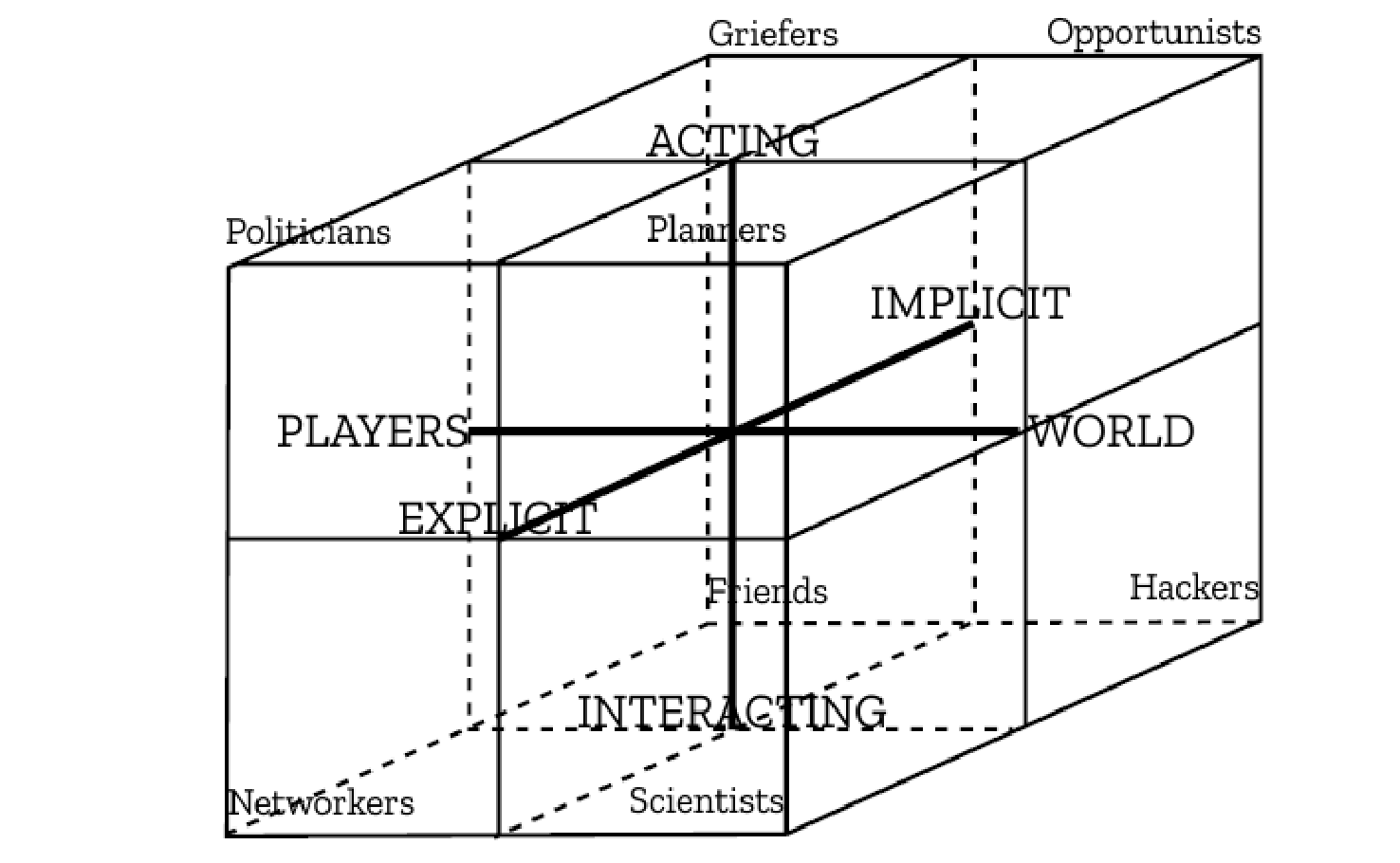
Figure 3.4 3D Player Interest Graph.
Whether this is of tremendous use is another matter, of course 10. Instead of four player types, we now have eight: opportunists, planners, politicians, griefers, hackers, scientists, networkers, and friends. The conflicts between some of the eight are meaningful (for example griefers versus planners), but for others the old types work just as well and are better at encapsulation (for example socializers versus achievers).
If having more categories doesn’t deliver more tools for designers, there’s little point in designers using them. Mere categorization doesn’t itself guarantee utility, even if it can be shown to be inclusive (as this one can) and is easy to validate empirically (as this one is). After all, adding a dimension for the time of the year in which a player was born would be inclusive and verifiable, but designers would find it of very little general efficacy 11.
Concerning our current discussion on player type progression, though, the addition of an extra dimension does have an effect for world-oriented players: It gives another sequence—opportunist to scientist to planner to hacker. We also can “unflatten” the main sequence (killer to explorer to achiever to socializer) from 2D into 3D, giving griefer to scientist to planner to friend. Tempting though it is to look for a sequence matching this of opportunist to networker to politician to hacker, this can’t be validated empirically: People simply don’t follow that career path. However, there is a minor fourth sequence, for opportunist achievers who learn by networking rather than by experimentation. This gives us:
Griefer to scientist to planner to friend (main sequence)
Opportunist to networker to planner to friend (minor sequence)
Griefer to networker to politician to friend (main socializer sequence)
Opportunist to scientist to planner to hacker (main explorer sequence)
At last we’re getting close to a model good enough to use for something. If designers can assess how players are likely to mature, they can account for their progress in their game designs. We’re not quite there yet, though.
The Hertzsprung-Russel diagram: Map absolute visual magnitude against spectral. The main sequence, on which most stable stars lie, runs roughly diagonally from high luminosity/low temperature to low luminosity/high temperature. ↩︎
“Ha! You call that an inferiority complex?!” ↩︎
The term is gender non-specific, meaning “wizards and witches.” ↩︎
For MUD2-specific reasons to do with the nature of the wiz invisibility command, the original axis labeling was open (explicit) and closed (implicit). ↩︎
Readers of Michael Moorcock and players of D&D can use law/chaos if they really must, but it’s not quite a match. ↩︎
Unsurprisingly, as obviously I wouldn’t have mentioned it otherwise. ↩︎
For the record, this also works on the original, wiz-specific graph. ↩︎
This suggests that at least in some cases, refining the model to account for gradations of immersion may be useful. ↩︎
This is in the traditional sense of the word, not the break-into-your- computer-and-erase-your-data one. ↩︎
Tools are only objects if they have no use. What’s more, it’s far better if the tool is designed to fit the problem than if the problem is designed to fit the tool. I don’t want to be a man with a hammer looking for things I can nail. ↩︎
Sorry to break the bad news to any astrologers among you. ↩︎
Development Tracks
The thing is, those sequences overlap. People can switch paths, if they have some moment of epiphany. Someone could go griefer to scientist (main sequence) to planner to hacker (explorer sequence). They could go opportunist to networker (minor sequence) to politician to friend (socializer sequence). They’ll tend to keep to whatever path they began on, but sometimes they decide to go a different way when they meet a fork in the road 1. Writing the sequences out linearly gives Figure 3.5.

Figure 3.5 Player development tracks.
From Figure 3.5, we can make a number of observations. It’s immediately apparent that there’s an oddity with politicians. Although people can become planners by applying knowledge they learned themselves (as scientists) or from others (by networking), for politicians only networking works as a qualification. Similarly, although planners can go on to become friends (forged through adversity) or hackers (understanding the world almost spiritually), politicians only ever go on to become friends. Designers can therefore be fairly confident that their world’s politician-friendly features should not be deeply hard-coded (because no one who experiments with them is going to use them) and that politicians should not be given too much ability to affect the physical structure of the world (because they’re never going to be attuned to it).
Another point that the development tracks show is that the elder game 2 (that is, what they do having played through the virtual world) would work best if it aimed at providing tools for people to tinker with the world or to enjoy one another’s company. Many textual worlds allow players to become builders once they’ve “won”; others provide private gathering places where players can sit and discuss the issues of the day. It’s certainly possible to have an elder game of a different kind, for example, by allowing players to repeat their time as a planner or politician in a different manner, but it’s less satisfactory for individuals that way 3. Only if the elder game is radically different from what went before will players begin development from scratch again.
Designers can take advantage of the fact that immersion is related to how far a player has proceeded in their development. Most networkers will not be deeply immersed, for example, therefore a designer could argue that it’s okay to put in immersion-breaking communication systems that facilitate networking. Most planners are immersed, therefore a designer might decide that statistical information regarding the operation of the virtual world is not available from within it: Players might know from a web site that their sword is a hackmaster +12, but when they bring it up on their inventory the number is represented descriptively or graphically instead.
As a more general comment, Figure 3.5 shows that identity paths progress in the same way; furthermore, this links directly to the 3D player interest graph (refer to Figure 3.4). The original 2D player interest graph (refer to Figure 3.1) is the same as the 3D graph (refer to Figure 3.4) with the implicit/explicit axis removed. If we take out the players/world axis instead, we get Figure 3.6.
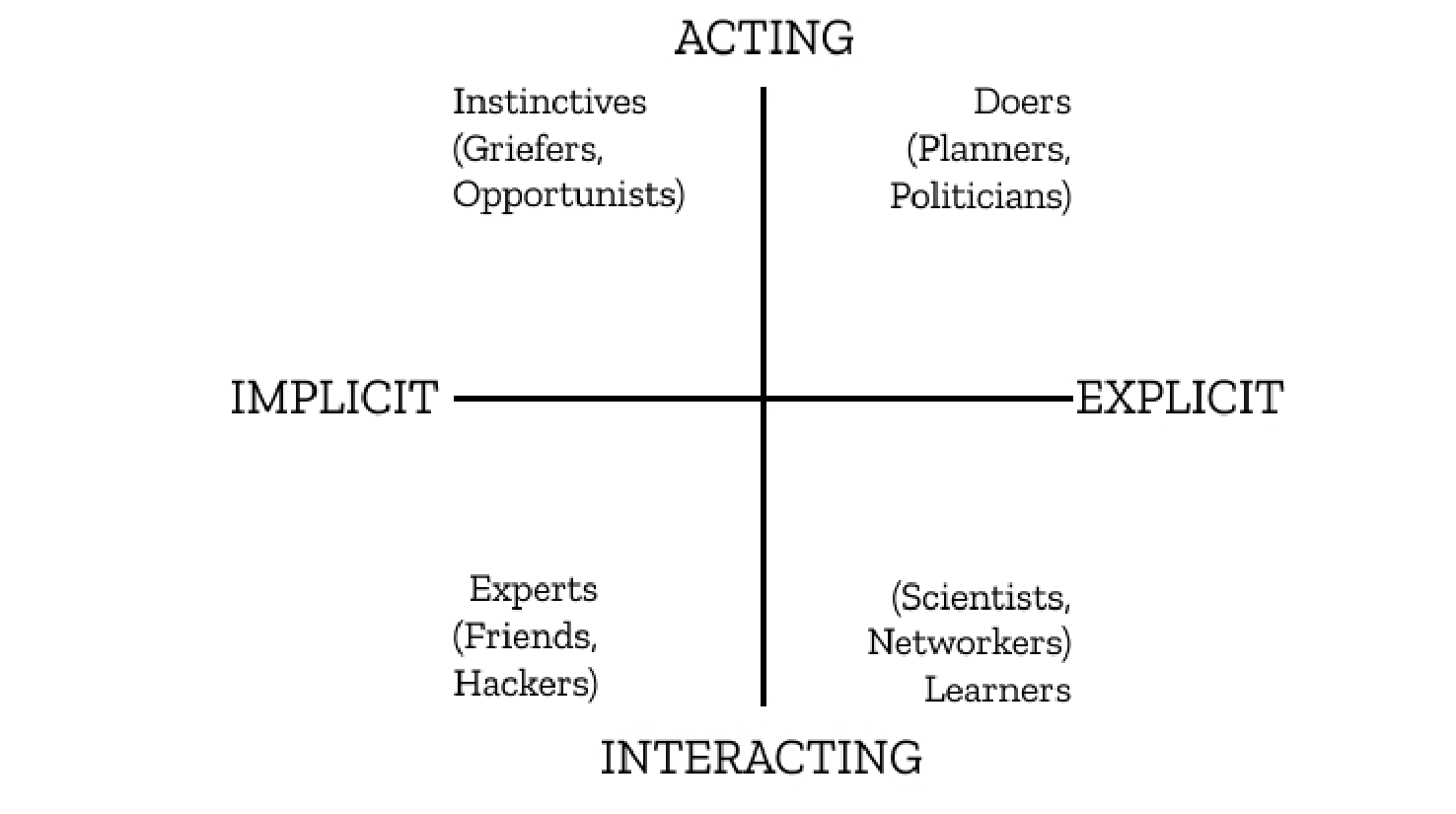
Figure 3.6 Flattened Player Interest Graph.
The player type labels for Figure 3.6 aren’t particularly important; more interesting is how players change from one to the next.
When a player arrives in a completely new situation, they have to act on instinct—there’s little else they can do. A player’s first aim is to determine the parameters that govern what they can do, which means trying everything he can think of to discover what basic actions are available. Having bootstrapped to a level where the player can reliably perform individual “primitive” actions, the next thing to do is to go about discovering sequences and combinations of these actions. The player does this methodically in a data-gathering phase, until he becomes thoroughly acquainted with the options available to them. Following this, the player applies what they have learned intensely, until eventually mastering it and it becomes second nature.
Baby arrives in the world. Baby flails about, until baby realizes how to move its legs, its arms, its feet, and its hands. Baby combines individual movements into sequences, some of which work and some of which don’t. Baby sits up. Baby toddles. Baby toddles more and more, until eventually baby can walk and run. Now, for baby, running is effectively a primitive action.
Locate, discover, apply, internalize. From acting on instinct, acquire knowledge, use that knowledge, and become able to interact on instinct.
I mention this feature of the 3D Player Interest Graph only to show how the player development tracks (refer to Figure 3.5) fit into the overall scheme. In practice, the tracks themselves are of more use to designers than the flattened graph (refer to Figure 3.6), although we’ll see later that there’s an interesting analogy that can be drawn from it.
There remains the question as to whether flattening the graph by removing the acting/interacting axis gives a useful new perspective, but it’s easily answered: No, it doesn’t. This may indicate that there are better choices for axes available which have yet to be discovered.
With that, we reach the end of this discussion of identity. There are some follow-up topics we need to look at, but we’re done with the central issue. The question might now be asked: Was it worth it? Although this analysis has produced some results of tangible use to designers, has it all really been necessary? Isn’t it, beneath the surface, just a lot of pseudo-psychological nonsense? What has it to do with design?
Directly, it contributes only in a few areas. Indirectly, it pervades everything. If you don’t understand the nature of what you’re designing, how can you design it?
People play virtual worlds to celebrate their identity. Designers must understand that. It’s a freedom thing.
Alternatively, they could completely hit a wall and bounce right back to the beginning again. Instead of developing in the face of a crisis, they could, for example, regress to some vengeful griefer state. This is, needless to say, not really what we want to see happening. ↩︎
This is another one of those terms that has come from game-oriented virtual worlds that doesn’t really have a non-game equivalent. ↩︎
This isn’t to say it wouldn’t be better for the health of the virtual world itself, of course. ↩︎