Player Types
In 1989 and 1990, the senior players of MUD2 got into a debate lasting several months to answer the question, “What do people want out of a MUD?” At its conclusion, I undertook an analysis of their replies, and summarized their ideas of what constituted “fun” for them as falling into one of four categories:
Achievers. These people put the game-like aspect of the virtual world to the fore. They like doing things that achieve defined 1 goals, thereby progressing their character through the world’s built-in ranking system.
Socializers. People for whom the greatest reward is interacting with other people, through the medium of the virtual world. Some do it as themselves; others role-play behind a mask.
Explorers. The ultimate delight for Explorers is increasing their knowledge about the way the virtual world works. Their joy is in discovery. They seek out the new.
Killers. People who want to dominate others. The classic way is through attacking them or otherwise making life difficult for them 2, but it also can manifest in less overt fashion, such as politicking, rumor-mongering, pedanticism, or guilt-trip maternalism (“No, it’s okay, you go and enjoy yourself. I’ll just sit here by myself, waiting for someone to come along, I’ll think of something to do…”) 3.
These categories seemed correct empirically, but I couldn’t be sure that they were exhaustive. Perhaps there was another category that I’d missed? I therefore needed a means of formalizing the player types such that each of them could be shown to be emergent from a more robust framework which was guaranteed to be exhaustive.
I quickly realized that as there were four player types, a two-dimensional graph (with four quadrants) would do the job. However, I needed to find the right axes.
I immediately saw that achievers and explorers were more interested in the game than in the players of the game, whereas socializers and killers were more focused on the players than any game aspects. This distinction provided one axis. What, though, did achievers and either socializers or killers have in common? Could the same partitioning work for explorers and either killers or socializers?
I felt confident that achievers and killers were active, in that they like doing things to other things (the game or its players, respectively). Explorers and socializers were passive, in that they liked things being done to them. I wasn’t very happy with this, however, as it was clear that socializers did like doing things to other people (talking to them) and explorers did like doing things to the game (experimenting).
Over the course of the next few years, I refined my ideas. I relabeled the x-axis players/world instead of players/game, because only achievers regarded the virtual world primarily as a game 4. I still had trouble with the y-axis, though. It wasn’t until I wrote the whole theory as a paper and submitted it for peer review that I got the answer: Alan Schwartz, founding editor of the Journal of MUD Research, suggested that explorers and socializers both valued forms of interaction. This was exactly what I needed to hear, and everything immediately fell into place.
The resulting Player Interest Graph is shown in Figure 3.1.
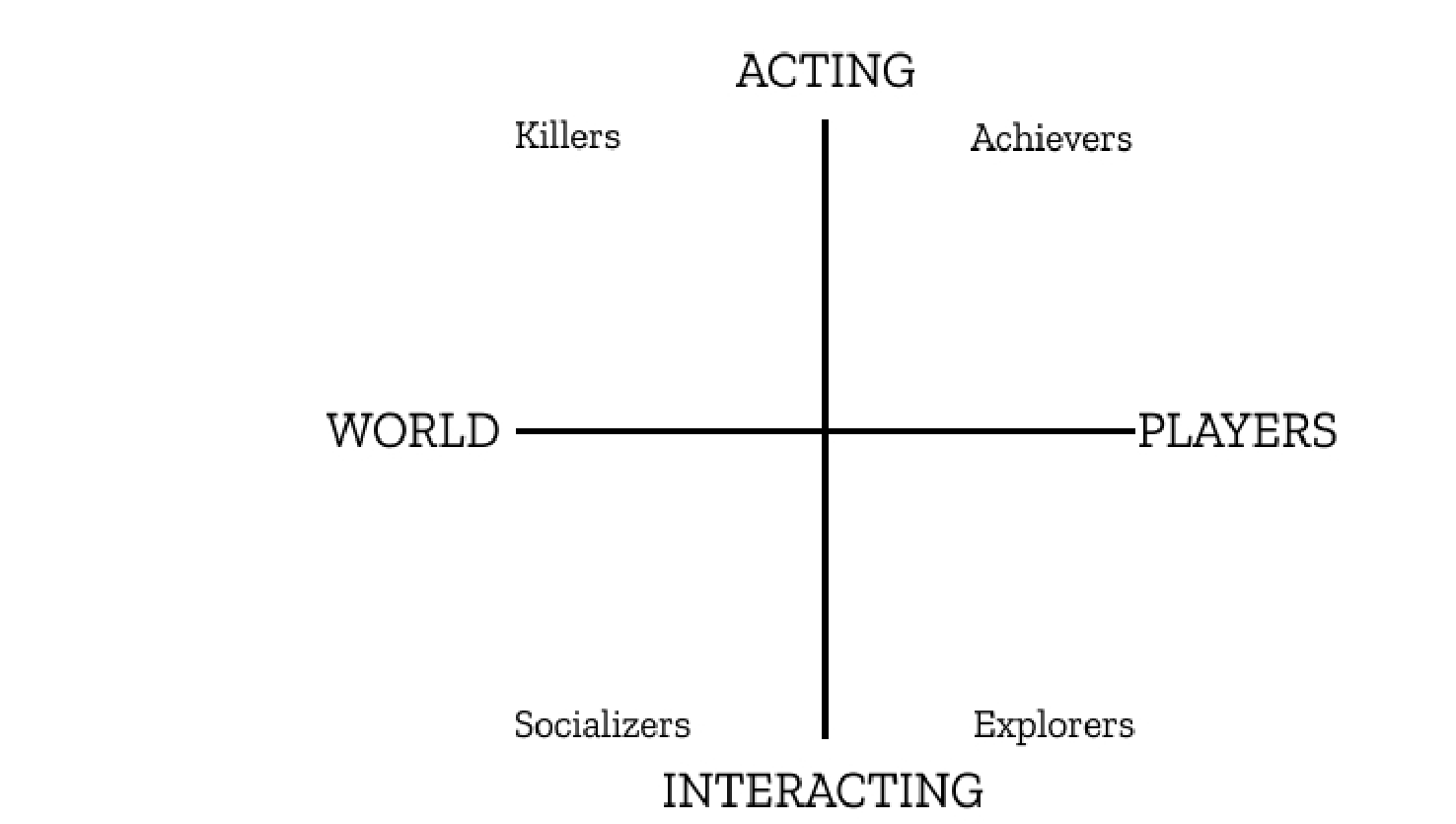
Figure 3.1 Player Interest Graph.
This graph describes players in terms of two (continuous) dimensions: How much they prefer acting on things as opposed to interacting with them; how much they prefer to direct their attentions toward the players or the world in which those players are present (as characters).
Achievers have fun acting on the virtual world.
Explorers have fun interacting with the virtual world.
Socializers have fun interacting with other players.
Killers have fun acting on other players.
Although other categorizations are obviously possible (and may well be superior), the use of opposing criteria for each of the axes in the Player Interest Graph shows that for this particular approach the categorizations are exhaustive.
As it stands, this graph tells designers quite a bit. If you want to increase the attraction of your virtual world to achievers, for example, you should include more content that involves acting upon the world; if you want to have more socializers, you should facilitate the capability to interact with other players, and so on. If you were to constrain the degree to which the world could be changed (for example by making areas out of bounds to certain groups of players), then you’d hit achievers and explorers but not socializers and killers. If you were to increase the capability to interact (for example by allowing players to keep notes on anything in the world they right double-click on), then you’d boost socializers and explorers but not achievers and killers.
It’s possible to do this with other dimensions appropriate either to particular virtual worlds or virtual worlds in general. For example, a MUSH might have axes for story-telling/story-building versus theory/practice. Someone who likes to teach other people how to role-play would be in the theory/story-telling quadrant, whereas someone who likes constructing new content would be in the practice/story-building quadrant. Designers will use whatever categorizations they find most useful.
It’s possible to do more with categorizations than merely state them and demonstrate them to be exhaustive, though. Having divided a set into four (or more) subsets, the question can be asked: What dynamics exist between the sub-sets? Are they independent (an increase in the number of people teaching how to build would have minimal impact on the number of people role-playing) or are there causalities (fewer people teaching how to build eventually leads to fewer builders)?
This is where it gets interesting.
Defined by the virtual world, that is, getting points and rising levels. ↩︎
In this context, they’re generally referred to as griefers. ↩︎
The word “killers” is perhaps unfortunate, given the misunderstandings that arise because of it; “dominators” is a less emotive alternative that some people prefer, although unfortunately it doesn’t imply a desire to dominate people (as with achievers, who want to ‘dominate’ the world). ↩︎
I also considered real/virtual, but didn’t feel it was accessible enough. Players/world deal in the manifestations of these concepts, and it is much easier to get a handle on. ↩︎