Dynamics
In the wild, what effect does increasing the number of wildebeests at a watering hole have on the number of lions in the vicinity? Lions eat wildebeests, so the more wildebeests there are, the greater the number of lions that will turn up looking for a meal. However, wildebeests flee en masse when they so much as sniff a lion. The more lions that show up, the fewer wildebeest will hang around waiting to be eaten. This will lead to a reduction in the number of lions, which will cause an increase in the number of wildebeests, and so on, until equilibrium is reached.
Suppose we were talking about a virtual world rather than a watering hole. Substitute “killers” for “lions,” “socializers” for “wildebeests” and you get a reasonable approximation of the relationship between the two.
This is an example of the dynamics of player types. Increasing or decreasing the number of players practicing one playing style can affect the number practicing another. This in turn can have knock-on effects, and so on, until eventually the system finds some point of balance.
There are two ways that player numbers can change (they can rise or fall) and 10 possible pairings of types (A/A, A/E, A/E, A/K, E/E, E/S, E/K, S/S, S/K, and K/K). Some of these are free of dependencies—increasing or decreasing the number of explorers has no direct result at all on the number of socializers, and vice versa. Others have effects of varying degrees. Based on empirical observations, the dynamics can be summarized as follows:
More achievers leads to:
Slightly fewer socializers
More killers
Fewer achievers leads to:
Slightly fewer socializers
Fewer killers
More explorers leads to:
More explorers
Slightly fewer killers
Fewer explorers leads to:
- Slightly more killers
More socializers leads to:
More socializers
More killers
Fewer socializers leads to:
Fewer socializers
Fewer killers
More killers leads to:
Fewer achievers
Slightly fewer explorers
Far fewer socializers
Fewer killers leads to:
More achievers
Far more socializers
Figure 3.2 shows these relationships.
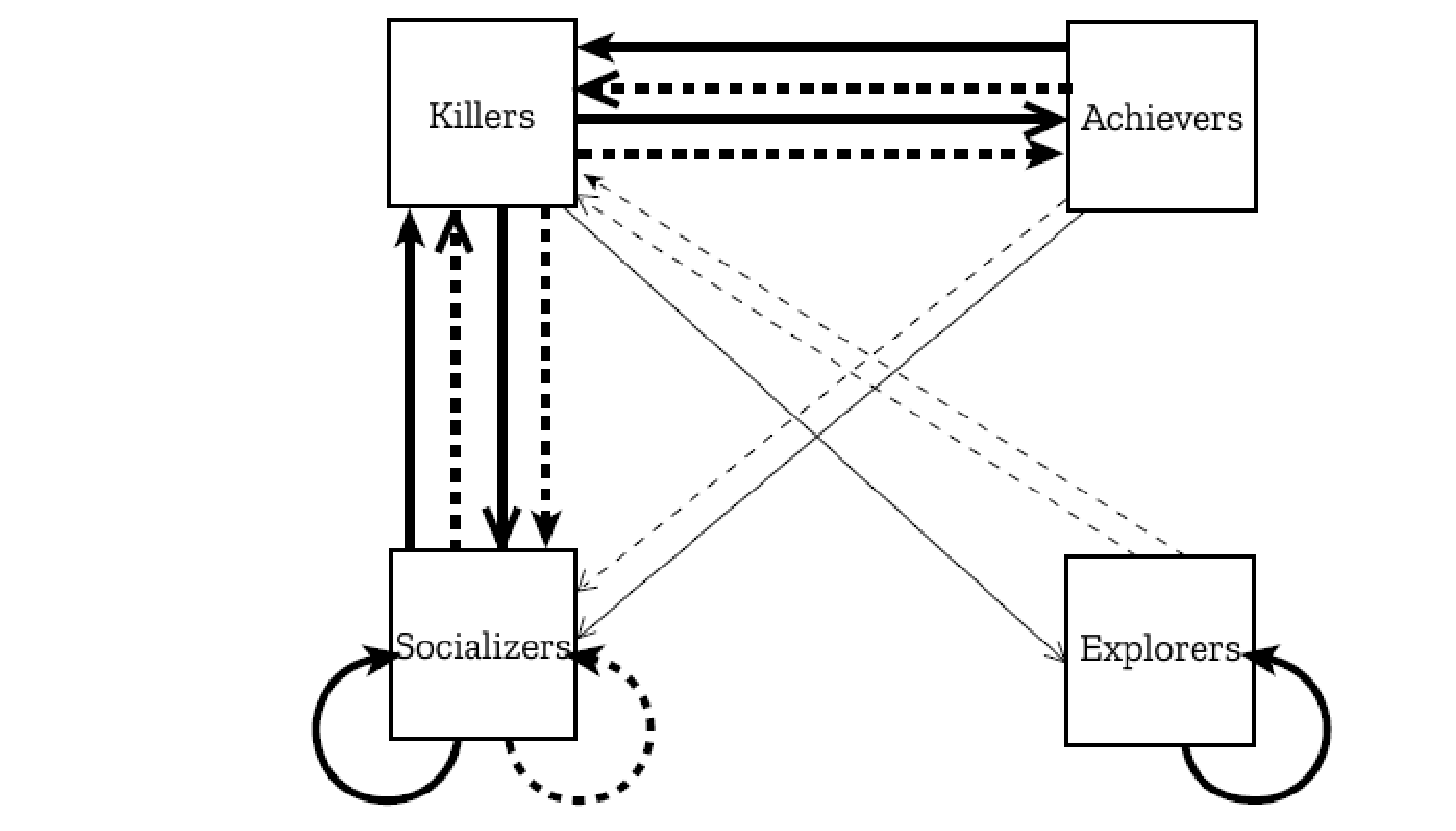
Figure 3.2 Influence graph.
Key: An arrow represents an increase (solid) or decrease (dashed) in the box from which it points. The effect on the box it points at will be either to increase (solid arrowhead) or decrease (open arrowhead) the contents of that box. The effect will be either slight (thin line), medium (medium line), or great (heavy line).
What Figure 3.2 shows is that most of the action concerns killers and socializers, where killer numbers are sensitive to those of socializers and socializer numbers are highly sensitive to those of killers. Explorers keep themselves to themselves, but have a mildly depressing effect on the number of killers; a virtual world can really only ever benefit by attracting explorers. Achievers and killers are in equilibrium, and there’s a negative effect on the number of socializers if the number of achievers changes (up or down).
How can this be used predictively?
As an example, suppose that for whatever reason (advertising, a new patch, the closing of another virtual world) the number of killers increased dramatically. What would happen? Looking at the influence graph, it’s clear that there would be a huge drop immediately in the number of socializers. Socializers are in an amplification loop with themselves—the more/fewer there are, the more/fewer will come/go. Thus, the number of socializers will drop even more until perhaps only a rump remains. Killers also have a lowering effect on the number of achievers. Lowering the number of achievers will reduce the number of killers. Either this will eventually reach some balance, or the numbers of both killers and achievers will drop so far that there are too few left to maintain a critical mass and the game will die.
By repeating this exercise for all player types, stable configurations can be discovered. It turns out there are four:
Type 1. Killers and achievers in equilibrium, with hardly any socializers and explorers.
Type 2. Socializers in dominance, with everyone else having only bit parts.
Type 3. A balance between all four types, with enough explorers to control the killers.
Type 4. An empty virtual world.
Of these, type 3 offers the best prospects for a world’s longevity (types 1 and 2 will tend toward type 4 eventually). However, it is not clear that a large-scale virtual world, with its inherent community fragmentation, could ever attain this state. This explains why most virtual worlds are either social (typified by MUCKs, MUSHes, and MOOs) or adventure (typified by DikuMUDs, LPMUDs, and the big, graphical games). In practice, among the general public there are large numbers of socializers and achievers in comparison to explorers and killers, so it’s just as well that types 1 and 2 are relatively stable.
After the underlying dynamics of a particular virtual world are understood, it’s possible for the live team to influence that world’s condition. If the number of socializers is dropping to the extent that the world is becoming “too” achiever-oriented, a simple solution might be to advertise the virtual world in a manner that would be more likely to attract socializers than achievers. Changes to the virtual world’s design can also help, for example by heavily increasing the challenge to achievers (so as to persuade them to go around in groups, which socializers like) or by adding socializer goodies (such as letting them write their own in-world newspapers). There are plenty of ways to do this 1. Solutions are easy to come by (if not necessarily easy to implement); you have to realize you have a problem first, though.
Incidentally, there is a possibility that a virtual world can fake the presence of a player type without actually having players of that type around. The type most amenable to this is that of killers. Players can tolerate being inconveniently beaten up by mobiles more readily than they can by fellow players, and mobiles have the advantage of being controllable. Surprisingly, there is a lot to be said for this approach; although it doesn’t replicate the effect of having killers exactly, nevertheless it can successfully approximate it to varying degrees. See the discussion on persona death in Chapter 5, “Life in the Virtual World,” for more details.
The original Hearts, Clubs, Diamonds, Spades paper lists over 30 examples. ↩︎